skip to main |
skip to sidebar
 I will be heading to Isla Guadalupe this week to film the island's magnificent great white sharks, so I will be a bit tardy in keeping up with RTSea blog postings for a few days. But hopefully I will have some great stories to report on my return.
Actually, I was at Isla Guadalupe recently, filming for a Greek television adventure series. And once again, the island's apex predator gave me a subtle reminder as to why it's the boss.
After having filmed from within the cage, capturing the show's host reacting to large females rising up from the depths and cruising majestically past the cage, I then moved to an Avon-like inflatable to shoot over the side - from open water back towards the cage - hoping to catch a shark passing between the camera and the cage.
Interestingly, we had three large sharks in close proximity to each other - closer than usual, as white sharks (particularly the large females) typically maintain some "space." The inflatable's pilot and I were in position for a great shot, but as a 16-footer came along side the cage, rather than pass in front , it made a beeline for our inflatable. Playing a little territorial game of "chicken", the shark pushed the stern of the inflatable up a good foot or so and his (my camera caught his claspers) caudal tail sliced the surface and gave me a good swat across the face as it headed back down, having clearly announced who is the big man on campus.
All very exciting, but when he came back a few minutes later and gave us another albeit smaller bump, we got the message and headed back to the boat.
Even within the accepted risk that you take as a professional, there are always moments that remind you of the caution and respect for unpredictability that any large animal in the wild rightly deserves. But, yes, it's loads of fun.
 In the United States, both presidential candidates are saying that our energy policy (or lack of one) needs to be addressed for the sake of both our daily energy needs and to address the issue of global warming. All well and good.
But I am concerned with the attention put on immediate drilling, particularly in heretofore protected areas like the Arctic regions. We have all heard the arguments that it will take 10 to 15 years to realize any fuel from such exploration, but that's the case whether we drill in the Arctic or in any of the currently approved areas, 80% of which has been untouched.
No, my concern is with catch phrases like "Drill now! Drill now!" - as if drilling will be the silver bullet panacea, after which we can all go back to driving our SUV's. Having grown up watching this nation's commitment to science and invention that ultimately put men on the moon, I ask why not "Invent now! Invent now!" We are faced with a massive scientific and social undertaking - to develop multiple technologies that will allow us to shift from a centuries-long dependence on fossil fuel. There's no getting around it - no single solution will fix it all.
Before we commit to more drilling, more status quo, let's harness the same inventive energy that took man into the Industrial Age, and then the Space Age, and the Computer Age  - and let's dedicate ourselves to the Energy Age, to finding new solutions rather than recycle the old solutions and continue to destroy the planet one carbon ton at a time.
Here's some more information from the Ocean Conservancy.
 Besides being asked about mercury levels in seafood, which I touched on in a recent posting, I also get asked about which seafood to buy in restaurants or markets based on population of the species, healthy aquafarmed, etc. The Monterey Bay Aquarium has for many years provided terrific Seafood Watch pocket guides. These guides, which cover national and regional areas, can be printed and carried in your wallet or purse and are updated annually.
  It's a great way to have a quick reference to insure that your are making sensible choices in healthy seafood. I always carry a couple of guides in my wallet.
The Monterey Bay Aquarium has also released a new Sushi Guide and you can view all of the guides on your mobile device browser. Add http://www.seafoodwatch.org to your mobile device's browser list and you'll have the guides right there at the touch of a button.
The concept of "sustainable seafood" works only when we choice seafood that is aquafarmed or whose reproductive capability has not been negatively impacted by overfishing. The Seafood Watch Guides are a great way for all of us to make sensible choices regarding seafood.
 The New York Times recently reported that the National Marine Fisheries Service has adopted a long-debated regulation requiring large ships (over 65 feet) to reduce speed to less than 10 knots in certain coastal areas on the east coast from Massachusetts to Florida.
The purpose of this speed restriction is an attempt to avoid hitting and injuring or killing Right Whales that populate the selected areas. Scientists estimate that only about 400 right whales exist today, even though hunting them was made illegal in 1935. These whales were so heavily hunted in the 1800's and early 1900's that, even with a 70+ year moratorium, their future is tenuous at best.
One or two whales are reported killed each year by ship collision - and that's just the reported cases. With a population so small, the loss of even one whale can have a negative impact.
This regulation was a long time in coming due to political pressure exerted by the shipping industry who refute the correlation between speed and the possibility of collision. The regulation will take effect in less than 60 days and will be subject to review in 5 years based on scientific monitoring of its effectiveness. Let's hope the results are positive for the whale's sake.
 For those of you (or your friends) seeking a good overview of information on coral reefs, but are plagued with a busy schedule or a short attention span, visit Microdocs.com. This is a site put together under the direction of Dr. Steve Palumbi, Director of the Hopkins Marine Station at Stanford University in California.
 The site contains a wide variety of short Flash videos - all very succinct and visually interesting. From the Bahamas to Palau, from the Turks to Micronesia, the videos discuss reef ecology, the intricate relationship between it inhabitants, what is impacting the reef, and solutions for future sustainability.
Remember, reef environments make up only 5% on the ocean's real estate but are home to 25% of all sealife. Even if you don't live in a tropical region, the health of our tropical reefs can have a direct impact on all of our lives. Microdocs - check it out.
 In a recent meeting, held in Madrid between Spain's Minister of Environment and Fisheries and the international environmental organization Oceana, some positive steps were made regarding commercial shark fishing. Here are some of the key points:
- Propose in ICCAT (the organization responsible for regulating tuna and shark fisheries in the Atlantic), via the European Commission, a prohibition on catches of all pelagic shark species, except the two species of highest commercial interest for the Spanish fleet: blue shark (Prionace glauca) and shortfin mako (Isurus oxyrinchus).
- For these two species, the Minister showed her willingness to accept the establishment of Total Allowable Catches (TACs), if recommended by scientists.
- Lastly, Elena Espinosa also showed a willingness for the Ministry to implement a pilot project to study the viability of storing caught sharks with their fins attached in a natural way, without the fins first being separated from the body, on board Spanish longline vessels.
Now while there was some hemming on hawing on Spain's part later (requesting more data before moving forward on all points), it was encouraging. The "fins attached" approach taken by much of the new regulations being proposed recently puts pressure on shark fisheries to not try to circvumvent existing regulations regarding fins and carcasses and subtly promotes abandoning shark finning all together. (Read Oceana press release.)
 In my capacity as a filmmaker with a special interest in nature, I've had the opportunity to film some fascinating animals. Sharks in particular, like tiger sharks or great whites, can be exciting because 1.) you're in the presence of an apex predator - not that you're on the menu, but 2.) they can be unpredictable.
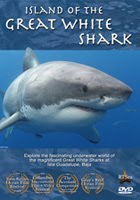
In filming a sequence for Island of the Great White Shark involving taking a biopsy sample, the plan was to lure a white shark close to the cage to allow the researcher, Mauricio Hoyos, to take a small sample using a biopsy pole spear. Taking the hangbait, the shark turned unexpectedly towards the cage and there were a few tense moments as the shark, weighing in between 1,500 and 2,000 lb., thrashed back and forth, slamming the cage several times with its tail before turning aside and moving on. Being in the cage at that moment was like standing inside one of those huge Buddhist temple bells; with each swing of its tail, the "gong" effect of the rattling cage could be felt right through your bones!
While responsible shark diving means not exposing the "paying customers" to unncessary risks for both the sake of the shark and the diver, researchers and professional documentarians often put themselves in less than ideal situations. As a filmmaker, you occasionally get to offset hours of tedium with a few heart-thumping moments of pure adrenaline.
 About a year ago, TIME magazine issued a terrific book on Global Warming in both soft and hard cover. It was both very thorough and readable - providing readers with the issues, causes and solutions surrounding one of the most critical issues facing mankind today.
To balance that somber subject, they have just released a new volume: Living Wonders, The marvels and mysteries of life on Earth.  Currently available in soft cover (I picked up a copy today at my local supermarket for $12.00) and soon to be available in hard cover at Amazon and perhaps other retail book outlets.
This publication is a delight to read, as it lectures or admonishes not, but instead simply presents many of the incredible forms and adaptions of life on Earth, above and below the waves - from whales to desert cactus, from eagles to bioluminescent deep sea fish, and much more. Pick up a copy for yourself or make it a gift to someone who may be inclined to view Nature with an indifferent eye.
You'll go "oooh" and "aaah."
 One of the ways to get commercial interests to move in more eco-friendly directions is to appeal to base instincts. In this case, economic viability.
  The Food and Agriculture Organization (FAO, part of the United Nations), in conjunction with the World Bank, has released an assessment of marine fisheries and, as one might suspect, it shows a massive loss of revenue due to a decline in catch. (Read the press release.)
But poor management is as much to blame as is declining seafood populations. Commercial fisheries are plagued by over-capacity and over-efficiency - too many boats and advanced fishing techniques. The rising cost of fuel might be a nail in the coffin, but the problems were brewing long before fuel became an issue. Basic business economics says when you have a limited market (or resource, as in the case of seafood) and you expand operations, at some point the rate of revenue will decline. How many businesses have we seen become victims of expansion beyond what the market can bear? From computer chips to coffee shops.
The commercial fishing industry must address the need to scale back its operations to become more efficient - which will have a positive effect on seafood populations and can actually prevent market prices for seafood from skyrocketing. But it requires a shift in the industry, moving and retraining manpower and resources into other related areas, such as aquaculture/aquafarming.
(Read the complete report.)