Showing posts with label shark fishing. Show all posts

Thursday, November 15, 2012

Conservation Victories: government steps up to help whales, sharks, and birds

Well, how about some good news for a change?  Conservation and protection of species and the environment got a bit of a boost from the machinations of government today in several areas.  Some of these advances are moving through cyberspace as I write this, while others are more quiet victories.

No Sonic Tests Off California for Utility
The California Coastal Commission today unanimously agreed to deny a permit to Pacific Gas & Electric, who had requested to begin a series of seismic tests using sonic air cannons to determine fault lines in and around the seafloor near the Diablo Canyon nuclear power plant.

Now checking for faults that could potentially threaten a nuclear power plant isn't a bad idea (nuclear power plants themselves are another controversial subject for another day) and PG&E officials claimed that the multiple sonic blasts would be ramped up in intensity to warm or scare off any marine mammals that could be at risk.

However, those same officials also stated that the tests would induce short-term disruption.  And given the number of beachings and deaths that have been documented regarding whales, porpoises, and dolphins, long-term effects can not be definitively ruled out.

According to the Associated Press, the coastal commission's staff recommended to the coastal regulators to reject the utilityy company's plan. "In a report this month, the staff said sonic blasts would cause 'significant and unavoidable impacts to marine resources.' More than 7,000 sea mammals would be disturbed by the ear-piercing noise, including fin whales, blue whales, humpback whales, and harbor porpoises."

PG&E has not yet said what it plans to do next, but should they appeal, they will find stiff resistance from many of the regulators.

Win one for the cetaceans!

American Samoa Bans Shark Fishing
In the South Pacific, the United States' unincorporated territory of American Samoa has initiated a ban on all shark fishing that will go into effect this week.  The ban will extend three miles from the shoreline and also include three reef fish species.

What is most encouraging with this news is that it was not an island nation like Palau or Kiribati that has imposed these restrictions; it was the U.S. government.  The Department of Marine & Wildlife Resources is the agency that has imposed the ban, recognizing the decline of shark populations throughout the Pacific Ocean.

Dog Fenner, who monitors sharks for the department, claims that these new regulations are the strongest ever imposed by the U.S.  About bloody time.

Win one for the sharks!

Animal Lead Poisoning Amendments
Getting a little less attention are two amendments to S.B. 3525, known as the "Sportsman's Act."  Filed by California's Senator Barbara Boxer, the amendments would 1.) eliminate an NRA-supported provision in the Sportsman's Act that banned the Environmental Protection Agency from doing anything regarding lead poisoning from lead ammunition and fishing tackle (originally supported by, and 2.) require the EPA to conduct a potential threat study of human health, wildlife, and the environment regarding lead ammunition and tackle.

According to the Conservation for Biological Diversity, which has been prodding the EPA regarding this issue for years, "Lead poisons and kills millions of eagles, loons, endangered California condors and other birds and wildlife each year." 

Win one (hopefully) for a lead-free wilderness!

The common thread in all of these encouraging developments is that it represents government, in one form or another, getting of its butt and doing something about the environment.  One can only hope that as the U.S. economy improves, attention will once again be turned toward solving long-term environmental issues with decisive action in the here-and-now. 

Source: Associated Press (Cetacea)
Source: Washington Post (Sharks)
Source: Center for Biological Diversity (Lead)

Thursday, September 20, 2012

North Sea Shark Fishing: group funds new study for needed data

 
There are several "hot spots" throughout the planet's oceans when it comes to commercial shark fishing and the North Sea is one of them.  Off the British isles, sharks and even rays are taken, but there is a lack of scientific data to demonstrate what kind of impact the commercial boats are actually having on the shark and ray populations.

The European Fisheries Fund is now funding a new shark research program, Shark By-Watch UK, to the tune of nearly $325,000.  The purpose of the program is to use commercial fishing boats to gather data on shark and ray by-catch and participate in tagging and releasing sharks and rays back into the sea.

Shark By-Watch is to managed by scientists from the Centre for Environment, Fisheries and Aquaculture Science (Cefas), which is dedicated to supporting sustainable fisheries.

Apparently, while arguments can take place regarding the decline of shark and ray populations in other parts of the world, there does not appear to be significant data that allows all interested parties - North Sea fishermen, conservationists, scientists - to effectively argue for sustainability except in the broadest of terms.  It is hoped this program will provide the data needed to successfully establish effective commercial shark and ray fishing policies. 

As reported in FishUpdate.com, Graeme High, European Fisheries Fund's England Deliver and Control Manager, said: "Such forward thinking measures are key to developing sustainable, economically viable fisheries and we were consequently keen to support this scheme. It is hoped this approach to research will promote greater industry involvement in future shark and ray assessments and will help determine practical ways forward for conserving local stocks. This work may also help fishermen to learn new skills – such as becoming competent tagging operatives.” 

I hope that their research will produce definitive data but I have come to be a bit skeptical of many efforts aimed at sustainability.  I often view it as a problem to which we are putting our finger in the dike, but the flood waters will continue to climb and ultimately breach the top.  When we catch fish, particularly slow reproducing species like sharks and rays, one fish taken from the wild is one fish too many.  Aquaculture - or aquafarming - for me, is the solution.

Perhaps that will be the final conclusion of the Shark By-Watch program, that shark and ray populations are too fragile to allow for any of viable commercial fishery.  Or perhaps science and commerce will strike a devil's bargain and commercial fishing will continue at some level, simply postponing the inevitable collapse of shark and ray populations in the North Sea.  Hard decisions need to be made, industries need to adapt and change, and it needs to be done now. 

Source: FishUpdate.com 

Thursday, May 24, 2012

Shark-Free Marina Initiative: 70 more marinas join in past week

And speaking of sharks, the Shark Free Marina Initiative (SFMI) is continuing to grow at a rapid rate, signing on marinas to promote pro-shark activities and attitudes to the recreational sportfishing industry, thereby putting pressure on shark tournaments and those seeking shark trophies - which are decidedly anti-shark at their core.

A press release from SFMI on Tuesday said, "Marinas on the east and west coasts of the United States are enthusiastically joining the Shark-Free Marinas Initiative (SFMI) to help conserve the world’s imperiled shark populations. Over 70 marinas have joined SFMI in the past week. There are currently over 200 marinas participating world-wide, including 164 in the U.S., 24 in Fiji, and 6 in Bahamas."         

SFMI started several years ago as an idea first promoted by SharkDiver.com.  When my friend, Luke Tipple, came on board as director, he enlisted my services to shoot the first promotional video for the organization.  From there, Luke garnered supporters and now it is managed by The Humane Society of the United States, the Pegasus Foundation, and the Guy Harvey Ocean Foundation with Luke still as director and with additional support from the Mote Marine Laboratory, the Pew Environment Group, and the Fisheries Conservation Foundation. 

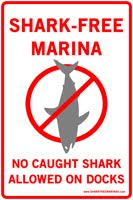
"The SFMI is a totally voluntary program that works in tandem with businesses, marinas and fishermen to increase the awareness of the need to protect our sharks and oceans. Marinas and businesses may join the program as either Shark-Free or Shark-Friendly:  A Shark-Free Marina does not allow sharks to be killed and landed at its facility; a Shark-Friendly Marina discourages killing or landing of sharks and does not serve shark products or promote activities that intentionally harm sharks.

Marinas are major players in the recreational fishing community and can help inform fishermen and reduce the number of sharks being killed by joining the SFMI and preventing dead sharks from being brought back to their docks. 'Marinas are key to the success of this initiative in the United States,' says Luke Tipple, managing director of the SFMI."  
 
Some might question what impact sportfishing has on shark populations compared to large-scale industrial shark fishing.  With the number of shark species already in such great decline, particularly among species that are popular targets for sportfishing, the impact may not be cataclysmic but it is, nonetheless, real and worth addressing.

“Recreational fishing in the U.S. has contributed to the serious historical decline in shark populations,” notes Dr. Robert Hueter, senior scientist and director, Mote Marine Laboratory’s National Center for Shark Research. “Sustaining these species is in the interest of recreational anglers as well as commercial fishermen and marine conservationists.” 
  
So, congratulations to the Shark Free Marina Initiative!  I'm glad to have been there to help at the beginning and, hopefully, it will continue to expand and cumulatively have a positive effect not only on the number of sharks taken in sportfishing, but also on the attitudes of the participants whether they be fishermen or onlookers on the dock.


Source: Shark Free Marina Initiative News

Sunday, March 11, 2012

Oceanic Whitetip Sharks in Fiji: island cultures revere a threatened pelagic predator

The oceanic whitetip shark is a beautiful but feared shark. A feared shark because of its reputation gained during World War II for being attracted to the sounds of sinking ships and then, what with blood in the water, attacking sailors floating in the water. In Jaws, Quint's fictional monologue about the sinking of the Indianapolis was based on the real account of the ship's sinking. And, in truth, the oceanic whitetip was responsible for a number of sailor's deaths - along with battle injuries, starvation, and sea water poisoning taking its toll.

However, the fact is that the oceanic whitetip is a beautiful, pelagic or open-ocean shark and like many other shark species, its numbers have been in severe decline due to commercial fishing and bycatch. The IUCN has listed the species as vulnerable to extinction and its situation is not holding steady or improving by any means.

An article ran recently in the The Fiji Times Online in support of the oceanic whitetip. Fiji has several species of shark in relatively fair abundance in and about its reefs and the oceanic whitetip is one that will make an occasional appearance, approaching reefs on narrow continental shelves near deep water. Also, Fiji has a cultural history with several Fijian island peoples that revolve around sharks as mythical, even god-like, creatures. Several legends specifically involve oceanic whitetips and have them serving as protectors not predators.

The Fiji Times reported that Fijian "
shark campaigner Manoa Rasigatale says the people of [the Fiji island of] Rukua, like elsewhere in Fiji where the shark is revered as a totem and protector, believe the oceanic whitetip and the rest of the species should be saved.

'Saving it is saving their tradition and their marine environment. It is as simple as that. Take away the shark and they lose their traditional tie to it and the story that has been passed on from one generation to another,' says Mr Rasigatale."

It's an interesting opposing juxtaposition to the Asian cultural history that defends the consumption of shark fin soup. Whose culture has a better right to predominate? One that promotes reverence of the shark or one that promotes its consumption?

Although Fiji has strict regulations regarding shark fishing, a movement is in the beginning stages with a shark sanctuary for the entire island chain as its ultimate goal. The Pew Environment Group and the Coral Reef Alliance (CORAL) are working with the Fijian government to make the sanctuary a reality.

Commendable as it may be, a shark sanctuary may not be enough to ultimately protect the oceanic whitetip as it is a long range nomad. That means considerable time spent outside of sanctuary boundaries, exposed to commercial fishing - whether deliberate or as accidental bycatch - in international waters.

The Fiji Times Online article is an interesting read both with regards to how the shark is entwined with the island's culture and identifying the specific fishing threats to the oceanic whitetip to which the island nation and supporting conservation groups are trying to address.

Source:
The Fiji Times Online

Saturday, December 17, 2011

Egypt's Endangered Sharks: Arab Spring had unintended consequence for conservation

It's been quite a few years since the week I spent diving in the northern Red Sea. Staying on a live-aboard dive boat, I had the chance to see corals that in many ways have remained unsurpassed to me ever since. The reef fish were quite abundant while, in more open water, most sharks were skittish and kept their distance, except for my first close-up encounter with a large nurse shark that was only interested in resting undisturbed on the sandy bottom.

However, according to the Egypt Independent, the Red Sea's geography that positions it as an almost completely closed body of water (open naturally in the south at the Ba-el-Mandeb Strait and in the north at the man-made Suez Canal) has not isolated it from the same problems that befall sharks throughout the rest of the world's oceans: Egypt's sharks are endangered.

Amr Ali, managing director of the Hurghada Environmental Protection and Conservation Association (HEPCA) , claims that the populations of hammerhead, oceanic whitetip, and other sharks species have declined by as much as 80 percent, and for much the same reason as is found in other oceans.

“Over the years we’ve had many different cases of illegal fishing in the Red Sea,” said Ali. "Five years ago there was a big issue with Chinese poachers; last year it was the Yemenis. It is certainly by far the main reason behind the sharp decline.”

With iconic pyramids and many other ancient locations to visit and artifacts to see, Egypt has a large and lucrative tourism industry to protect. Because of that, the economic value in tourisim dollars for a living shark as opposed to a dead one is not lost on Egyptian officials. But they have been slow to respond to the overfishing or illegal fishing of sharks because they consider what shark fishing brings to lower-income local fisherman and because there has not been a convincing amount of study done in the Red Sea on shark populations.

Reported in the Egypt Independent, "
Relying on the Egyptian Environmental Affairs Agency (EEAA) is useless, says Ali. 'So our role, if we’re serious about preventing declining populations, has to be a very active one.' In 2006, the HEPCA obtained two decrees from the Red Sea governor banning fishing for and trading sharks. Getting caught with a shark illegally resulted in severe penalties."

Encouraging, but with the coming of the Arab Spring in December of last year, the law enforcement infrastructures for many countries bordering the Red Sea weakened and with that, illegal shark fishing has increased dramatically. Government resources and priorities are being drawn elsewhere and, while the demise of dictatorships and oppressive governments are being welcomed as good news by major developed countries and Arab citizens alike, an unintended consequence has been a loss of environmental protections.

“The [army] coast guards used to fend off poachers which really helped,” Amr Ali observed. “But with them gone, it’s impossible for us or other NGOs to monitor 160km of coast.”

To help make a compelling case for shark protection - strong enough to once again make it a government priority - scientists will need to conduct more research. An overwhelming body of facts combined with a thorough explanation of the consequences of doing nothing (the trophic cascade effect that can occur when top predators like sharks are removed from the ecosystem) is what is needed for government officials to realize the magnitude of the problem and how the short-term gain for local fishermen is far outweighed by the long-term negative impact on the entire Red Sea ocean community and, by extension, on the local fishermen as well.

Mexican researchers faced this same problem in the early 2000's when they sought protections for several species of sharks and rays. The Mexican government wanted data - a lot of it. And so years of tagging and tracking studies were engaged until the evidence was indisputable. When I first met Mauricio Hoyos Ph.D. in 2005, the then graduate student was tagging and tracking great white sharks at Isla Guadalupe for just that purpose. And he continues to tag and monitor white sharks to this day.

In Egypt, HEPCA intends to embark on an extensive tagging study in 2012, along with developing a database of shark fin species and location identification, using DNA from the fins, to compile the data needed to make a case for renewed and more aggressive conservation measures.

Amr Ali said, “Once these studies are done, we’ll hopefully be able to create a proper science for shark conservation in Egypt.”

Let's hope so. I still consider the Red Sea as one of my all-time favorite dive locations even though I was there just the one time - that's how impressed I was with the beauty and biodiversity of this unique body of water. Without sharks, it stands to suffer greatly.

Source: Egypt Independent.

Tuesday, November 23, 2010

Atlantic Shark Conservation: Oceana appeals to ICCAT for leadership

As reported earlier today, the ICCAT (International Convention for Conservation of Atlantic Tuna) is meeting this week in Paris as a part of the organization's annual review of bluefin tuna catch limits. But ICCAT's charter is not limited to the management of only tuna fisheries. It also considers the management of "tuna-like" fisheries, which is a catch-all phrase that can include other pelagic migratory predators including swordfish, sailfish, and sharks.

While outcomes from past ICCAT meetings have served more to support the commercial fishing industry than the support of ocean species conservation, recognized conservation groups, like Oceana, continue to bring information to the attention of the ICCAT regarding the rapidly declining numbers of apex ocean predators. This year, Oceana is focusing on sharks and the need for the ICCAT to seriously consider addressing the number of sharks being taken - whether legally or otherwise - and the potential for further abuse through under-reporting.

Oceana has released a new report that estimates that as many as 1.3 million sharks were taken in the Atlantic in 2008. Averaging the weight of the various 21 species listed in the report as being caught within ICCAT-monitored waters, that number equates to 65,000 tons of shark. To put that into perspective, the ICCAT currently limits tuna harvests to under 14,000 tons of tuna - and that is a figure that many scientists believe will doom the Atlantic bluefin tuna to extinction. Just what can we expect with 65,000 tons of shark disappearing each year?

On top of that, Oceana believes 1.3 million sharks could be a gross underestimation due to under-reporting. According to Oceana, based on scientific estimates from Hong Kong shark fin trade data, the true number could be three times higher - although, you can expect that figure to be dismissed by fishing industry advocates as speculative and unreliable.

“Sharks are virtually unmanaged at the international level,” said Oceana's Elizabeth Griffin. "ICCAT has a responsibility to protect sharks. It is time to protect our ocean's top predators."

While ICCAT does have in place minor shark fin restrictions and a prohibition on bigeye thresher sharks, there are other crucial Atlantic shark species that are afforded no fishery management or protection at all. This includes several species that are currently listed on the International Union for Conservation of Nature (IUCN) Red List. Of particular concern are porbeagle, oceanic whitetip, scalloped hammerhead, and shortfin mako sharks.

According to an Oceana press release, the group's representatives will be calling on the ICCAT to implement the following initiatives:
  • Prohibit the capture of endangered and vulnerable species, including hammerhead, oceanic whitetip, common thresher and porbeagle sharks;
  • Establish science-based, precautionary catch limits for other commonly caught species in ICCAT fisheries, especially for at-risk shortfin mako sharks; and
  • Improve the ICCAT shark finning ban by requiring sharks to be landed whole, with their fins still naturally attached
Considering the ICCAT's dismal track record, Oceana has its work cut out for itself. But they continue to go up against the pro-shark fishing interest groups in these international arenas, hoping that at some point forward-thinking policy makers will take decisive action in favor of sharks before it is too late.

As they push the agenda forward, we, as individuals, can support them and make responsible pro-conservation choices regarding shark, tuna, and billfish products. After all, the fishing industry is, in large part, simply responding to market demand.

Read the Oceana press release.

Sunday, November 14, 2010

Bimini Bay Resort Goes Shark-Free: major marina joins Shark-Free Marina Initiative

The Shark-Free Marina Initiative (SFMI) - an organization devoted to shark conservation measures by focusing on eliminating caught sharks from marinas, thereby incrementally ridding the taking of sharks for contests, trophy records and photos, and basically anything else associated with bringing in landed sharks - continues to grow by bringing on major sportfishing marinas as "shark-free."

The Bahamas Weekly recently reported that the Bimini Bay Resort is now a member of SFMI (see excerpt below). SFMI was the brainchild of SharkDivers.com and has been directed with great success by Luke Tipple. SFMI is now supported by the Guy Harvey Ocean Foundation and the Humane Society of the United States. While not the end all for protecting sharks, the Shark-Free Marina Initiative does achieve significant progress in both making a dent in the number of sharks taken for sportfishing and in developing new attitudes among all patrons of participating marinas - sportfishermen, boaters, and tourists - regarding shark conservation.

Bimini Bay Resort Joins The Shark Free Marina Initiative
By Danielle Dunfee
11/11/10
Bimini Bay Resort announced its voluntary participation as the third marina resort in Bimini to join the Shark-Free Marina Initiative (www.sharkfreemarinas.com) whose purpose is to focus on the importance of reducing worldwide shark mortality. Bimini Bay Resort now prohibits the landing of sharks at its marinas and pledges to work in tandem with its sport fishermen to develop protocols under which threatened species of shark are permitted to recover and replenish their populations. As a leading employer of Biminites on the island, Bimini Bay will work to create and enforce community-conscious awareness of the need to protect Bimini’s sharks and waters. “One of our main focuses in 2011 will be to encourage responsible use of our ocean,” stated Rafael Reyes, President of Bimini Bay Resort.

The Shark Free Marina Initiative works with marinas, fishermen and non-profit groups to formulate community conscious policies and to increase awareness of the need to protect sharks. Currently 60 to 100 million sharks are slaughtered worldwide each year, which in turn poses a serious threat to the health of the earth’s oceans. Over the last five years, the United States recreational fishery has harvested an average of 500,000 sharks per year.

Bimini Bay’s participation in the Shark-Free Marina Initiative takes the Bimini
Islands unanimously one step closer to this marina initiative; a boon to the shark populations of the area and to the Bimini Biological Field Station. Bimini is home to healthy shark populations and to the Bimini Biological Field Station. Informally known as the Shark lab, the Bimini Biological Field Station on South Bimini is a world-renowned research facility whose subjects
of study are the many species of sharks in the unique habitat of the Bimini’s North Sound and Bimini's surrounding waters.

Click here to visit the Shark-Free Marina Initiative web site and become an SFMI Ambassador.

Friday, October 15, 2010

Shark-Free Marina Initiative: brochure available from expanding shark conservation group

Many readers of this blog have come across posts that mention the Shark-Free Marina Initiative (SFMI), an organization dedicated to the incremental but crucial and challenging step of ridding marinas of caught sharks. Supported by the Humane Society of America and the Guy Harvey Ocean Foundation, SFMI has an informative website and now, as this recent press release below cites, there are informative brochures available for distribution.

Shark-Free Marina brochures introduce the membership campaign
14 October, 2010

Mid-October heralds the beginning of our SFMI membership campaign. As part of the campaign we've selected strategic marinas around the country to join the Shark-Free Marina Initiative. The first point of contact will be the new SFMI brochures which are now available. Beautifully designed yet highly informative they feature artwork generously provided by the Guy Harvey Ocean Foundation and scientific contributions from many of our advisers.

Click on the thumbnails for a larger view of the artwork and message. You may also use the link provided to download a PDF version.

As you read this post our brochures are speeding their way across the USA destined for 1500 marinas around the country. Their mission? To introduce the Shark-Free Marina Initiative to key marinas who have it in their power to significantly reduce the tens of thousands of sharks killed ever year by recreational fishing activity.

To receive a package of 10 brochures please write to staff@sharkfreemarinas.com and tell us how you plan to make an impact. We suggest talking to your local marina, dive shop, tackle store or classroom about the need to protect our sharks.

A very special thanks to all who were involved especially those who let us use their names, message and artwork.

Download a PDF version

8.5x14 - 4 Fold Brochure - Outside

8.5x14 - 4 Fold Brochure - Inside

Saturday, June 19, 2010

Bahamas' Sharks: a moment's scarcity with disturbing implications

I returned late Thursday night from a video assignment in the Bahamas as director of photography - hence, the lack of postings over the last few days. The crew was out there to film sharks but, as it turned out, we had to look far and wide to find what we were looking for. In the "usual places" where we would expect to find numerous lemon, tiger, and Caribbean reef sharks, we were being skunked - a highly unusual experience.

The boat captain made radio calls to other boats in the area only to find that they were also experiencing the same lack of sought-after quarry. So, we were not the only ones and apparently this had being going on for several weeks. Two possible theories were being bandied about - either of which raised concerns as they illustrated the fragility of a marine ecosystem.

Hunting for sharks:
One of the dive operators that regularly works the area off the Bahamas related a rumor that a tiger shark, possibly a pregnant female, was taken by a fisherman the week before. Had the sharks, in response, moved away from their usual haunts, perhaps deeper or farther out to sea? Possibly - although the theory demands a multi-species reaction to a singular event that may not be that plausible. But it's a tantalizing idea: what would be the response by schooling predators like lemon and tiger sharks to life-threatening events? No matter how much bait or chum was used, at sites where we would normally have so many sharks on hand, you could almost walk across the water on their backs, there were virtually none.

Rising temperatures:
The other theory, which we were experiencing first hand, was an increase in water temperature. We found the temperature in be in the mid-80's from the surface (which is to be expected this time of year) to as deep as 60 feet before it abruptly dropped about ten degrees. Could this abnormal wider range of warmer water have pushed the sharks to deeper and more comfortable depths? Several of the locations where one would typically be surrounded by sharks are in the 20-foot depth range - and we had no luck at those sites. Ultimately, on the last day of shooting, we came upon a small but suitable number of Caribbean reef sharks at 80 feet. My B-camera operator, Scott Cassell, commented to me that he also noticed a lot more algae growing on the reefs in the shallower, warmer depths, versus the more colorful sponges and corals.

In the end, the production crew was able to get the footage it needed, but it was challenging to say the least. And disturbing to think about the implications to a balanced and healthy marine ecosystem when normal conditions are disrupted. In the end, either of these two mitigating factors - fishing or water temperature - which impacted the number of sharks we encountered could be mere anomalies. But it did provide a disturbing indication as to the impact of shark fishing and climate change.

In a couple of weeks, all we experienced could be forgotten and the frequency and range of the Bahamas' sharks could return to normal. But it was sobering to think what the future may hold in store.

Monday, February 22, 2010

Great White Sharks: local fishermen catch juveniles in Baja, Mexico

Having spent a considerable amount of time filming the great white sharks of Isla Guadalupe, I am always dismayed with reports like this one from SharkDiver.com:

Great white sharks 'more endangered than tigers?' - Very likely

Saturday, February 20, 2010

Researchers in California and around the world are raising concerns about the population statistics of white sharks in our oceans.

Some are suggesting the population numbers are less than even tiger shark populations worldwide...and we would agree with that assessment.

For the past 5 years Shark Diver has been monitoring one small fish market in Ensenada, Mexico. What we have found is a thriving white shark fishery sold as "swordfish" for 60-100 peso per kilo on most days.

This image came from a recent trip down to the market with Captain Greg Grivetto from Horizon Charters in late 2009.

We were there to document the take of white sharks and did not have to wait long. Within 10 minutes of our arrival this 6-foot animal showed up. It was a female "young of the year."

Up and down the coast of Mexico and Baja these animals are regularly taken by small co-operatives who drop long lines overnight seeking more profitable species like swordfish and tuna.

From our conversation with local fishermen in Ensenada these white shark pups are not being targeted, they are an unfortunate by-product of a local fishery, and most animals arrive dead at their boats to be sold later in the day.

Direct evidence of a younger generation of sharks that never get to add to the population cycle. If the numbers of animals at this one small fishing port are evidence of a larger fishery, we might suggest the entire population is at risk, if not declining.

Tracking data, showing these same animals moving into the Sea of Cortez for extended periods of time, do not bode well for their survivability in this well-known, and notorious, hook-filled environment.

Tuesday, February 16, 2010

CITES Meeting Coming: shark species to be proposed for protection

On several occasions over the past months, I have mentioned the upcoming convening of CITES (Convention of International Trade in Endangered Species) set for next March. These meetings are always important because CITES is one of the leading international bodies that can generate worldwide policy decisions regarding a wide range of flora and fauna species.

Several species of sharks are expected to be introduced for consideration under CITES system of Appendix classifications (Appendix I requires a complete ban in harvest & trade, while Appendix II does not ban but requires restrictions to "acceptable & sustainable" levels).

The Humane Society International circulated an email today as a reminder of the upcoming CITES meeting and the need to make sure that as much friendly pressure as possible must be exerted on those nations that are undecided on the issue of shark species.

One of the sharks up for consideration is the Spiny Dogfish - a smaller shark, one of the less remarkable or noteworthy sharks but critically important all the same. Populations of these sharks in the Northern Atlantic are in rapid decline with over 75% of mature breeding females having been lost. Surprisingly, the sharks are caught for fish and chips, not shark fins (although some are caught for that market), and are a substitute for declining stocks of cod or haddock. However, unlike cod or haddock, spiny dogfish are slow to reproduce - as is the case with all sharks - and so the impact of commercial fishing has been profound and rapid.

The European Union and Palau will be proposing Appendix II protections for the spiny dogfish. The Humane Society is providing an online form so that people may contact key U.S. officials as the U.S. has not made a firm commitment to the proposal and there are plenty of commercial fishing industry organizations and lobbies hard at work to prevent passage.

Whether it's the "celebrity" sharks like great whites, hammerheads or whale sharks or more obscure sharks like the spiny dogfish, all need protection. Click here and add your voice to insure that CITES will do its part to help save these important ocean animals.

Saturday, December 12, 2009

Shark News: improved regulations in Florida; handling conspiracy buzz

Two issues regarding shark conservation: one encouraging; the other not so encouraging, if not down right annoying.

Florida Tightens Rules:
The Florida Fish and Wildlife Commission recently took additional steps to improve the protection and management of sharks within Florida waters. The commission prohibited the harvesting of sandbar, silky, and Caribbean sharpnose sharks and extended the minimum catch size to 54-inches on approximately 14 shark species. This will decrease the take of juvenile sharks and hopefully improving the chance for better reproduction rates. Additionally, the new rules require that sharks are to be taken by hook-and-line only and must be brought back whole - the head and tails cannot be removed at sea, as has been currently happening. This allows for better monitoring and management of catch levels by government officials.

A lot of attention amongst shark advocates has been placed on protection of Florida's lemon sharks - sharks that have been gaining considerable interest with commercial shark fisheries for the shark fin market. Lemon sharks can congregate in large numbers in shallow water and this makes them a potentially easy catch. The Florida commission has responded with a proposed rule that prohibits recreational and commercial harvesting of lemon sharks in Florida waters. This is a great step on the commission's part but it is only a proposal - meaning it's subject to a period of public comment before being acted upon or rejected. You can expect plenty of comment from conservationists and commercial or sportfishing interests alike. And I am sure there will be plenty of pro-lemon shark petitions circulating for you to consider.

Read FWC press release.

Shark Con and the 100 Million Debate: The less-than-encouraging news has to do with a soon-to-be-released documentary that purports a conspiracy within the shark conservation/shark ecotourism community. It all started with an issue of concern - the possible exaggeration of the worldwide shark catch numbers. Ever heard the figure 100 million sharks killed each year? I'm sure you have but that number is being challenged or questioned (and perhaps rightfully so). But the concern for accuracy is being manipulated into being the tip of the iceberg of some worldwide conspiracy to be exposed in the upcoming film Shark Con.

As a filmmaker, I smell a hyper promotional campaign in full swing and while I regard the need for using verifiable or at least reasonably estimated data when it comes to shark catch numbers, I have suggested to other shark advocates to take a breath and rather than add to the hype and buzz that the producers are looking for, let's wait until the film is out so that we can better examine - and I suspect dispute - what ever fanciful conspiracy theory they are putting forth.

David Schiffman at the Southern Fried Science blog, ran a post about this issue and received some 40 responses to date. Here was my response:

For myself, as an ocean advocate but also someone who is familiar with the film/TV business, I am both concerned – when inaccuracy can be construed as incompetence or, even worse, conspiracy – and I am suspicious – as we have filmmakers here who are trying to generate buzz and sell a product.

Indeed, 100 million has always been a conveniently round number. When I speak to groups about shark conservation, I have used the range of “20 million to as high as 100 million” and then I proceed to explain the wide discrepancy as an estimate based on legal catch, illegal catch, and by-catch – questionable variables indeed and ones that many scientists and researchers do not like to work with. But even if we use the low-end numbers, given the low reproductive rate of these animals, wouldn’t that be cause enough for concern?

But nothing hurts a cause more than exaggeration. And, conversely, exaggeration is a mainstay of entertainment promotion.

So, what is the big Shark Con? A conservation movement fabricating numbers for what nefarious purpose? Shark diving operators forming some worldwide collective of small businessmen to drain divers of their hard-earned dollars? Shark-huggers hiding the fact that the populations of sharks are greater than they ever have been? Or . . . an attempt to simply exploit and capitalize on, for entertainment purposes, the lack of precision that is inherent with many environmental issues today – from shark conservation to climate change?

I suspect we are witnessing a classic public relations strategy: start a quiet dialog about shark catch discrepancies; raise the bar with indignant reactions and comments from some scientists and researchers; introduce the conspiracy angle; let the viral/rumor mill stir a bit; then start promoting the film that purports to bare it all.

We are living in a world of rumor, over-opinionated blogs and radio hosts, heated partisanship, and unfettered viral communication. Shark conservationists need to take a breath, calmly and rationally promote the cause based on the most reliable data, and rebut Shark Con only when they have made their arguments or accusations clear.

Monday, December 7, 2009

Shark Conservation: the need to resonate on a personal level

I have said in the past that shark conservation is a tough sell. Whether it's the public's general uneasiness with sharks thanks to years of over-sensationalized media or an ingrained cultural bias towards shark products (or seafood in general), gaining converts throughout the masses has been challenging. Part of that lies in the difficulty in making a personal connection, making an argument that resonates within the individual - "this will affect me." But sometimes it's the opposition that, unfortunately, is able to accomplish that to their advantage.

Case in point: If you have been reading some of the shark conservation blogs or web sites, you may have read about a recent study that detailed how U.S. scientists were able to use DNA testing to trace the origin of shark fins for sale in Hong Kong. It turned out that 21% of the fins tested came from endangered scalloped hammerhead sharks from the western Atlantic. A ground-breaking study because it established an accurate method for determining the species and geographic source of a shark fin and because it put Hong Kong's lucrative shark fin market on notice.

Those are the basic facts that caught the attention of most shark advocates. But what caught my eye was the response from the shark fin industry's representative. In criticising the study, Mak Ching-po, chairman of the Hong Kong Dried Seafood and Grocery Merchants Association, said, "Shark populations will grow exponentially if we don't keep fishing them. As a result, humans will be in short supply of smaller fish such as garoupa, as sharks will eat them."

Clever. Fiendishly clever because he just made it personal.

Sure, there's a kind of pretzel logic here: if we don't overfish the sharks, we won't be able to overfish the other fish in the sea. But the sinister beauty in what he said is how it will resonate subtly with the Asian people, a population that has been heavily dependent on seafood for centuries: If we can't fish the sharks, you will go hungry.

Or how about the continued use of shark nets at Australian recreational beaches. Despite the number of sharks and other large sea animals not deterred but killed by these nets, their use is still being supported. Why? Because it's personal. Overtly or covertly, the issue becomes: without the nets, you will be eaten.

Regardless of how weak or illogical the argument, if the listener can make a personal connection then the argument will have some traction. This unfortunate aspect of human nature has been exploited in other areas. It's a mainstay of political campaigns. Some who deny the impact of climate change often turn to fanciful Orwellian conspiracy arguments because people are sensitive and distrustful of intrusive government, real or imagined. Climate change proponents will explain ongoing changes that, for many people, are taking place in faraway, remote places; so curiosity, sympathy, or even a few well-meaning baby steps might be achieved but decisive action lies just out of reach - because it hasn't hit home hard enough. It's still very complicated, abstract or nebulous.

That's why you will see more personal connections trying to be made at the Copenhagen Climate Conference that began this week, connections that link climate change to human misery that is happening right now. (A past post of mine cited a UN report that attributed 300,000 deaths annually to climate change.)

But I digress. . . For shark conservation to really have an impact on the general population, the argument needs to be distilled to very personal messages. To say that the loss of reef sharks will disrupt the marine ecology to where we will lose coral or even oxygen is perhaps possible but may be a bit too abstract for most people to embrace. To position sharks as warm and friendly to man, while agreeable to some ardent shark fans, really pushes the envelope beyond what the everyday individual can accept. (Just look at how those "shark huggers" are always portrayed as irresponsible in the media.)

International organizations like CITES, the IUCN, and legislation like the U.S. Senate Bill S850 look after the big picture. We must support these efforts as they set the framework for regulation and, hopefully, enforcement. But to impact the market demand (which can fuel legal and illegal activities), we must make personal connections to win the hearts and minds of the general public.

It's not easy. When I speak with people, I always emphasize the important role sharks play as predators and scavengers; I don't downplay it. But I will try to distill it down to a simple message. In fact my message is the opposite of Mr. Ching-po: without sharks, other fish populations - fish populations that some people depend on - would potentially be less healthy, their numbers would be impacted. Sometimes I see it working, sometimes the light bulbs of recognition turn on - and sometimes not.

Think about personal connections that will resonate with people who are perhaps less committed than you to conserving animals like sharks. Use them and feel free to share them here in this blog.

Wednesday, December 2, 2009

Bluefin Tuna Update: ICCAT perpetuates bad management

Several times I have posted updates on the fate of the Bluefin Tuna, particularly those populations that have been heavily fished in the Atlantic and Mediterranean seas. The two organizations that could have an impact internationally on how bluefin tuna fisheries are managed are CITES and ICCAT.

In early October, I reported that scientific groups, including ICCAT's own advisers had recommended a severe cutback in the catch quota as the population was on the brink of collapse, having shrunk by more than 85%.

"Many countries turn to the International Commission for the Conservation of Atlantic Tuna (ICCAT) for guidance regarding commercial limits but their quotas have often fallen short of levels recommended by many research groups, showing a bias towards the commercial tuna fishing industry. But that may be changing.
"

I was wrong.

According to a press release from Oceana, the ICCAT has just approved a catch limit of 13,500 tons for next year:

"'The risk of collapse has already been addressed in previous assessments, and there is scientific consensus about what's happening right now. [The proposed quota] is not sufficient to recover the stocks and it will lead to individual vessel quotas that are too low to economically sustain fishing activities. This will definitely encourage underreporting of catches and illegal fishing, said Xavier Pastor. He added: 'ICCAT has now definitely lost its credibility and its CITES' turn to avoid the collapse of this species.'"

This means we must turn our attention to the next major CITES meeting in March to see if it will list Bluefin Tuna as an Appendix I endangered species, as has already been proposed by at least one CITES member nation. This listing would mandate a complete cessation of commercial bluefin tuna fishing.

Also mentioned in the Oceana press release, ICCAT apparently took little if any action regarding limiting the take of certain shark species:

"'Sharks are being caught without any limit at all in the Atlantic, and there is little hope now for getting these fisheries regulated in the near future,' said Rebecca Greenberg, shark campaigner with Oceana. 'ICCAT scientists recommended that mortality for shortfin mako be reduced years ago, and the Commission still has not done anything to implement this. ICCAT is ignoring the advice of its own scientists, and dooming species to overfishing and imminent stock collapse.'"

Despite the scientific data, ICCAT appears to be an organization dedicated to preserving a floundering industry rather than a floundering marine species. It's sad that they can't seem to live up to their own namesake.

Read the Oceana press release.

Tuesday, October 27, 2009

Thresher Shark: non-profit dedicated to shark's preservation

Speaking of sharks, here's a species you don't hear too much about and yet faces imminent danger: the thresher shark.

One of the more unusual and distinctive sharks due to its namesake elongated upper caudal fin or tail, it is believed that the shark might use its tail as a hunting device to stun schooling fish. The thresher shark is a popular seafood item in many forms - fresh, dried, salted - and so it's numbers have suffered (all three thresher shark species are listed as "vulnerable" by the IUCN).

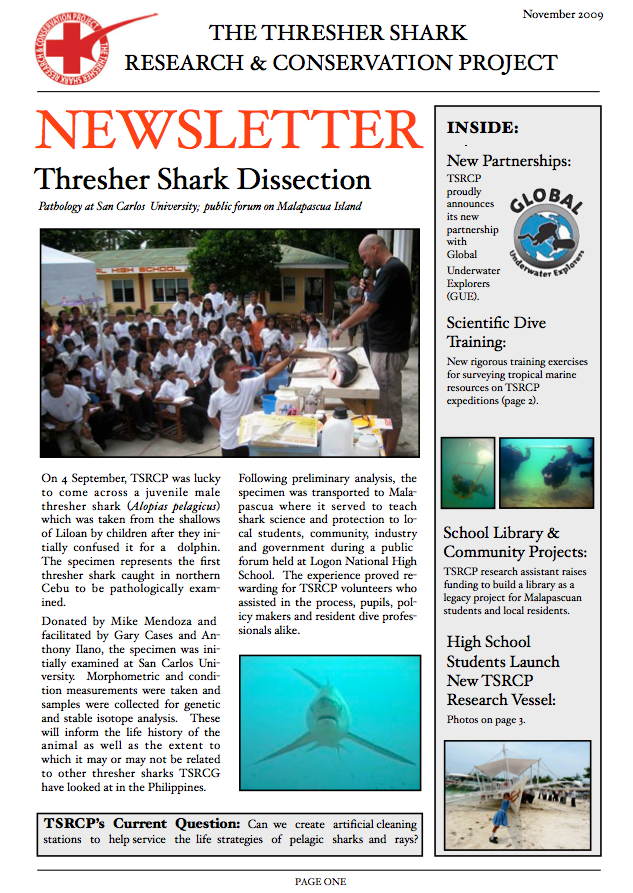
Here's a post from the Shark Divers blog, discussing one of the few shark organizations devoted to the thresher shark. Based in the Philippines where considerable local fishing, commercial and, sometimes, illegal fishing takes place, this group has their work cut out for them.

Of the myriad of shark conservation sites worth visiting, none come better then the Thresher shark research & conservation project.

We have been following this site for the past year and are always happy with the vibrant field updates, images, video and news.

Consider taking the time to get to know the team behind the Thresher shark research & conservation project.

Shark conservation efforts are hard enough to get traction with; in places like the Philippines, it's doubly so.

It's takes determination, good outreach, and a serious research program to make a difference.

Friday, September 25, 2009

Palau Shark Sanctuary: island nation declares economic zone a protected haven for sharks

Let's end the week on some great news! This just in from the United Nations: before the General Assembly today, the President of Palau declared its 230,000 sq.mile Exclusive Economic Zone a shark sanctuary. This is the first shark sanctuary recognized by any country and it will hopefully send a message to other countries, regardless of their economic standing, that in the end it is better business to save and protect sharks than to slaughter them. Bravo, to Palau's President Toribiong for taking this step!

Here is the press release from Palau's Shark Sanctuary (www.sharksanctuary.com):

FOR IMMEDIATE RELEASE: September 25, 2009
LATE BREAKING NEWS!


PALAU DECLARES EEZ A SHARK SANCTUARY!


On Friday, September 25, 2009, H.E. Johnson Toribiong, President of the Republic of Palau, a tiny Pacific Island nation, declared the waters of Palau's Exclusive Economic Zone (230, 000 Sq. Miles / 620,000 Sq. Kms.), as the worlds first officially recognized SHARK SANCTUARY, during a meeting of the General Assembly of the United Nations, in New York.

President Toribiong also called for a global ban on shark-finning and for other nations to follow suit. Through his actions, President Toribiong has placed Palau at the very forefront of worldwide efforts to protect sharks.


This is a tremendous day for Palau and for worldwide efforts to protect sharks from absolute and unsustainable destruction!


Palau Shark Sanctuary deeply commends President Toribiong for his international leadership in world efforts to protect sharks.

We are very proud of President Toribiong and of Palau on this momentous occasion.


Well done Mr. President!


Thank You!


Dermot Keane

Palau Shark Sanctuary


As I had mentioned in a previous post back in April, Palau went through a rocky period regarding commercial shark fishing, pressured by some outside commercial interests. That makes this move all the more important.

You can learn more at the Palau Shark Sanctuary web site and blog. To write congratulations to President Toribiong, the address is: Office of the President, P.O. Box 100, Koror, Palau 96940.

Monday, May 25, 2009

Shark Tournament Changes Tact: event goes "catch and release"

Next weekend in Ft. Meyers Beach, Florida, the annual "Are You Man Enough" Shark Tournament was going to be held where fishermen could vie for recognition and prize money for the largest shark caught and brought back to the docks. The event brought the attention and wrath of several conservation organizations and the resulting pressure was enough to make the organizers opt for a catch-and-release policy only.

"I'm not passionate about killing sharks," said Jack Donlan, director of the tournament. "I was just putting on a fishing tournament. This was the best move for our tournament. It's going to expand our ability to put on a bigger event each and every year."

The Shark-Free Marina Initiative got good news coverage from CBS Miami and the Shark Safe Project exerted considerable pressure with a proposed demonstration this weekend (unfortunately, CBS erroneously attributed the efforts of the Shark Safe Project to the Shark-Free Marinas Initiative - they have similar names and motives).

Mr. Dolan's comments are of interest because they represent one of the best strategies in getting businesses or commercial enterprises on board with environmental or conservation issues: show that they will benefit commercially in the end.

Friday, April 3, 2009

Palau's Shark/Fishing Legislation: a reputation for conservation at risk

Palau has been a favorite dive tourist destination for many years because of its wonderful reefs and bountiful fishlife. And the island has, in the past, taken active steps to protect its shark populations with aggressive action against illegal shark finning operations. All of these efforts have contributed to the island's tourist economy and sound conservation policy.

But that all could potentially be undone with recent legislation that was introduced to both allow for commercial shark fishing and allow for the use of purse seining - a method that brings in a large amount of by-catch. Palau commercial fishing interests have been working with Philippine fishing groups and the combined influence on Palau legislators has produced SB8-44 (which drops the ban on shark fishing) and SB8-50 (which drops an export tax on fish caught by purse seining).

According to FinsMagazine, the collective result of the laws would be:
  • To permit and encourage the killing of sharks in Palau’s waters
  • To promote shark finning
  • To promote fishing methods that according to Monterey Bay Aquarium “result in large amounts of unintended catch” including sharks, dolphins, turtles, rays and juveniles:
    http://www.montereybayaquarium.org/cr/cr_seafoodwatch/sfw_gear.aspx
  • To exempt fishing companies from any export taxes on fish taken from Palau’s waters
  • To make it practically impossible for Palau’s law enforcement personnel to successfully prosecute alleged violators in the courts
  • To risk destroying Palau’s sustainable tourism industry
  • To risk destroying Palau’s marine resources through unsustainable practices
  • To gamble on all of the above for no apparent gain to Palau or Palauans.
This issue has made the rounds of several shark blogs recently, but opinions from everyone - from divers to land-bound ocean advocates - are needed to remind the Palau government that the negative impact on tourism and the island's marine ecology will ultimately outweigh the short-term gains in a working relationship with Philippine commercial fisheries.

Email the Palau Chamber of Commerce (
pcoc@palaunet.com) and Belau Tourism Association (bta@palaunet.com) and the government tourism office Palau Visitors Authority (pva@visit-palau.com) .