Showing posts with label Philippines. Show all posts

Sunday, September 30, 2012

Post BLUE Film Festival News: new shark species in the Philippines

First off, my apologies to my readers for being a bit derelict in my duties as contributor to this blog.  I have spent the past week at the BLUE Ocean Film Festival & Conservation Event in Monterey, CA and there was so much taking place there - regarding ocean conservation, wildlife/ocean film making and, of course, a full slate of films - that keeping up with my posts became a challenge, to say the least.

However, meeting up with old and new colleagues provides me with a considerable amount of material to work with so you can expect some interesting posts over the next few weeks that include interviews with ocean conservation notables like Dr. Sylvia Earle (www.thesealliance.org), Fabien Cousteau (PlantaFish.org), Dr. David Guggenheim (the "Ocean Doctor"), Christopher Chin (COARE.org/Shark Saver), and more.

One short item that caught my eye today was a news article that helps highlight the importance of protecting marine areas because we often do not know the full range of biodiversity that can exist in a specific area.

The Philippine Daily Inquirer reported on a recently discovered new species of shark in a well-traveled area of the Philippines called the Verde Island Passage Marine Corridor (VIPMC).  It is a body of water that is well-traveled by both ships and migratory species and so responsible management of the VIPMC is important to ensure that human activity does not adversely impact what is proving to be a marine ecosystem rich in biodiversity.

The newly discovered shark is referred to locally as a "bubble shark" and appears to be a close relative of the swell shark.  As a California diver, I am very familiar with swell sharks.  They are smaller, bottom-dwelling sharks with the unusual ability in take in a large quantity of water and therefore "swell up" as a defensive mechanism (the swelling allows it to be lodged tightly on crevices or cavities in the reef, making it difficult to grab onto by any larger predator.

The shark was actually discovered in 2011 by scientists conducting a broad investigation of various sites in and around the Philippines as part of a California Academy of Sciences expedition.  Several new species were uncovered in the process and the results, which are now being released, show that the Philippines may be one of the richest areas in marine biodiversity.  New species allow researchers to better combat the argument of "so what" when it comes to the need to preserve and protect our aquatic natural resources.  We are still finding new species and the more we learn, the better we can understand the wide range of biodiversity inter-relationships and what can happen on a broad scale when human activities negatively impact those relationships. 

"[A new species is important] because when you sell conservation to people, especially people who are not really interested or who do not really care, they need something else, like, why is it important?" said Vera Horigue of Australia's James Cook University. "It's really helpful to get people to become interested, because you can show just how special the place is by the uniqueness of the species found in it. It promotes the area; thus, funds pour in." 

Source: AsiaOne News 

Sunday, March 18, 2012

Philippine's Irrawaddy Dolphin: endangered but with a potential future thanks to local fishermen

In the Philippines, the Malampaya Sound is known for its ecological diversity, ranging from coral reefs to sea grasses to mangroves and lowland forests. It is also home to one of the most endangered species of dolphin: the Irrawaddy dolphin. The number of dolphin in the sound has dropped from 79 in 2001 to 42 and scientists believe that if the number dips below 40, the Irrawaddy dolphin population in the sound will collapse.

The Irrawaddy dolphin is a rather cute looking creature; a bit like a small beluga whale with a similar head shape and light grey in color. There are only about 6,000 Irrawaddy dolphins worldwide and it has been listed as "critically endangered" by the IUCN. Because of the Malampaya Sound's biodiversity, commercial and local fisherman have been attracted to the area and the sound is showing the impact of overfishing. No more so than with the plight of the Irrawaddy dolphin which is not commercially sought after but does become ensnared in the longline nets and, being then unable to reach the surface, drowns.

However, there could very well be a positive future for the Irrawaddy dolphin if the indigenous Tagbanua people have anything to say about it. Representatives of the World Wildlife Fund (WWF) who have been monitoring the situation and working with local Philippine officials, say that the Tagbanua tribe have both a cultural history that supports protecting the dolphin and employ fishing techniques that could allow the Irrawaddy dolphin's numbers to return.


“For them [the Tagbauna people], the dolphins are bearer of good tidings and are also the omen of something bad that will happen like typhoons or calamities, depending on the behavior of the animal,” said Mavic Matillano, who lead a study five years ago on the Irrawaddy dolphin. “That, in a way made the lumad [non-Muslim indigenous peoples in Mindanao] also believe that when you hurt a dolphin, something bad may happen to you.”

The cultural position forms the background for their approach to fishing. The Tagbanua fishermen use specific moon and tide schedules and selective harvesting, regardless of market demands, to avoid overfishing and wasted bycatch (which is the category in which the Irrawaddy dolphin finds itself).

According to the Philippine's Inquirer News, "
WWF officials said the most important thing to do right now was to change the fishing practices of the coastal communities there. The group and [WWF author Raoul] Cola pointed to the Tagbanua fishing practices as a model of sustainable practice."

“Based on the principle of the interconnection, not only of ecosystems but also of the natural, social and spiritual worlds, these strategies demonstrate that the world view of the users molds their environment and defines the prospect of its sustainability,” said Cola.

The WWF is working with several Philippine agencies to implement commercial fishery management strategies based on the techniques employed by the Tagbanuas. The WWF is working hard to address funding issues, but they are encouraged by that fact that an indigenous Philippine tribe can serve as a model for many local coastal areas, rather than some outside group of "foreigners" imposing their beliefs on local fishermen.

The Irrawaddy dolphin, like other dolphins, is an important apex predator and vital to maintaining a healthy biodiversity in the Malampaya Sound. Let's hope that local wisdom and responsible fishing techniques can spread to ensure the dolphin's future.

Source: Inquirer News

Monday, February 20, 2012

Philippine Shark Fishing Ban: senator pushing legislation to protect all sharks and rays

Philippine Senator Loren Legarda is receiving considerable coverage in local news outlets for her proposal to put forth legislation that would ban the catching of all sharks and rays in Philippine waters. Her proposal goes beyond the type of shark fin ban that has been initiated elsewhere, such as in several U.S. west coast states and Hawaii. Legarda seeks "to declare as unlawful the wounding or killing of sharks and rays, unless there is threat to human life or safety. The shark’s fin soup and the selling of shark’s fin will likewise be prohibited to eliminate the demand that results in the massive killing of sharks."

This proposal, Senate Bill 2616, was actually first proposed over a year ago, in November, 2010, and mirrors similar legislation that was proposed in July, 2010 by Representative Gloria Macapagal-Arroyo which has been languishing in committee since then.

The senator cites several arguments for pushing for this legislation,
“Sharks, as predators of the sea, play a vital role in regulating the ecological balance, particularly the health of important commercial fish species, population balance, and protection of coral reefs. Being a country with about two-thirds of the known marine species of the Pacific living in its coastal waters, the Philippines plays a crucial role in protecting marine species.”

Being that Senate Bill 2616 has been on out on the floor for some time, I find this sudden attention to be of interest. This morning, I counted five different Philippine news outlets picking up the story and, as much of what I read was verbatim from one source to the next, it was clear that a press release had been circulated. News reports claim that the senator's renewed drive was a result of recent local reports of shark finning operations taking place, and there's no reason to doubt that.

“Clearly, the absence of the law forbidding the catching of sharks, gives people the courage to continue the practice, which could eventually lead to the extinction of shark species in the country, especially [sic] that they reproduce slowly,” said Legarda in a statement on Sunday.

However, the release of Legarda's statement could also be propitious as a response to recent statements made by a panel of experts at a forum held in Singapore and sponsored by the Institute for Southeast Asian Studies. Expressing their controversial views were Dr. Giam Choo Hoo, a member of the United Nations Convention on International Trade of Endangered Species (CITES), Prof. Steve Oakley of Shark Savers Malaysia and Hank Jenkins, president of Species Management Specialists. The three put forward the position that prohibiting the trade in shark fins will not dramatically reduce the number of sharks killed worldwide. They noted that many countries such as Germany, France, Australia and Iceland have long killed sharks for their meat.

“Even if shark’s fin were banned, these countries would continue to catch sharks for the meat,” said Oakley.

Giam used statistics from the UN Food and Agriculture Organization (FAO) to say that 70 percent of all sharks caught are done by local fishermen in developing countries who consume the entire shark, not just selling the fins. And Jenkins was critical of the statistics that are often used regarding the number of sharks caught worldwide. He questioned the accuracy of 73 million caught each year, saying that it was a manipulation of data originally research by marine scientist Shelley Clarke who put the number at 38 million in 2000 with a wide variance of 26 million to 73 million.

While the idea that shark finning is not the sole issue threatening sharks (albeit the most distasteful) or that catch numbers can be widely inaccurate and prone to manipulation are actually valid points of discussion and consideration, the manner in which they were presented in Singapore has raised the dander of many shark advocates (read here, here, here) and pro-shark organizations. The panel's most inflammatory statement was probably made when, as reported in The Jukarta Post, they insisted, "there is no evidence that live finning - cutting sharks’ fins off before throwing the sharks back into the sea - is a prevalent practice. 'Although practiced by some fishermen, it is illegal, relatively infrequent and condemned by the industry,' said Jenkins."

Just a few days following these statements, Senator Legarda reignites discussion and news buzz regarding her Senate Bill 2616. Coincidence? Perhaps, but it's not much of a stretch to imagine the Singapore news coming to the senator's attention and generating a reaction.

Definitely, the impact of shark finning and total shark consumption and the accuracy of the estimated numbers require more research. But they are not easy facts to ascertain. Extinction is the ultimate test bed for measuring the impact that sharks have on a marine ecosystem, but there is a wealth of data to date that can provide indications without going to such a ridiculously extreme approach. With more and more data, computer models can be further refined to determine impacts based on species and specific environments or locales.

Statistics regarding catch and population numbers will always be a bit elusive and subject to abuse. How many sharks are caught specifically for fins and/or meat versus how many are caught as accidental bycatch will always need to be extrapolated from sources of varying reliability. And when you add to that the number sharks that go unreported due to illegal activity, it becomes even more challenging. However, even a low end number like Clarke's estimated 38 million is an astounding toll to impose on an animal being caught in the wild whose reproductive rate is low. To reach a level of commercial "sustainability" is a lot to ask of nature when it comes to sharks.

So, we can either downplay the potential or theorized impacts on shark populations and proceed as we have been for decades, waiting for a possible negative outcome that would be irreversible; or we follow Senator Legarda's lead and move towards total protection. That would require facing stiff economic and political challenges in transitioning market demands and the direction of commercial industries, ranging from fishing to tourism, but it would be a fine testament to our ability - some would say a god-given right - to exercise true stewardship of the seas.

Source: Manila Bulletin.com
Source: GMA News
Source: Business World Online
Source: philSTAR.com
Source: Journal Online
Source: Jakarta Post

Saturday, December 10, 2011

Philippine Whale Sharks: local fishermen see economic value in embracing ecotourism

Ocean ecotourism is becoming more and more a method by which countries, particularly developing or 2nd/3rd world nations, can find economic justification for instituting conservation measures. The island of Cebu, part of the Philippines, has recently become a typical example of ecotourism's benefits, but it also highlights some of the challenges.

The town of Oslob in southern Cebu is predominantly a fishing village and local fisherman often bring in vast catches of a small shrimp locally known as "uyap." Over the past few months, another fisherman of sorts has taken a liking to the shrimp: whale sharks. The number of reported sightings began with just one and soon increased to up to seven at a time.

Though the whale sharks, reported to be from 16 to 25 feet (5 to 8m), were competing with the fishermen for the shrimp, which represented an important source of income, the fisherman wisely chose not to chase off or harm the whale sharks but to capitalize on their appearance. Ecotourism in the form of whale shark diving. Whale sharks are a popular attraction worldwide in both aquariums and in the wild. While some may question the wisdom of keeping such a large animal confined within an aquarium exhibit, seeing them in their natural habitat can be an exciting and enlightening experience.

Successful ecotourism relies on two key components: 1.) Recognizing and transitioning to a new business revenue model and 2.) establishing the logistics that will ensure its long-term success.

In Cebu, the fisherman reportedly charge 100PHP (Philippine Pesos) to allow tourists in the water with the sharks, and they charge an additional 100PHP for snorkel gear. The fishermen use some of their shrimp catch to coax the sharks up to the surface and for that they charge 100PHP for the shrimp. [For Westerners, those are bargain rates, about $7USD total per diver, so I would expect rates to rise as business continues to improve.] The response from tourists has been good and the number of divers has been steadily increasing, thereby allowing the fishermen-turned-ecotourism operators to successfully offset their losses from the sharks feeding in their local waters. So the recognition of the economic value of a living whale shark and the transition to a new source of revenue have been successful.

However, some of the logistics or the specific details as to how the shark diving is carried out have pointed out challenges that need to be addressed immediately. Reports started to circulate that the whale shark operators were unfamiliar with how to safely handle these sharks. Apparently, some fishermen were showing the tourists how they could ride the whale sharks, grabbing the dorsal fin or even, it was reported, grabbing the gills. This can stress the animal unnecessarily and can actually damage the skin, exposing it to unwelcome bacteria.

A Philippine-based dive group, the Sea Knights, stepped in last week to observe the whale sharks and the ecotourism operators' methods. In many parts of the world, there are specific procedures and guidelines that whale shark diving operators follow to both ensure the safety of the sharks and the divers and to make that their actions do not permanently chase away the sharks. The Sea Knights plan to present a report to local government officials soon.

“Oslob is already planning on making an ordinance to protect the whale sharks. We want to recommend to the local government that they make an ordinance as soon as possible and have it implemented right away since the number of whale sharks is growing rapidly,” said Fr. Charlie Orobia, OAR, Sea Knights vice president.

Shark ecotourism is being promoted by many shark conservationists as a viable way to get local communities to recognize the economic value in conserving and protecting sharks, whether it's a relatively benign species like the whale shark or more iconic species like tiger or white sharks. But it is equally important that it be implemented in a safe and prudent manner and that it be effectively managed with guidelines strictly enforced.

To a shark advocate, that's good conservation. To the local fisherman, that's good business.

Source: Cebu Sun-Star.

Wednesday, April 27, 2011

Sparkle-Clean Sharks: thresher sharks practice good hygiene in the Philippines

As marine biologists continue to study the physiology and behaviors of sharks, we are learning more and more about these fascinating creatures and what we can do to protect them if it's not too late. Case in point:

Thresher sharks have been greatly depleted in number - caught for their fins and meat - which is disappointing over and above the obvious loss in population because it is a very unique species. The thresher shark's namesake elongated tail fin has been shown to be used as a hunting tool, slashing and stunning its prey. Diver encounters with thresher sharks have always been scarce as they often swim in deep, open waters and don't typically congregate in large groups.

However, off the northern tip of Cebu in the Philippines, a dive tourism business is growing based on the thresher shark. Apparently, a concentration of thresher sharks frequent a seamount there, which increases the opportunity for divers to see these beautiful sharks in the wild.

Researchers from U.K.'s Bangor University have been studying the behavior of these sharks in the Philippines and have recently published their findings in the journal PLoS One. According to the research team, the thresher sharks are frequenting the deep seamount to get a good
cleaning. Residing at the seamount are a number of cleaner wrasses, a fish well-known for cleaning larger reef fish by picking away parasites and dead skin or scales. It seems that thresher sharks have caught on to the benefits of this hygienic service and will cruise close to the seamount, slowing down to half their normal speed and allowing the cleaner wrasses to give them a thorough once over.

The researchers have filmed this behavior, amassing over 1,000 hours of footage. They are quick to point out that mankind can have a disruptive effect on this symbiotic relationship - the seamount already shows evidence of dynamite fishing, a local commercial technique that literally destroys reef communities.

According to lead researcher Simon Oliver,
“Our findings underscore the importance of protecting areas like seamounts which play an important part in [the sharks'] life strategy to maintain health and hygiene.”

Fellow researcher Dr. John Turner said, regarding their studies, “The work uniquely describes why some oceanic sharks come into coastal waters to perform an important life function which is easily disturbed by man.”

Tuesday, October 27, 2009

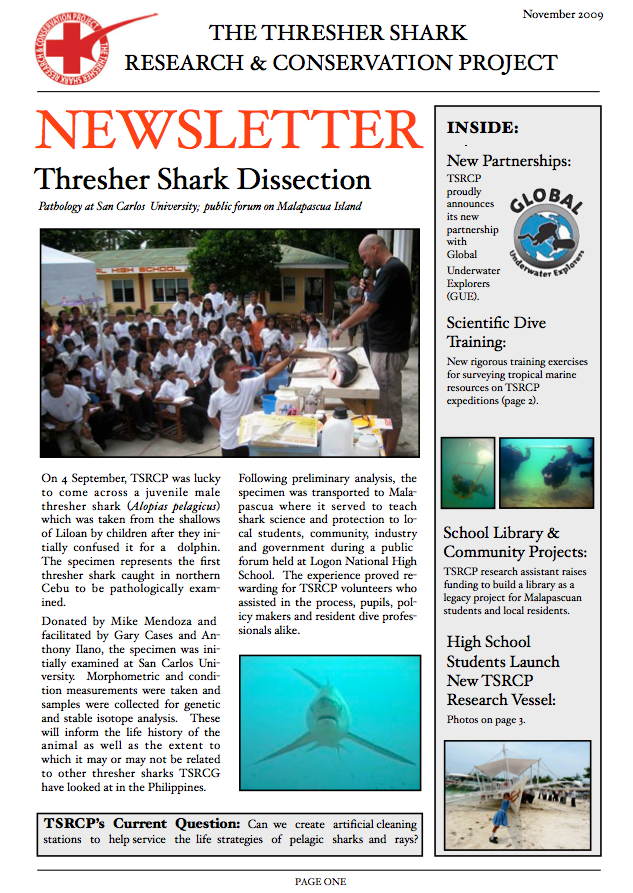
Thresher Shark: non-profit dedicated to shark's preservation

Speaking of sharks, here's a species you don't hear too much about and yet faces imminent danger: the thresher shark.

One of the more unusual and distinctive sharks due to its namesake elongated upper caudal fin or tail, it is believed that the shark might use its tail as a hunting device to stun schooling fish. The thresher shark is a popular seafood item in many forms - fresh, dried, salted - and so it's numbers have suffered (all three thresher shark species are listed as "vulnerable" by the IUCN).

Here's a post from the Shark Divers blog, discussing one of the few shark organizations devoted to the thresher shark. Based in the Philippines where considerable local fishing, commercial and, sometimes, illegal fishing takes place, this group has their work cut out for them.

Of the myriad of shark conservation sites worth visiting, none come better then the Thresher shark research & conservation project.

We have been following this site for the past year and are always happy with the vibrant field updates, images, video and news.

Consider taking the time to get to know the team behind the Thresher shark research & conservation project.

Shark conservation efforts are hard enough to get traction with; in places like the Philippines, it's doubly so.

It's takes determination, good outreach, and a serious research program to make a difference.

Friday, April 3, 2009

Palau's Shark/Fishing Legislation: a reputation for conservation at risk

Palau has been a favorite dive tourist destination for many years because of its wonderful reefs and bountiful fishlife. And the island has, in the past, taken active steps to protect its shark populations with aggressive action against illegal shark finning operations. All of these efforts have contributed to the island's tourist economy and sound conservation policy.

But that all could potentially be undone with recent legislation that was introduced to both allow for commercial shark fishing and allow for the use of purse seining - a method that brings in a large amount of by-catch. Palau commercial fishing interests have been working with Philippine fishing groups and the combined influence on Palau legislators has produced SB8-44 (which drops the ban on shark fishing) and SB8-50 (which drops an export tax on fish caught by purse seining).

According to FinsMagazine, the collective result of the laws would be:
  • To permit and encourage the killing of sharks in Palau’s waters
  • To promote shark finning
  • To promote fishing methods that according to Monterey Bay Aquarium “result in large amounts of unintended catch” including sharks, dolphins, turtles, rays and juveniles:
    http://www.montereybayaquarium.org/cr/cr_seafoodwatch/sfw_gear.aspx
  • To exempt fishing companies from any export taxes on fish taken from Palau’s waters
  • To make it practically impossible for Palau’s law enforcement personnel to successfully prosecute alleged violators in the courts
  • To risk destroying Palau’s sustainable tourism industry
  • To risk destroying Palau’s marine resources through unsustainable practices
  • To gamble on all of the above for no apparent gain to Palau or Palauans.
This issue has made the rounds of several shark blogs recently, but opinions from everyone - from divers to land-bound ocean advocates - are needed to remind the Palau government that the negative impact on tourism and the island's marine ecology will ultimately outweigh the short-term gains in a working relationship with Philippine commercial fisheries.

Email the Palau Chamber of Commerce (
pcoc@palaunet.com) and Belau Tourism Association (bta@palaunet.com) and the government tourism office Palau Visitors Authority (pva@visit-palau.com) .