Showing posts with label oceanic white tip shark. Show all posts

Sunday, November 4, 2012

Pacific Shark Populations In Decline: new study provides hard numbers on pelagic species

The results of a recent study published in Conservation Biology paints a disturbing picture of ongoing decline of sharks in the Pacific Ocean.  Now, to many who are familiar with the subject of shark finning and overfishing, this does not necessarily sound, unfortunately, like anything new - it is what many of us have been fighting about for some time.  However, it's an important report because it covers a wide period of time, has specific numbers, and notes that some areas in shark conservation that receive considerable public support may not be as effective as hoped.

The study by the Secretariat of the Pacific Community in New Caledonia, headed up by Dr. Shelley Clark, covers a fifteen-year period, examining catch records from several fisheries throughout the Pacific, and shows significant declines in the catch rates for blue, mako, oceanic whitetip sharks, along with declining average size in oceanic whitetip and silky sharks (following the same fate of tuna and billfish).  These are all, basically, pelagic or open water sharks that operate outside of most national ocean boundaries in international waters.

Oceanic whitetips were shown to be declining annually at a rate of 17%.  Based on just that number alone, that would mean that oceanic whitetips in Pacific waters have 5-6 years left.  Unfortunately, that could be accelerated because of how animal populations can reach a "tipping point" where their declining numbers can no longer be supported by any means of natural reproduction and the population suddenly collapses and they plummet to oblivion.

Blue sharks were also reported to be declining at a rate of 5% in the North Pacific.  Blue sharks are a bit more abundant and more productive, but they, along with the oceanic whitetip are highly sought after by commercial shark fishing operations.  Physically, these two species have particularly large pectoral fins so, quite literally, fishermen get more bang for the buck with a shark with large fins, in open international waters and, at least with the blue shark, are slightly more abundant.

The New Caledonia study goes on to report that, in international waters, shark fishing for fins or the entire carcass, has proved to be a difficult practice to regulate due to insufficient enforcement, complex laws regarding fin-to-carcass ratios (the result of compromises by international agencies to commercial interests), and no follow-through enforcement or prosecution at the domestic level.  And then there is the impact of illegal fishing or longline fishing where numbers of sharks are caught but were not necessarily targeted.  Time and time again, we find that laws or regulations that are in place mean nothing if there is insufficient enforcement and prosecution.  Pardon the pun, but too often the laws have no teeth.

As reported in a recent press release, Sonja Fordham, president of Shark Advocates International, had this to say about the report and the current state of regulations, "These findings underscore conservationists' messages that most finning bans are not properly enforced, and alone are not sufficient to reverse shark population declines.  Prohibitions on at-sea removal of shark fins not only bolster finning ban enforcement, but also facilitate collection of species-specific fisheries data that are key to refining population assessments and informing the establishment of urgently needed shark catch limits."

This is why it is critical for all shark conservationists to focus some of their interest, energy, and passion into prodding and supporting those organizations that work on behalf of sharks in the international arena.  It may seem a bit removed and you may feel a bit ineffectual compared to regional efforts like state or local shark finning or fishing bans, but, remember, most of the ocean is in international jurisdiction.  If we do not pressure these worldwide agencies to act responsibly, based on current scientific information, then we will find ourselves putting band aids on our local waters, while the open oceans are hemorrhaging badly.

Source: PRNewsire       

Sunday, March 11, 2012

Oceanic Whitetip Sharks in Fiji: island cultures revere a threatened pelagic predator

The oceanic whitetip shark is a beautiful but feared shark. A feared shark because of its reputation gained during World War II for being attracted to the sounds of sinking ships and then, what with blood in the water, attacking sailors floating in the water. In Jaws, Quint's fictional monologue about the sinking of the Indianapolis was based on the real account of the ship's sinking. And, in truth, the oceanic whitetip was responsible for a number of sailor's deaths - along with battle injuries, starvation, and sea water poisoning taking its toll.

However, the fact is that the oceanic whitetip is a beautiful, pelagic or open-ocean shark and like many other shark species, its numbers have been in severe decline due to commercial fishing and bycatch. The IUCN has listed the species as vulnerable to extinction and its situation is not holding steady or improving by any means.

An article ran recently in the The Fiji Times Online in support of the oceanic whitetip. Fiji has several species of shark in relatively fair abundance in and about its reefs and the oceanic whitetip is one that will make an occasional appearance, approaching reefs on narrow continental shelves near deep water. Also, Fiji has a cultural history with several Fijian island peoples that revolve around sharks as mythical, even god-like, creatures. Several legends specifically involve oceanic whitetips and have them serving as protectors not predators.

The Fiji Times reported that Fijian "
shark campaigner Manoa Rasigatale says the people of [the Fiji island of] Rukua, like elsewhere in Fiji where the shark is revered as a totem and protector, believe the oceanic whitetip and the rest of the species should be saved.

'Saving it is saving their tradition and their marine environment. It is as simple as that. Take away the shark and they lose their traditional tie to it and the story that has been passed on from one generation to another,' says Mr Rasigatale."

It's an interesting opposing juxtaposition to the Asian cultural history that defends the consumption of shark fin soup. Whose culture has a better right to predominate? One that promotes reverence of the shark or one that promotes its consumption?

Although Fiji has strict regulations regarding shark fishing, a movement is in the beginning stages with a shark sanctuary for the entire island chain as its ultimate goal. The Pew Environment Group and the Coral Reef Alliance (CORAL) are working with the Fijian government to make the sanctuary a reality.

Commendable as it may be, a shark sanctuary may not be enough to ultimately protect the oceanic whitetip as it is a long range nomad. That means considerable time spent outside of sanctuary boundaries, exposed to commercial fishing - whether deliberate or as accidental bycatch - in international waters.

The Fiji Times Online article is an interesting read both with regards to how the shark is entwined with the island's culture and identifying the specific fishing threats to the oceanic whitetip to which the island nation and supporting conservation groups are trying to address.

Source:
The Fiji Times Online

Wednesday, June 29, 2011

Penny Palfrey & Bad Buzz: misreporting about killed sharks detracts from her accomplishment

News reports that the support crew, for ocean endurance swimmer Penny Palfrey, killed several curious oceanic whitetip sharks during the course of her swim from Little Cayman to Grand Cayman are now having to do an about-face. The Cayman Islands Department of Tourism looked into the reported killings and found there was no evidence of any sharks being harmed. Several were hooked and towed away to be released at a safe distance - and that's a far cry from saying they were killed.

A variety of information outlets ricocheted the story like a steel ball in a pinball game, from respectable news sources to the blogosphere where, unfortunately, attitudes can get nasty. I read many of the reports and chose not to report it in my blog until Monday, when I mentioned it in regards to Diana Nyad's upcoming swim. Based on what she was hearing in the press, Diana decided to do an 11th-hour revamping of her security protocols and, in the end, it was a wise move regardless of what did or did not take place during Penny's swim.

But there were many who took poor Penny to task in a big way and it illustrates the zealous passion that some people have regarding the preservation of sharks, how it is becoming a hot button news topic, and how dangerous the entire "social media" craze is to the tenants of accurate and balanced reporting.

According to The Daily News of Open Water Swimming, Penny Palfrey's man in charge of security may have used a poor choice in words which was misinterpreted by some news outlets, and so the bad buzz began. "
The findings were that The Cayman Islands Department of Tourism contacted the individual named in the original report, Charles Ebanks, who confirmed that he did not kill any sharks during the historic Bridging swim and states that reports to the contrary are inaccurate. He stated that he 'hooked the sharks and lead them away', he further added, 'I was there, I did not kill any sharks. They are assuming I did something which is not true and you can quote me on this.' Charles stated that the boat captain from the boat asked him what he did with the sharks and he replied, 'I got rid of them.' He said he thinks this could have been taken to mean that they were killed."

Hooking a shark (basically fishing for them with a baited line) is the last ditch approach to be taken with a shark that is proving to be intensely curious to the point of being a threat to the swimmer. There are several other steps that are taken to ward off the shark before one decides to catch it and then quickly motor a mile or so away and release it. It's a bit more involved than a straight forward catch-and-release because the shark needs to be transported out of the area.

Apparently, Penny Palfrey's crew felt compelled to take that step because a shark was reported to have bumped her during the night - and you can imagine how that could rattle a swimmer's concentration.With all the questionable reporting that has been swirling about for the past week, I have no reason to question the actions of Penny's staff. Is the loss of three sharks worth an ocean swim record? I think not. And it now appears that, for Penny, that dilemma does not have to be debated.

Hopefully, Penny will be able to regain some of the attention regarding her accomplishment that was lost due to the media storm. In my brief time so far with Diana Nyad, I have come to appreciate the dedication and commitment these ocean endurance swimmers invest into their sport. So, let me join the chorus of others who are saying, "Bravo, Penny! Bravo!"

In the meantime, I wait for the call to join up with the film crew as she prepares for her Cuba to Florida swim, a staggering 103 miles in 60 hours. One for the record books.

Read about the investigation in The Daily News of Open Water Swimming.

Saturday, November 27, 2010

Bahamas' Oceanic Whitetip Sharks: can divers and researchers work together?

The Oceanic Whitetip shark: a fascinating and elegant shark and, as a pelagic or open water shark, one that does not encounter people often. It has a bad reputation in some corners as it has been implicated in human fatalities following wartime shipwrecks. But, like other species of shark, the oceanic whitetip has paid dearly in the commercial shark fishing trade and it has become one of the rarer of all shark species. By example, its numbers in the Gulf of Mexico have been reported to have declined by as much as 99.3 percent.

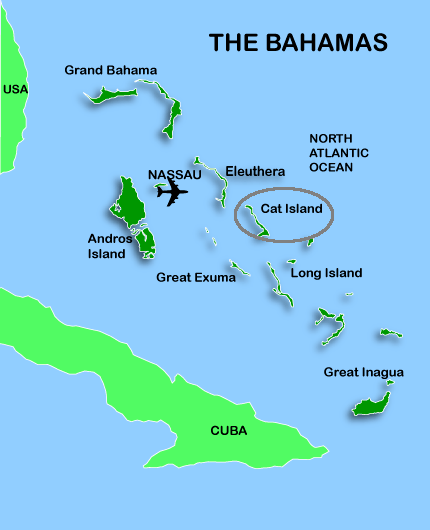
In the Bahamas, the remote Cat Island is reporting a respectable number of oceanic whitetips - given the current population numbers - and this has attracted the attention of several shark diving operators. Patric Douglas of Shark Divers has some interesting suggestions as to how these sharks could be made both a source of tourism and conservation research efforts. Patric is known for calling it as he sees it and, while not currently planning shark diving operations there, he is concerned that the oceanic whitetip site at Cat Island needs to be properly managed to insure it is not carelessly exploited by dive operators or sport fisherman.

Here are his recently posted suggestions:
1. A Bahamas Carcharhinus longimanus [oceanic whitetip] educational website. This site will feature the animals, the site, the conservation status of these animals, and tie in directly to ongoing efforts of PEW and the BNT [Bahamas National Trust]. The site would also feature several pro-shark conservation PSAs; just the sharks, not the divers and the sharks. We're not looking to redefine these animals, or even make a simple point about how safe they may or may not be with divers, that conservation/industry message can be left for another time and place. Under conservation also add research and a non-profit donations page.

Additionally this should tie into PEW Trusts, and here's why. Conservation efforts need to be funded; real shark conservation sometimes requires a "step back moment" where you have to realize who has the conservation horsepower to get something done or not. After all we're in this for the sharks. If someone can run the ball into the end zone let's get it done. Hanging any conservation effort on the mantle of friends and industry buddies who lack the horsepower does nothing for sharks...but that's another post for another time.

2. A Bahamas Carcharhinus longimanus research effort with immediate tagging and tracking of these animals. This effort should be a "Bahamas thing" and there's plenty of folks who can get the job done, they just need funding. In addition operators could charge an extra $100 per diver for the project. Divers will pay for this, gladly, if they believe this benefits the sharks, and it will.

Some of you will start screaming right about now as you wipe off your
Epoque D170 Dome Ports, tags on Carcharhinus longimanus? Yes, tags, and here's why. If you want to hedge against sport fishing interests, declaring this site an active shark research site will get the job done. It lends instant credibility to the counter charge that shark divers are just making money from these sharks, and with real data, Bahamian conservation laws put on the books have teeth.

3. Cross-operator/conservation promotion. Every operator servicing divers and
Carcharhinus longimanus at Cat Island should have the new conservation website and research efforts on their own sites home pages with a set industry dive protocol agreement. Again a tall order, but we're talking about a brand new shark site with just two or three guys [shark diving operators]. This is not Isla Guadalupe, or even South Africa. As industry members we can look back and see with 100% clarity where non-action will lead us at Cat Island. Is it too much to ask for a round of phone calls, two websites and a conservation tagging program?

I think not, and done right this could be the shining beacon on the hill for future sites worldwide.

Read the entire post on the Shark Divers blog.

Friday, May 21, 2010

Oceanic White Tip Sharks: curious pelagic predators with an unfair reputation

A sleek but muscular body gliding effortlessly through cobalt blue water, its rounded snow-capped dorsal fin slicing the water just below the surface, the Oceanic White Tip Shark is one of the premier pelagic (open ocean) predators.

Beqa Adventure Divers's blog picked up on a series of terrific photos of oceanic white tips, posted by LupoDiver on a recent South Atlantic trip with Jim Abernethy's Scuba Adventures.

Oceanic white tip sharks are important open ocean predators and scavengers. As with most other sharks, they play a critical role in keeping the oceanic backyard clean and the populations of their prey healthy by culling the weak, injured, and sick. They are intensely curious as they do not live in a world of wall-to-wall animals, so anything that catches their attention either visually or by scent is quickly investigated.

Unfortunately, these sharks also have a bad reputation carried down through history as a man-eater. Often attracted by the low frequency sounds given off by sinking ships (not your typical underwater background noise), particularly from sinking warships, these sharks were known to attack sailors in the water - their hunting/scavenging instincts piqued by blood from wounded sailors. Sadly, what began as natural curiosity and a reaction to food stimulus in a limited-prey environment turned into a fearsome oceanic killer reputation. Turn down the anxiety level a few notches and you get a lot closer to the truth, as LupoDiver and his fellow divers discovered on their trip.

Beqa Adventure Diver also comments on LupoDiver's picture of a blue shark, another pelagic predator whose numbers have dropped considerably over the years, a favorite target for the commercial shark fisheries.

My first unexpected encounter with a shark in open water was with a beautiful blue shark, over 20 years ago, off Santa Cruz Island which is part of California's Channel Island chain. Following that, my first cage diving experience was being surrounded by a group of blue sharks. Now, Southern California's blue shark diving operations have all but disappeared and, sadly, I suspect I may never come across another blue shark without a lot of chumming and patience.

LupoDiver, treasure your experience with the oceanic white tip and blue shark. Like the great white shark and others, these are very unique and important members of a healthy marine ecosystem. Without them, both the oceans and mankind are the lesser for it.