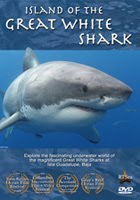
In 2005, I began filming what was to become Island of the Great White Shark, a documentary on the white sharks of Isla Guadalupe, Baja and the important working relationship that exists between the shark diving operators and Mexican researchers. It took several seasons of filming at Isla Guadalupe, returning year after year, looking to grab one more shot that was needed for editing - at least that was always the excuse. Actually, any chance I got to see these amazing predators first hand and up close, eye to eye - well, I took it.
During one particular trip to the island, during the second season of filming, I had one of those special encounters, the memory of which has stuck in my mind and I hope I never give it up. We had been seeing sharks all day and, as is the case at Isla Guadalupe in the latter part of the season, they were mostly large females. Due to the rough and tumble nature of shark mating, mature females are often badly scarred. This comes from amorous males who secure their grip on the female prior to mating by biting her around the head and gills.
On this trip, I was filming within the cage - although I use that term rather loosely. Professionally, I tend to not use a cage but in my earlier years working with white sharks I would at least use the cage as a secure platform from which I would lean out into open water to get striking close-ups of the sharks as they pass by. Familiar and, for the most part, totally disinterested in the cages or the divers inside, the sharks, however, would become curious about this large protrusion (me!) extending from the cage into their domain.
Following a lull in shark activity, I was about to surface when out of the depths below a large female rose up to see what was going on. Attracted by the scent of fish (this was before restrictions were imposed on chumming), this 16-foot leviathan came into view and she was truly magnificent. At around 3,000 pounds, she was fully mature and perfect in shape and proportions, with hardly a scratch on her - absolutely stunning. I started to roll tape, hoping I would get a shot or two before she moved on.
Her name was "Mystery", given to her by researchers who have studied and cataloged the great white sharks of Isla Guadalupe. Sharks can be easily identified by various body markings and scars. Even the pattern of gray above and white below that runs along the side of the shark's body acts like a lasting fingerprint.
Mystery was quite curious with me and provided me with a wonderful close pass right in front of my lens before sniffing the bait floating in the water and then gliding off into the gloom, out of sight. "That was a really great shot," I thought.
And then she returned. Another close pass, another swing by the bait, and then you could see her cruise just along the edge of visibility. I was beginning to get a feel for her whereabouts, her preferred movement patterns, so I could anticipate her approach and ready myself for when she either approached the bait and then swung by to take another look at me, or vice versa.
Each encounter I expected to be the last and she would then move on to more interesting opportunities. But she stayed. And for the next hour and a half, I had an ongoing love affair with a gorgeous animal, the likes of which I have never seen since. When I returned home, I had marvelous new footage to add to my documentary. Mystery became the leading lady of Island of the Great White Shark and much of the natural beauty of these animals that I was able to convey to the viewer I owe all to her.
Mystery appeared the following season at Isla Guadalupe but, sadly, I have not seen her since nor have I heard of any reports of her being seen by other divers. The great white sharks of Isla Guadalupe are pretty regular in their migrations - from the island to the mid-Pacific and back again, over and over. It's been several years since I have last seen her and I worry that she may have met her end, perhaps at the hands of poachers or illegal shark fishing operations. White sharks are protected at Isla Guadalupe and within U.S. territorial waters, but their annual migrations take them well into unprotected waters.
Mystery. She may truly be a mystery now, but the memory of our brief time together - not as predator and prey, but as two intensively curious fellow creatures - will always remain as one of the highlights of my underwater filming career.
Island of the Great White Shark is available on DVD at Amazon.com and in gift shops at several major aquariums across the country. Learn more about the film and the white sharks of Isla Guadalupe at www.islandofthegreatwhiteshark.com.
From the large and majestic humpback whale, mentioned in yesterday's post, we can travel to the other end of scale: the rare and diminutive Vaquita. Reaching a mere 5 feet in length, the vaquita is a member of the porpoise family and is only found in the northern end of the Sea of Cortez (Gulf of California). And at a scientific meeting of the International Whaling Commission being held in Agadir, Morocco, the findings of a 2008 population study show that there are only approximately 250 vaquitas alive today. As disturbing as that low number may seem, it is even more disconcerting when compared to a 1997 population study that estimated the population to be 567 - a decrease of 55% in just one decade.
The vaquita is similar to other small porpoise species that inhabit deltas and river outlets (one such species in China was considered extinct by 2007). Probably attracted to the shallows of the Sea of Cortez near the mouth of the Colorado River, the vaquita's habitat was impacted by the damming of the river in the U.S.; but researchers do not believe this has been a detriment to the vaquita. What appears to be the primary cause for the vaquita's decline is its tendency to get caught in the gill nets of local fishermen - a tragic victim of bycatch.
The 2008 population study represents the combined efforts of both Mexican and U.S. research groups with additional government support. To conduct the study required an elaborate high-tech version of a common biodiversity technique: to determine basic biodiversity, a transect is used to define an area and then sealife is counted within that area. Doing that several times over a wider area, estimates can then be extrapolated. For the vaquita population, several vessels were used to make large surface transects within which visual sightings and results from hydrophones (which picked up the distinctive clicking sounds made by the vaquitas) were tallied. From that raw data, the current population of 250 was estimated.
Although their primary range is now within a protected reserve, as of 2005, and includes a ban on the use of gill nets; the vaquitas are still very much at risk from illegal fishing. A lack of resources to provide effective enforcement combined with the economic needs of subsistence-level fishermen continue to put the vaquitas at risk. Plans are being considered to introduce fishing techniques that do not use gill nets, but getting local fishermen to abandon their traditional fishing methods will be challenging.
According to Nature News, "A more immediate challenge is to expand the protected area. 'We need to get all the gill nets out of the water,' says Timothy Ragen, executive director of the Marine Mammal Commission in Bethesda, Maryland. But a broader ban would be a difficult economic and political challenge, pitting the vaquita against the livelihoods of local fishermen."
The unique vaquita is one more cetacean that stands at the brink of extinction - not from industrialized commercial fishing or whaling, but from the needs of local fisherman trying to survive. This is dilemma being played out in many other parts of the world.
There's no Friday night partying this week; it's off to bed for an early call tomorrow as I head to the Sea of Cortez for a two-week film assignment. I will be joined by Scott Cassell of Undersea Voyager Project as we travel to Baja, Mexico's Bahia De Los Angeles. Hopefully, I will have internet access so that I can post some news and updates while on location.
In the meantime, be sure to watch the developments coming from the CITES conference which begins tomorrow (3/13) and runs through the 25th. I'm sure there will news updates and press releases on the CITES web site. Stay tuned - there are a lot of important proposals regarding threatened or endangered species.
Mexico, like many Latin American countries, is a land with a rich history but facing many challenges in today's world. There are Mexican-based conservation organizations and government agencies in charge of overseeing the country's natural resources but on some issues the general populace is either in the dark or at least has not yet been propelled to care. Other priorities considered more fundamental seem to take precedence.
This past fall, I was approached by WildCoast/CoastaSalvaje to film the great white sharks at Isla Guadalupe for Televisa SA - one of the major Latin American networks. Televisa was planning a multi-part news piece on the island, providing Mexican viewers with an inside look at this marvelous place, shielded by the Mexican government as a protected biosphere. The end result was an interesting series that placed considerable focus on the white sharks that migrate to the island and the eco-tourism and research that takes place there.
The Mexican people need to appreciate the importance of white sharks as a key component in a healthy marine ecosystem and to know that Isla Guadalupe serves as a crucial migratory hub for a sizable portion of the eastern Pacific population of white sharks. Unfortunately, you can find caught juvenile white shark for sale in Ensenada fish markets (sometimes "mislabeled" as marlin or swordfish) and the loss of these juveniles along the Baja coast serves to only further impact the decline of this important ocean predator.
I came across the program on YouTube and so here are the show segments - albeit in Spanish. If you don't speak the language, you can get the gist from the images. I was assigned to provide the underwater footage and it was a bit challenging because on this trip my proximity was confined to the cages and the sharks, while plentiful, were being a bit coy.
I will be offline for a few days as I will be returning to Isla Guadalupe aboard the Horizon to film great white sharks for WildCoast.net, Televisa SA, and Telemundo.
WildCoast.net is a California- and Mexico-based ocean conservation group that tackles a wide variety of ocean conservation issues but with a decidedly Spanish-speaking emphasis. That gets them involved in issues ranging from Baja, Mexico throughout Latin America and anywhere worldwide where a Spanish-speaking perspective can be effective. Televisa SA is one of Mexico's largest broadcasters and Telemundo services Hispanic U.S. and Mexican communities and all through Latin America.
WildCoast.net is working with these broadcasters to promote stories about shark conservation and shark ecotourism. While there is not a major market for shark fins in Latin America, there are commercial operations that engage in shark finning to meet Asian demand. Within their borders, there is primarily a limited demand for shark meat and then there is the greater lost tourism dollars from shark ecotourism when compared to the value of a dead shark. Along the coast of Baja, juvenile white sharks are caught for their meat and teeth; because of the white shark's slow rate of reproduction, this can have a profound impact on overall populations.
Whether or not a country is a major consumer of shark products, it's important that everyone understands the critical and necessary role that sharks play as ocean predators and scavengers. The oceans can't do without them.
Here is a prime example of dropping the ball - or maybe it's a case of turning a blind eye. The above picture was taken at an Ensenada fish market in Baja, Mexico. What you see is juvenile white shark being marketed as marlin or swordfish. Local Mexican fishermen having been illegally catching juvenile white sharks along the Baja coast - disastrous not only because of the loss of the shark but its reproductive potential is also lost for good.
So why "dropping the ball"? Because just a few minutes away from this market are the offices of the governmental agency that oversees the environmental Biosphere program, not to mention other marine-related academic organizations - and not to mention local law enforcement agencies.
Some of the fish markets are now removing the tell-tale shark skin to help further disguise their illegal catch. According to SharkDiver, this has been going on for some time without any government intervention or enforcement. When governments pay lip service by instituting regulations without the required support and enforcement, the sharks lose . . . and we lose.
On 05/20/07,RTSeawrote: This past week, I was watching a segment of the Today show, a U.S. morning news program, that examined the famous annual migration of the Monarch butterfly from the eastern U.S. to one particular spot in Mexico: millions of butterflies swarming together deep in a Mexican forest. An amazing sight but one that is also in jeopardy due to illegal tree-cutting that is shrinking their available habitat.
Oddly enough, these same insects reminded me of the great white sharks that inhabit Isla Guadalupe off the Baja coast during the months of September through December. There are actually strong similarities between these magnificent sharks and the Monarch butterfly. The great white sharks return to Isla Guadalupe after a long migration, one that has been suspected to include stops at deep seamounts in the middle of the Pacific Ocean. After their long journey, they come to feed on the island"s tuna and seal populations. But the similarity goes beyond their remarkable migrations.
The other tragic similarity is that both of these creatures are endangered: the butterfly from a potential loss of habitat, and the shark from hunting for fins, jaws, and teeth. At the present time, there are laws on the books to protect both, but the Mexican government is painfully short of resources to enforce the laws it has enacted. Several years ago, the Mexican government declared Isla Guadalupe a "protected biosphere" and last year laws were put in place to outlaw the taking of great white sharks, in addition to several other elasmobranchs, in and around the island. All well and good, however, Isla Guadalupe is a rugged and remote island 150 miles west of the Baja coast and the Mexican authorities are in no position to station a vessel or personnel there during the months the sharks appear. Rather than let it die as an empty promise, this is where the citizen activist can play a role.
Eco-tourism companies, like SharkDiver.com, have been working closely with scientific researchers from Mexico and the U.S. who have been studying the population and behaviors of the sharks at Isla Guadalupe. While providing people the opportunity to see great white sharks from the safety of protective cages, these operations have also been providing research teams with logistical support and supplies. It is a unique working relationship that has proven itself successful for several years. Self-serving, you say? Perhaps to a degree, but in that respect, it serves as a perfect example of how business and science can work together towards a common environmental goal. And as a filmmaker, I have worked closely with several of these organizations and can attest to their genuine concern for the fate of the great white shark - not as a potential cash cow, but as another endangered species that we cannot afford to lose.
In lieu of a lack of resources to enforce the laws protecting the great white sharks at Isla Guadalupe, the Mexican government needs to tightly restrict the number of permits that allow boats at the island: if you can qualify and quantify your willingness to, both, support scientific research and act as ad hoc enforcement, then you can be considered for a permit. In essence, when there are not enough sheriffs, then form a posse. Not all shark diving operations are so environmentally committed, so only the dedicated companies would qualify. But this would be better than an all out ban, as there would then be no one watching out for the sharks.
Mexico is now beginning to send patrols deep into the forest jungle to ward off tree poachers (it amazes me that these poachers are able to get away with it; we are talking big trees here). If the Mexican government is unable to provide the naval vessels or crew to regularly patrol the waters around Isla Guadalupe, then a small number of dedicated eco-tourism vessels would seem a viable alternative - a way to give well-intended legislation a little teeth, pardon the pun.
The RTSea Blog was started in 2008 and now includes over 950 entries available for media or academic background research use, including observations on a wide range of topical issues and events involving the oceans, sharks, and nature in general. After a brief break in 2012-13, there will now be more posts forthcoming.
Use keywords in the Search tool below or at the bottom of this web page to locate articles of interest.
Cinematographer/media consultant & producerRichard TheissandRTSea Mediaadministers this blog with the intent that information will be disseminated across the Internet and, in so doing, will illuminate others as to the serious challenges that lay before us in preserving and protecting our natural resources.
Search This Archive
Richard Theiss - DP/Media Consultant & Producer
Available for HD video assignments, media consulting, and speaking engagements. For contact information, click on the image above.

 In 2005, I began filming what was to become Island of the Great White Shark, a documentary on the white sharks of Isla Guadalupe, Baja and the important working relationship that exists between the shark diving operators and Mexican researchers. It took several seasons of filming at Isla Guadalupe, returning year after year, looking to grab one more shot that was needed for editing - at least that was always the excuse. Actually, any chance I got to see these amazing predators first hand and up close, eye to eye - well, I took it.
 Each encounter I expected to be the last and she would then move on to more interesting opportunities. But she stayed. And for the next hour and a half, I had an ongoing love affair with a gorgeous animal, the likes of which I have never seen since. When I returned home, I had marvelous new footage to add to my documentary. Mystery became the leading lady of Island of the Great White Shark and much of the natural beauty of these animals that I was able to convey to the viewer I owe all to her.