Today, we are experiencing a significant environmental and ecological movement, and well we should, as more and more evidence of our poor stewardship of earth's natural resources continues to mount. But for many movements there is a maturation process that is occurring where we are moving beyond building an emotional groundswell of awareness to realizing concrete, quantitative results. And that means developing successful strategies that can ward off intransigent corporate interests and get decision-makers to do what we elect them to do - to look out for the best interests of their constituencies.
While we look to others for tangible results, there are still personal decisions that we can make which can have an impact. Here are a couple that I came across.
Phosphate-Free Detergent Ever wonder how your dishwasher gets your glasses sparkling free of spots? Phosphorus - one of those better-living-through-chemicals that binds to food particles and minerals, allowing dishes to rinse off free of residue. As much as a third of the phosphorus that makes its way as treated wastewater - which ends up in rivers and other waterways - comes from dishwasher detergent. The rest comes from fertilizers and our own body waste.
The problem with phosphorus is what it does in open water. It stimulates the growth of algae and this, in turn, impacts other aquatic life by either forcing them out in a territorial tug-of-war or by depleting the oxygen levels in the water - one component to the oxygen-free "dead zones" you may have read about.
Phosphorus detergents are slowly being phased out in many countries and U.S. states. But it has been a slow step-by-step process as chemical companies push hard to resist. By choosing to purchase phosphate-free detergent and living with a spot or two on your wine glasses, you are not only doing your part to protect the environment but you are telling the chemical companies, through the marketplace, how they need to adapt their business models to changing realities.
Plastic Bag Ban in Los Angeles County In the United States, the groundswell toward banning the single-use plastic bag is in its infancy but slowly making progress. The Los Angeles Board of Supervisors has initiated a plastic bag ban in unincorporated areas under its control which should produce an annual reduction of 600 million bags.
Several other cities have tried for bans and seen them defeated due to the concerted efforts of plastic bag lobbyists, so plastic bag ban supporters learned from those mistakes and focused less on the big picture issues of greenhouse gases and ocean pollution/biodegradability associated with plastic bags. Instead, they built convincing arguments regarding local pollution/litter, contaminant-free reusable bags, the failure of plastic bag recycling programs, and the right of stores to charge customers a modest 10-cents for recycled paper bags.
As these represent the efforts of environmental organizations and politicians, what should be our personal contribution? Support. At the very least, ask for paper bags instead of plastic when you go to the market. Use reusable cloth bags when you can (make sure they can be easily washed or disinfected). Keep one in your car for those unplanned runs to the store which often result in one more small plastic bag entering the environment.
But aren't single-use plastic bags convenient? Sure they are. However, it is a convenience that we are now seeing takes a heavy toll on the health and aesthetic appearance of the environment - from floating garbage patches at sea to roadside eyesores.
Favor Buying Farmed Fish While international organizations work to limit the catches of dwindling species like tuna, swordfish, and many, many others, we can lend our support by buying farmed fish whenever we can. Commercial fishing, like many other industries, is slow, if not outright resistant, to the necessary transition from fishing to farming. The idea that a particular species will literally disappear does not resonate within the industry as well as changes in market demand does.
The logic behind aquafarming is simple, really. Imagine where we would be today if there was no cattle ranching or chicken farming - all beef and poultry came from what was caught right out of the forests and fields. What do you think those wilderness areas would look like today? Raising cattle and poultry was inevitable to meet the demand of a growing population. It wasn't without its problems or issues but it was better than a land devoid of animal life.
It's the same situation with seafood, with one crucial difference. That being, we can see what is happening on land but we don't see what is happening beneath the waves. And so, one after another, commercial aquatic species are facing literal extinction. Aquafarming is not without its problems. But if the market demand is there, the solutions will follow if for no other reason but to make it sustainably profitable. I hope to touch on some of those in future posts.
We turn to the policy- and decision-makers to take the steps necessary to secure a future for the planet and the generations that will inhabit it. But we must be prepared to show them that we can change our personal behaviors to fit a new appreciation of our limited resources.
Read about phosphorus in TIME. Read about L.A. County's plastic bag ban at Heal The Bay
Just this past September I reported on a sea jelly invasion in Monterey, California. For a good portion of the late summer, the popular central California ocean community was beset with west coast sea nettles - beautiful to look at but potentially painful, given the numbers that were accumulating from the bay right up to the shoreline.
Another high concentration of sea jellies recently occurred at Ocean Beach, located near San Francisco. This time it was thousands upon thousands of moon jellies that had washed up on the beach overnight this past weekend. But in this instance, it was not so much an invasion as it was a freak occurrence linked to a cyclical event.
Moon jellies are one of the more prolific of all jellies. A popular attraction at many aquariums, they are relatively easier to breed, compared to other species, and do not pose a threat to humans. In the fall, they can have large spikes in their populations along the eastern Pacific coast. These sea jelly "blooms" can go unnoticed for the most part, unless the right tidal and wave conditions push the floating moon jellies ashore. Which is apparently what happened this past weekend.
Gary Williams, a researcher of invertebrates at the California Academy of Sciences described it as a "regular event," “Jellyfish cluster in massive blooms well offshore that we rarely see. But sometimes, with just the right combination of wind and currents, those blooms wash ashore.”
As relatively common as the moon jelly is, there is surprisingly little we know about them. The when, where, and how of their reproduction habits is still predominantly a mystery. Because of that, it makes it difficult for scientists to attribute any apparent rise in population to outside factors such as climate change.
However, further south from San Francisco in San Diego, California, a rare black sea nettle has been making more frequent appearances along that Southern California coast. Actually deep purple in color, the black sea nettle is much larger than the west coast sea nettle, reaching 3 feet across and with up to 30 feet of trailing tentacles.
Though not yet seen in invasion-size numbers, the black sea nettle, according to some oceanographers, could be increasing in numbers due to warming temperatures or a consistent increase in the primary food source, plankton - which also "blooms" with warmer water temperatures.
Beautiful, fascinating, and in many ways a mystery, sea jellies are basic predatory invertebrates (and, technically, by definition not a fish - as in "jellyfish"), simple in structure with no brain or heart but exhibiting behaviors that have yet to be fully explained.
Read about San Francisco's moon jelly stranding. Read about San Diego's black sea nettle.
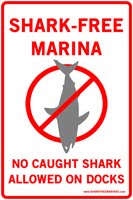
The Shark-Free Marina Initiative (SFMI) - an organization devoted to shark conservation measures by focusing on eliminating caught sharks from marinas, thereby incrementally ridding the taking of sharks for contests, trophy records and photos, and basically anything else associated with bringing in landed sharks - continues to grow by bringing on major sportfishing marinas as "shark-free."
The Bahamas Weekly recently reported that the Bimini Bay Resort is now a member of SFMI (see excerpt below). SFMI was the brainchild of SharkDivers.com and has been directed with great success by Luke Tipple. SFMI is now supported by the Guy Harvey Ocean Foundation and the Humane Society of the United States. While not the end all for protecting sharks, the Shark-Free Marina Initiative does achieve significant progress in both making a dent in the number of sharks taken for sportfishing and in developing new attitudes among all patrons of participating marinas - sportfishermen, boaters, and tourists - regarding shark conservation.
Bimini Bay Resort Joins The Shark Free Marina Initiative By Danielle Dunfee 11/11/10 Bimini Bay Resort announced its voluntary participation as the third marina resort in Bimini to join the Shark-Free Marina Initiative (www.sharkfreemarinas.com) whose purpose is to focus on the importance of reducing worldwide shark mortality. Bimini Bay Resort now prohibits the landing of sharks at its marinas and pledges to work in tandem with its sport fishermen to develop protocols under which threatened species of shark are permitted to recover and replenish their populations. As a leading employer of Biminites on the island, Bimini Bay will work to create and enforce community-conscious awareness of the need to protect Bimini’s sharks and waters. “One of our main focuses in 2011 will be to encourage responsible use of our ocean,” stated Rafael Reyes, President of Bimini Bay Resort.
The Shark Free Marina Initiative works with marinas, fishermen and non-profit groups to formulate community conscious policies and to increase awareness of the need to protect sharks. Currently 60 to 100 million sharks are slaughtered worldwide each year, which in turn poses a serious threat to the health of the earth’s oceans. Over the last five years, the United States recreational fishery has harvested an average of 500,000 sharks per year.
Bimini Bay’s participation in the Shark-Free Marina Initiative takes the Bimini Islands unanimously one step closer to this marina initiative; a boon to the shark populations of the area and to the Bimini Biological Field Station. Bimini is home to healthy shark populations and to the Bimini Biological Field Station. Informally known as the Shark lab, the Bimini Biological Field Station on South Bimini is a world-renowned research facility whose subjectsof study are the many species of sharks in the unique habitat of the Bimini’s North Sound and Bimini's surrounding waters.
Click here to visit the Shark-Free Marina Initiative web site and become an SFMI Ambassador.
As a follow up to my post on wobbegong shark behavior: researchers in Ireland are studying their resident populations of basking sharks and, as with the wobbegong studies, are able to draw conclusions on changing environmental conditions based on changes in animal behavior.
At the 14th European Elasmobranch Association conference held in Galway, Ireland, marine biologists and shark experts from across Europe gathered to discuss the state of shark populations and consider new research techniques to better understand the fate and future of sharks and rays worldwide. Irish researchers who have been working with Ireland's National Parks and Wildlife Service, presented their study which indicated that a high percentage of the remaining number of basking sharks move through Ireland's local waters.
Basking sharks are typically a cold water species and the second largest fish on the planet, topped only by the whale shark. Like the whale shark, the basking shark is a filter feeder, opening its cavernous mouth to strain hundreds of gallons of water, searching for zooplankton - a collection of tiny creatures including larval or minute juvenile forms of fish, mollusks, and crustaceans. Zooplankton are sensitive to changes in the aquatic environment, such as temperature changes due to global warming or changes in oxygen levels or pH, which can occur in response to acidification. Where the zooplankton go, so go the basking sharks.
“Tracking basking sharks may be far more effective than tracking zooplankton, and [may] provide one of the best indicators of the health of our seas and thus the planet,” said Dr. Simon Berrow, the study's group leader.
Extensive tracking of basking sharks has taken place off of Ireland, replacing the intense hunting that used to occur as the basking shark was prized for its sizable supply of shark oil. Worldwide estimates of basking shark populations have been placed as low as 20,000. Extrapolating population estimates from the 250 sharks that have been tagged, the study claimed that there are probably several thousand that frequent the cold waters off Ireland's coast, making the island nation a prime location and home for an increasingly rare shark species.
One of the more unusual sharks found throughout the temperate and tropical waters of the western Pacific Ocean is the wobbegong. A bottom-feeder, the wobbegong has camouflaging motley coloration and frilly appendages around its mouth that some believe act as a lure for unsuspecting prey.
While the populations of various shark species that cruise the reefs can be used as a barometer as to the overall health of the ecosystem, according to researchers in Australia, the behavior of the wobbegong can also be used as an indicator of a healthy environment. By studying the behavior and understanding what geographical or habitat factors determine that behavior, then any recorded change in behavior may point to changes in the marine environment.
Dr. Susan Theiss of the University of Queensland has studied the light sensitivity of several wobbegong species and how different sensitivity establishes different levels of activity. She reported, "It appears that the wobbegong species we studied have different visual adaptations that could be linked to times of increased activity. For example, the spotted and dwarf spotted wobbegongs are probably more active in low-light conditions such as night time, or in the early morning or late afternoon, whereas the western and ornate wobbegongs are visually suited to a range of light conditions."
Professor Shaun Collin of the University of Western Australia, who also worked with Dr. Theiss in the study, said, "Almost nothing is known about the behaviour of wobbegongs, but what our research on the visual systems can do is predict their behaviour, so we look at the shark's visual system at the level of the photoreceptors, which are the cells that detect light. If you see these common species interacting and behaving normally in a particular environment, this can be a good indicator of the health of that part of the ocean."
Marine biologists study the role that sharks play as predators and scavengers in maintaining a healthy marine ecosystem. Declining shark populations, due to commercial overfishing, can have pronounced effects on the ocean environment - from changes in the health of other fish species to degraded water quality and even reduced oxygen levels. By monitoring the behaviors of animals like the wobbegong shark, researchers gain insight into how animals respond to changes in their environment.
"This research is important in establishing general trends and predictions in biogeography and ecology that we don't yet have data for,"Dr Theiss said.
Oh, and yes, we are related. I am her proud uncle. Dr. Theiss is a U.S. national working for the University of Queensland and I someday hope to get across the Pacific and have her show me some of her frilly-mouthed friends first hand.
Fiddler crabs are small but striking members of the salt water marsh community. They are also a perfect example of the roles that different species play within a particular ecosystem and how these roles form a complex web of interdependency.
There are actually some 96 different species that fall within the fiddler crab genus. Reaching a maximum of only two inches, the fiddler crab gets its name from its disproportionately larger claw and how the crab uses it during feeding in what appears to be a violin-playing like motion. The claw is actually used for signaling potential mates as part of a "hey, look at me" courtship behavior in addition to battling possible rivals during the courting process. If the crab loses its large claw to a predator or a rival suitor, it will grow back but only as a much smaller claw. However, as if to make up for the loss, the crab's other smaller claw will increase in size.
Fiddler crabs feed by filtering sand and ingesting any algae, fungus, microbes, or detritus it finds. In so doing, it plays an important role in cleaning and aerating the salt marsh sediment. Unfortunately, being such a small crab makes it a delicious morsel for other predators, so the fiddler crab population is kept in check by shore birds, fishes, and larger crabs.
While adult fiddler crabs make a home by burrowing in the sand, the juvenile crab seeks shelter by using an empty snail shell, much like the hermit crab. But whereas the hermit crab carries its protective housing with it, juvenile fiddler crabs simply use the empty shells as temporary shelter. A recent study by researchers from the Georgia Southern University in Statesboro (United States) found that with every 100 snail shells, almost 80 would typically have baby fiddler crabs inside.
"Small mammals and reptiles feed on fiddler crabs as they move across the salt," said Prof. Sophie George, the study's leader. "An abundance of Littoraria irrorata [snail] shells [provide] a welcome refuge for juvenile fiddler crabs."
So, the tiny fiddler crab plays important functions both as a filter feeder of marsh sediment and as a prey item for other animals within the community. And its success depends on the presence of snails which provide sustenance to some predators and a temporary home to the juvenile fiddler crab.
Such is the complexity of nature's ecological web. Read more about the fiddler crab in the BBC Earth News.
"Data for data itself is not very powerful. When data turns into information, it's very powerful. But if it only has a limited audience then it has a limited effect. And so, you have to get that information to the people that make decisions." - Ed Cassano, CEO, InMER.org
To implement a media communications plan to support any scientific research project, it must be considered a vital component of the project, not an afterthought. It needs to be included in the early planning stages - hypothesis, methodology, logistics, analysis, and media communications. Depending on the nature of the project and the type of communication plan chosen, documentation and distribution of information could be ongoing throughout, as opposed to a "now that we're done, let's talk about it" approach. This could entail press releases, blog postings, or several other communication channels that can provide expedition updates.
Does this tack pose the hazard of discussing results prematurely, letting the cat out of the bag as it were? Not necessarily. A lot depends on how the communiques are fashioned and how true to scientific objectivity the project is trying to maintain. In any event, whether communication is distributed during the project or not, it must at least be involved from the get go to insure that all appropriate documentation takes place for future use.
Establishing a New Paradigm Realistically, some media communication strategies would be less robust than others based on the specifics of the project. A study of, say, oceanic temperature variations throughout the Arctic over an extended historical period may relate to broader themes and issues than a project devoted to the migration patterns of one particular species of insect along the Arctic border. The former could more easily connect with an audience on the larger issue of global warming than perhaps the latter.
For research that has a more narrow or specific focus, cooperative consolidation with other researchers can help in bringing together similar or related data that can then be communicated under a unified topic or issue. However, this requires a new paradigm shift in thinking for many researchers and their supporting academic institutions. A protective, insular attitude often exists regarding research sites and data to insure maximum credit and attention is paid to those who have worked so hard to either conduct or fund a particular research project.
Given the types of limited communication strategies that have existed in the past (typically, a published paper followed by a press release and perhaps a lecture or two), these kind of self-centered attitudes are understandable but not productive when one considers the broader, global effects that the data can have in addressing critically important ecological issues. With cooperative consolidation, combined with a more proactive media communication plan, a greater good is served at a time when it is most needed and equal credit can be bestowed on all of the participants, from which all will benefit.
When I have spoken with scientists and researchers about this new paradigm, their enthusiasm becomes palpable. You can see the spark that originally ignited their love for exploration and scientific study suddenly burn bright again. But it can be fleeting. "Sounds great but that's not how the system works." "It's what we should be doing but our university just won't go for it." The challenge is in finding and supporting those who will be the drivers, the leaders, of this new way of thinking.
Bucking the System Change will need to come from the top down. Whether demanding more effective, proactive media communication and outreach strategies or reshaping the system through cooperative consolidation, those who will change the system will be the ones at the top of the pyramid - in many cases, that means the funding sources.
As a media communications consultant and filmmaker, I am more than prepared and willing to assist any organization in reaching broader audiences. However, truth be told, my position is near the bottom of that pyramid. My interests are both global and self-serving and I am a support member to the project team, albeit one with unique expertise. The scientists or researchers are farther up the pyramid, with much greater influence, but they have others to answer to who may be less willing to change established protocol.
Change will come from those who greenlight these projects, whether it's private foundations, universities, investors, or government agencies. The National Science Foundation (NSF), one of the leading sources of scientific research funding in the United States, now requires an outreach component in all grant proposals submitted for consideration. Coming from a major government-supported funder of research projects, this is a significant step.
Some of the major NGOs (non-governmental organizations) - like Conservation International, Oceana, WildAid, and others - are making great strides in combining scientific research projects with their own fund-raising operations and international outreach efforts. Seaweb directs their specific resources towards issuing newsletters that include collections of abstracts from published scientific studies - although not "translated" for the general populace, imagine receiving 25 to 35 abstracts on, say, climate change or commercial fisheries each and every month. Would these issues be less questioned if the information was proactively disseminated?
We could very well be on the cusp of a major change in expectations from funding agencies. With media communication strategies designed to reach greater audiences, supporters of scientific research will benefit from increased return on investment (ROI), to borrow a term from the business world.
And why shouldn't they? In today's world of limited economic resources, funders are willing to invest more in projects that will further educate target audiences, generate more quantitative and qualitative results (like shifts in public opinion or changes in government or international policy), and bring greater recognition to the supporting organization itself. They expect more than a published paper that ultimately collects dust on a shelf. With ecological and environmental issues pressing down on us, the stakes are too high to demand anything less.
Scientific Research - Time to Reach Out Having been scuba diving for over 25 years, I have seen the decline in marine habitats, both locally and worldwide. Working in television commercial production and corporate marketing communications for several decades, I came to appreciate the power of the message in reaching a variety of audiences.
Now, as I focus on conservation issues at this stage of my life, deep down in my own personal, ideal world, I visualize a future where messages on coral reef protection share digital signage space with sales at Bloomingdale's at the local shopping mall; where protection of our natural resources is as much a part of our day-to-day psyche as is pondering what we shall have for dinner. A fanciful dream perhaps, but there is no time like the present for science to begin moving in that direction. And media communications can help do that.
Media communications can:
Reach those who can/should demonstrate change through personal awareness
Bring forth issues to policy- and decision-makers for direct action
Provide exposure which can open doors to other research opportunities
Generate a better qualitative return to facilitate future funding
Throughout history, science has often lead the way in innovation and advancement, but today the world is faced with serious issues that require comprehension and consensus among peoples, their leaders, and their economic interests. Science can provide many of the answers to these pressing issues. However, to do that requires information - ready available, understandable information.
About the author: As media producer, filmmaker, and marcomm consultant, Richard Theiss has provided high definition images for broadcast networks and non-profits in addition to developing and implementing marketing strategies for multi-billion dollar corporations. From sweeping Arctic vistas to pensive human interaction to the power of the great white shark, Richard Theiss/RTSea adheres to the principle of "Making the Message Matter."
Over the years, government wildlife agencies have found themselves in the difficult situation of dealing with encroaching predators. Environmental changes to habitat or food supply or urban development have often pushed predators like coyotes into greater proximity with other animals and humans. It's not the predator's fault, but what to do when a coyote is feeding on local pets or commercial livestock?
Catching the animals in traps or hunting them to anesthetize and then relocate them can be logistically complex and sometimes meets with limited success as the predator often returns because the conditions that brought about the encroachment have not changed.
Poison has been a measure of last resort, but it brings with it tremendous risk to other unintended victims including endangered species like wolves and condors, not to mention domesticated pets and even humans. The Defenders of Wildlife is bringing the issue to the EPA as the poisons that have been used are extremely toxic and there is a question as to how well the placement and management of bait traps has been handled. The non-profit group - which focuses primarily on wolves, bears, and other threatened predatory mammals - has initiated a campaign to get the EPA to halt the use of two of the most common toxic compounds used by the U.S. Department of Agriculture's Wildlife Services: sodium cyanide and sodium monofluoroacetate (known as Compound 1080).
Here is an excerpt from their write-in campaign: "As someone who is concerned about the safety of people, pets and wildlife, I strongly urge your agency to ban sodium cyanide and sodium monofluoroacetate (commonly called Compound 1080).
Sodium cyanide and sodium monofluoroacetate are considered to be some of the deadliest toxins known to humanity. Yet, Wildlife Services, a program of the U.S. Department of Agriculture (USDA), regularly uses these two poisons to kill coyotes and other predators. In 2009, the two poisons killed an average of 1.5 animals every hour. In many instances, these deadly poisons are deployed on public lands.
But these poisons don't just threaten their intended targets. They can also poison any threatened or endangered species, people or pets that happen to come into contact with them.
Sodium cyanide is used in M-44 trigger traps, which kill more than 10,000 animals each year, including domesticated dogs and a whole host of other non-target species including kit foxes, ringtails, javelinas, and swift foxes. M-44s have also killed California condors and wolves.
Compound 1080 is classified as a chemical weapon in several countries. It is deployed in poison collars placed on sheep and goats and is highly toxic to birds and mammals. Carcasses with Compound 1080 must be handled as hazardous waste and, if ingested, can kill wolves and other animals. Compound 1080 has even been used to illegally kill wolves and people's pets.
The continued availability of these poisons poses a threat to people, pets and homeland security. Government reports have concluded that Wildlife Services has been unable to account for stockpiles of the toxins, which leaves the hazardous materials vulnerable to undetected theft and unauthorized use.
There are effective alternatives to these poisons, including a wide range of proactive, nonlethal methods for protecting livestock such as fencing, guard animals, fladry, non-lethal ammunition and improved animal husbandry.
For the safety of our people, our pets and our wildlife, I strongly urge you to ban the use of sodium cyanide and Compound 1080."
You can visit the Defenders of Wildlife website to learn more about this situation and how you can participate in voicing concern of the use of these poisons.
Developing a Strategy There are many pieces to a media communications strategy and no two plans are alike. Though there can be a methodical process to building it, the end result should be unique to each project. A good starting point is to explore three fundamental and interdependent questions: what you want to say, how you want to say it, and to whom?
The first question we'll explore in more detail shortly. "How you want to say it" opens the door to a vast array of communication vehicles at your disposal. Besides the traditional academic paper, there are solicited or self-written articles for non-academic publications, summary brochures or booklets, press releases, media opportunity announcements, educational curriculum materials, books, direct mail, email, informational websites, blogs, and many, many more. And that's just in the print medium.
Then there are the visual arts: photographs, slide/"powerpoint" presentations, lectures/speaking engagements, videos/films - either for broadcast, online, or DVD/download distribution, PSAs (public service announcements), webcasts and podcasts, retail digital and outdoor signage and, again, many more. Combined with other high-tech distribution methodologies and outlets, there is a seemingly endless number of avenues to pursue.
But you can't have it all. Some of the determining factors in narrowing down the field to the most appropriate communication channels can be resources (the almighty dollar), time, and even the participants themselves. Is the project best served by having the project members before the camera, before live audiences? Can they be another Carl Sagan? Or should there be qualified stand-ins or representatives; or should the data simply speak for itself?
Tied in very closely with all of this is the question of to whom you want to say it. Basically, who it is you are trying to reach. In the business world, this is referred to as identifying your markets. A company considers the best way to reach its different market segments - and a scientific research group developing an outreach program would be doing the exact same thing. Do you wish to reach politicians and other policy- or decision-makers? Adults? Men or women? School kids? Younger children? National or international audiences, particularly ones with different or even opposing cultural perspectives? Even if your decision was to reach all of the above, careful consideration must be given as to how best to speak to each group.
Data Translation: What did he just say? "In polar bear plasma samples no binding of [125I]-T4 to TTR was observed after incubation and PAGE separation. Incubation of the plasma samples with [14C]-4-OH-CB107, a compound with a higher binding affinity to TTR than the endogenous ligand T4 resulted in competitive binding as proven by the appearance of a radio labeled TTR peak in the gel. Plasma incubation with T4 up to 1 mM, a concentration that is not physiologically relevant anymore did not result in any visible competition." - excerpt from a study abstract.
What you want to say usually requires translation. The language of science can be precise and detailed. It can also be obscure and arcane to a non-scientific audience. A media communication strategy succeeds only when it is able to relay a message, a story, to a particular group of people on a level that can be easily understood and appreciated.
However, this does not mean that one must appeal to a lowest common denominator, to "dumb it down" as it were. An effective translation is, in a sense, not a vertical exercise but a horizontal one. You are sidestepping from one language to another. I never underestimate the capacity of any audience to grasp complex subjects. The difference is in the steps one takes to lead the audience to the conclusion you want them to comprehend.
There are exercises that I take a client through to distill the data down to an easily understood message. While which exercise I choose may depend on the nature of the project or the people I am working with, all have a common trait: they are simple but repetitive, running the data through a linguistic filter over and over again until you are left with just the valuable nuggets of information.
Often, the desired message is one that is relevant to the audience, impacting their lives and provoking some sort of response or action. In advertising, this is the "call to action" - what gets someone off of the couch to order the chrome-plated swizzle stick and deep fryer combo shown on TV. But it must never be deceptive or misleading (as can be the case in some advertising). This is critically important. The data depended on scientific accuracy and precision; a successful message depends on credibility and integrity.
It is important that any scientist or group of scientists, who wish to enlist the aid of a media communications specialist, have a good working relationship and a clear understanding with their media counterpart. Veteran nature film producer Chris Palmer described it in his book, Shooting in the Wild, when discussing ethical film making, "It's important to choose partners carefully. Before they begin, the parties need to agree on both the goals of the project and the most ethical way to accomplish them. If a film tells a scientist's story well, it's easier for that researcher to find funding for further study and to cultivate a scientifically literate public."
Three Message Goals Often when the data has environmental or ecological significance, a good message can be derived by focusing on three sequential goals: issues, implications, and solutions.
The media communications expert works with the scientific team in translating the data and its results into clearly defined issues. What is at stake here? What does this mean to the audience we are addressing? One might think that it would be fairly obvious and easy to glean from the research, and most of the time it is. However, there are situations where the data is so observational, it takes time to define the conclusions that will resonate with a non-scientific audience.
Issues lead to implications. This is where the message, in essence, becomes personal. One of the best ways to get the attention of any group is to show how an issue will effect them personally. For the most part, mankind is a pretty self-centered species. And conservation or environmental issues can seem remote or obscure until the implications to our day-to-day lives can be shown. Research can often identify a cause and effect - that's the issue. But in that complex puzzle we call nature, one effect often cascades into another and another; and from there implications can be ascertained. Part of the success of Vice President Al Gore's slide show presentations and subsequent documentary, An Inconvenient Truth, was his ability to take the data and present it as issues and then implications, many of which jarred the viewer into realizing the seriousness of global warming.
Providing solutions is where the call to action comes into full force. Without solutions, the message then is driving the audience right into a brick wall: What are we to do? What should our political or business leaders be doing? How can I help? The solutions can be specific, directed towards individual or governmental action, or they may simply infer a direction for others to pursue. In any case, providing solutions is as equally important as presenting the problem.
In the opening passage to this article (Part 1), the importance of a message's issues, implications, and solutions was expressed, ". . . unsure of ourselves without a clear understanding of what is happening and what is at stake. But science can illuminate the future of this planet."
What is happening: issues. What is at stake: implications. Science can illuminate: solutions. Three fundamental components to an effective media communications strategy.
One of the great learning tools is engagement and, unfortunately, conservation issues are sometimes hampered by the inability of people to truly feel engaged or appreciate what may be happening in a distant part of the world, say the Arctic for instance.
The issue of polar bears and what is threatening their existence due to warming Arctic temperatures, will be brought to light in a series of live webcasts being staged by Polar Bears International. Called Tundra Connections, the 30 scheduled webcasts started on October 28th and will run to the end of November. Viewers will be able to log on and ask, in real time, questions of the research scientists and conservationists that are monitoring the polar bear migration in Churchill, Manitoba, Canada.
There will be a wide range of people involved: zoologists and other experts on polar bears, climatologists to discuss the impact of climate change on the Arctic, even legal advisers from the Center of Biological Diversity. Check out the Tundra Connections website for broadcast dates.
Speaking of the Arctic, NOAA has released its Arctic Report Card 2010 and it still shows that grades are slipping in the areas of sea ice, long-term climate change, and weather pattern disruption. While the Arctic still experiences warm/cold cyclical temperature patterns that can temporarily alter ecosystem patterns, the overall trend is still towards warmer temperatures.
NOAA reported that this year was the shortest duration of Arctic snow cover since record-keeping first began in 1966. And areas like Greenland continue to experience significant ice and glacier loss. With more fresh water mixing into the Arctic's oceans, everything from algae growth to fish populations to currents gets disrupted.
The Arctic regions are experiencing polar amplification whereby, with more sea ice melting (sea ice that would normally reflect sunlight), more dark exposed ocean now absorbs sunlight which accelerates the warming process. A by-product of this effect is changes in polar winds. Pushed southward, these cold winds can produce colder winters in mid-latitudes - making some people wonder how can there be global warming when I'm freezing? Just ask a polar bear.
The RTSea Blog was started in 2008 and now includes over 950 entries available for media or academic background research use, including observations on a wide range of topical issues and events involving the oceans, sharks, and nature in general. After a brief break in 2012-13, there will now be more posts forthcoming.
Use keywords in the Search tool below or at the bottom of this web page to locate articles of interest.
Cinematographer/media consultant & producerRichard TheissandRTSea Mediaadministers this blog with the intent that information will be disseminated across the Internet and, in so doing, will illuminate others as to the serious challenges that lay before us in preserving and protecting our natural resources.
Search This Archive
Richard Theiss - DP/Media Consultant & Producer
Available for HD video assignments, media consulting, and speaking engagements. For contact information, click on the image above.

 Today, we are experiencing a significant environmental and ecological movement, and well we should, as more and more evidence of our poor stewardship of earth's natural resources continues to mount. But for many movements there is a maturation process that is occurring where we are moving beyond building an emotional groundswell of awareness to realizing concrete, quantitative results. And that means developing successful strategies that can ward off intransigent corporate interests and get decision-makers to do what we elect them to do - to look out for the best interests of their constituencies.
 Several other cities have tried for bans and seen them defeated due to the concerted efforts of plastic bag lobbyists, so plastic bag ban supporters learned from those mistakes and focused less on the big picture issues of greenhouse gases and ocean pollution/biodegradability associated with plastic bags. Instead, they built convincing arguments regarding local pollution/litter, contaminant-free reusable bags, the failure of plastic bag recycling programs, and the right of stores to charge customers a modest 10-cents for recycled paper bags.