Showing posts with label Bahamas. Show all posts

Monday, May 27, 2013

Filmmaker's Journal: Oceanic whitetip sharks


Filmmakers and avid amateur underwater photographers are constantly on the prowl for new locations and new species to document.  This holds true for those interested in sharks, too.  Either on assignment or as part of a stock footage expedition, I have been to Isla Guadalupe, Baja to film great white sharks at least 16 times and I have been to Tiger Beach, off Grand Bahama, around eight or ten times.  And while I have more footage of white sharks, lemon sharks, and tiger sharks, and other species than I know what to do with, I usually jump at the chance to see these incredible animals one more time.

One shark species that I had not had the pleasure of seeing face-to-face, was the oceanic whitetip.  This shark is a pelagic predator, which is to say that it spends most of its time in open water, far away from shore.  It has the reputation of being in the top four of the most dangerous sharks (along with the great white, tiger, and bull shark) as it was typically associated with shark attacks during World War II following the sinking of ships in tropic waters.

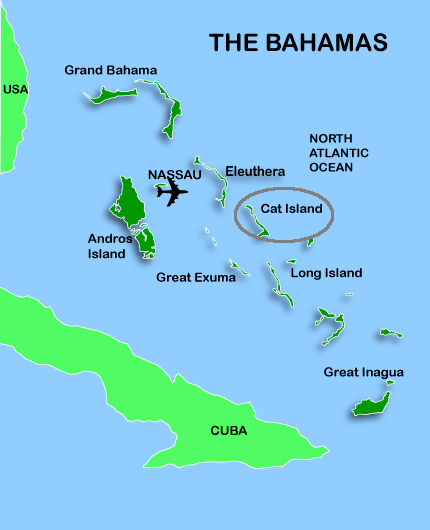
Epic Diving, based in New Jersey and operating for four to five months out of the year at Cat Island in the Bahamas, has made a specialty of diving with oceanic whitetips.  During the spring, these sharks seem to migrate to the island, primarily staying in the deep drop-offs that surround the island.  The Cape Eleuthra Institute has been tagging and studying these sharks to try to determine the whys and wheres of their migration.  It's still not fully understood, but their springtime sojorn to Cat Island affords divers the opportunity to see these beautiful sharks, with their distinctive rounded, snow-capped dorsal and long pectoral fins.

For this trip, I was trying out a new camera rig.  I typically shoot video with a Sony EX-3 with a nanoFlash external recorder.  This provides me with broadcast quality, 4-2-2 footage (unless my client wants to shoot with something higher up the food chain like a RED Epic) and it has served me well for many years.  The drawback is that it requires a rather large housing which is great for stability but not so much fun when you need to be more mobile - like chasing after a whale shark or maneuvering to catch a shot of schooling tuna or jacks.

So here, I was breaking in a Canon 5D Mk III with Sea & Sea YS-D1 strobes and Light & Motion Sola 4000 video lights.  In addition to taking great still pictures, the Canon 5D Mk III also shoots terrific video.  This has made it a popular camera with independent filmmakers as it delivers a film-like range in depth of field with a variety of lenses at the filmmaker's disposal.  For me, that versatility was attractive for both topside and underwater shoots, but it also provides me with a smaller package to push through the water.  

Slipping into the water with a new species of shark always gets the adrenaline pumping and this first day of the expedition proved to be no exception.  We found ourselves being visited by five or six very curious oceanic whitetips.  These sharks cruised the surface so scuba gear wasn't necessary, just freediving (mask, snorkel & fins).  As Vincent Canabal of Epic Diving instructed us in our pre-dive safety briefing, it was important to keep an eye on the sharks around you or you could get bumped.  Photographers and videographers can get wrapped up in looking through the viewfinder, setting up or waiting for that perfect shot.  But in the world of shark diving that can be a very limiting view of what is truly going on around you.

Oceanic whitetips are beautiful sharks.  Elegant with distinctive markings, they move at a very relaxed pace and, for the filmmakers and photographers, they are very accommodating.  Their curiosity takes them from one diver to another, coming straight at you and then drawn to their own reflected image in your camera dome.  You often would find yourself having to nudge them away at the last moment for fear that they would brush up against your dome lens port with their rough skin (my acrylic fisheye dome port suffered a few abrasions which I was able to buff out, fortunately).

The oceanic whitetip shark's curiosity is understandable, given their lifestyle as a pelagic predator.  Imagine swimming day after day through deep blue water, not sure where your next meal is coming from.  Any sound, scent, or visual cue would grab your attention as it would represent a change from the norm and could portend a possible meal. 

While getting eye-to-eye closeups with these magnificent sharks is always exciting, one of my favorite still photographs from the expedition was one that captured the solitary existence of this pelagic predator who spends its life cruising through the endless blue.

Tragically, the curious nature of the oceanic whitetip, combined with its preference for open water, has made it a target for commercial shark fishing boats that ply international waters - right in the oceanic whitetip's backyard.  The IUCN (International Union for the Conservation of Nature) lists the oceanic whitetip on its Red List as "vulnerable" to extinction and that its population trend is decreasing.  The recent world meeting of CITES (Convention on International Trade of Endangered Species) resulted in having the oceanic whitetip placed on CITES' Appendix II, which is a first step in monitoring and ultimately regulating the trade in this particular species.  Hopefully, such steps will be in time before the oceanic whitetip's population reaches a tipping point wherein its inability to replenish its numbers faster than the rate of extraction causes an irreversible collapse.

My thanks to Vin and Debbie Canabal of Epic Diving for a first-rate operation.  And a special thanks to Amanda Cotton who was there to provide a photo workshop and advice to all the divers.  Playing with new toys, it's always great to have someone to turn to who is so accomplished in her field.  

Photos copyright 2013 by Richard Theiss/RTSea Media
Source: Epic Diving
Source ACottonPhoto.com   

Thursday, May 3, 2012

Phasers On Stun: media zeroes in on laser test with lemon shark

Sharks with lasers - my, oh my.  My friend, Luke Tipple, is gaining a lot of media attention with a recent experiment - actually two experiments really: testing a safe but secure attachment device and testing a low-power laser which can be used for various studies of shark movements.

So, no, the sharks won't be seeking revenge just yet, but that hasn't stop the media from taking notice.  Simply Google "laser sharks" and you'll find a long list of news outlets all running the story.

Here's a recent post from Underwater Thrills: Swimming with Sharks that includes some video.  It's a nutty world.

Sharks with Frickin' Lasers - The Video
Thursday, May 3, 2012
Wait, there's a video?

Of course there's a video, what you don't think a new fin clip innovation that will revolutionize shark research as we know it would rely on a few images and about three thousand print media outlets to make that case did you?
Never.

Oh, and by the way enjoy. No sharks were harmed, inconvenienced, delayed, disrespected, and or annoyed in the making of this video. As it turns out Mr.Biggelsworth has a bit of a thing for our buddy Luke Tipple:


Sunday, December 11, 2011

Bahamas MPA in Need: Summit Series group raising funds to support South Berry Island

Marine protected areas (MPAs) can be an effective means in protecting and conserving natural marine resources. By defining a specific boundary and then managing - and in some cases prohibiting - activities such as commercial fishing, marine ecosystems are allowed to flourish, which can have a beneficial effect on marine life even outside of the MPA. Worldwide, there is only a small percentage of the ocean's surface that has been designated as a protected area, even with recent record-breaking MPAs like the Northwestern Hawaiian Islands, Phoenix Islands, and Chagos Archipelago.

But designating a marine protected area is just the first step. The next step can be an imposing hurdle: establishing the infrastructure to support, maintain, and enforce all related regulations. Without those components, an MPA becomes nothing more than a good intention.

In 2009, the Bahamian government set aside 6 new marine protected areas, bringing the total to 25 MPAs in the Bahamas. One of those areas, the South Berry Island Marine Protected Area, covers only 70 square miles but is considered one of the most ecologically diverse areas in the Bahamas and includes coral reefs, a conch nursery, and a 6,000 feet deep trench known as the Tongue of the Ocean. Unfortunately, it is also sadly lacking in a functional infrastructure and so the area is largely unregulated.

Hoping to come to the South Berry Island MPA's rescue is an organization of influential entrepreneurs, artists, and innovators - members of a group that sponsor the Summit Series, a kind of creative brain trust of individuals who are dedicated to giving back to the planet in one way or another. This past April, the Summit Series held a Summit at Sea aboard a cruise ship in the Bahamas and donations came forth to meet the $500,000 price tag that was determined to be what was needed to implement and sustain the South Berry Island MPA infrastructure.

To date, they have reached over $475,000 of the needed total. Individual donations are being managed by The Nature Conservancy and accepted through Crowdrise.com, another of the growing number of online fundraising sites, and there are some enticing prize drawings for donors including a $1000 Zappos gift certificate
(Tony Hsieh, Zappos CEO, has offered a dollar-for-dollar match to $25,000) and 600-foot submarine ride off the south coast of Florida, compliments of my friends at OceanGate Expeditions.

If you would like to learn more, here are several website you can visit:
Click here to learn about the Summit Series.
Click here to learn about the Summit at Sea.
Click here to visit the Crowdrise.com website to donate and enter in a drawing.

Sunday, August 28, 2011

Filmmaker's Journal: one of Bahama's groupers comes to play

The last time I was in the Bahamas this past spring, I was there aboard Blue Iguana Charters' MV Kate to film sharks . . . again. Not that I ever get tired filming those incredible animals but, after all, variety is the spice of life, right? That's what makes the Bahama's so much fun and Capt. Scotty Gray knows how to pack a lot into one trip: sharks, wreck diving, dolphins, and beautiful reefs.

Here's a quick video that briefly shows some of the shark fun the Bahamas are famous for, but also highlights a great encounter that crew member Rob MacDonald and I had with a large grouper. Groupers are popular gamefish with Florida sportfishermen and that's unfortunate because their numbers have declined - just when the marine ecosystem needs them most. With the explosion in the past few years in the number of lionfish, a beautiful but voracious reef fish that is an invasive species to the Caribbean, the grouper is one of only a few large predators that can potentially help keep the lionfish population in check, if only the grouper population itself was in better shape.

The grouper that visited Rob and I was initially interested in our bait crate, which contained some slabs of fish to attract Caribbean reef sharks. The reef sharks knew who was boss and you'll see one dart out of the grouper's way, as groupers are not afraid to butt heads with a shark if need be. With no easy meal available, the grouper proceeded to act like a cat weaving between our legs looking for a good petting. Actually more of a back scratching, as these large fish will attract small, pesky parasites and the grouper won't shy away from an opportunity to dislodge some of these hitchhikers.

The grouper continued to pass back and forth between the two of us for a good five to ten minutes. Then Rob pulled out a hunk of fish from the crate as a thank you to the grouper for spending time with us. And with that, it was on its way.

It's always a treat when you have the chance to safely interact with large animals. Sometimes it takes a few minutes to size up the animal's behavior to ensure, as best you can, that you won't be harassed or bitten. There's always that thought: "I wonder if this big fella is looking for some payback for all the relatives we humans have pulled out of the sea?"


Monday, April 18, 2011

Bahamas Shark Sanctuary: the call is out to protect a leading shark locale

Having just recently returned from a video expedition to the northwest banks off of the Bahamas, I was again reminded as to why this region is considered one of the shark capitols of the world. The underwater topography, from white sandy plains to lush reefs to expansive beds of sea grass, lend themselves as hospitable environments for a variety of shark species. Caribbean reef sharks and the occasional tiger shark cruise the reefs. Lemon sharks in large numbers, tiger sharks, and nurse sharks patrol the sandy bottoms. And in deeper water you can find hammerhead and oceanic white tip sharks.

With scuba diving and shark diving being major tourist attractions that support the Bahamas' fragile economy, it is surprising to find that there are no established management policies or regulated safe zones for the protection of the sharks in the Bahamas. These animals are exposed. But that could soon change.

The Bahamas National Trust (BNT), with cooperation from the Pew Charitable Trusts, is beginning a campaign to have a shark sanctuary established in the Bahamas. This would be the first of its kind in the Atlantic Ocean, and that could start the ball rolling much like what is occurring in the Pacific with the Palau Shark Sanctuary and the shark fishing regulations or prohibitions that have sprung up in several Pacific island nations.

But first, you must get the people on your side. With a committed, or least understanding and willing, constituency, you then can generate support and action within the halls of government. The Dorsal Fin blog noted the following two videos produced by the BNT and Pew Trusts. Each delivers basically the same message but with a slightly different angle. The first video is designed to appeal to the human element and to show that even Bahamian children understand the importance of protecting such a vital national natural resource and that what could happen to sharks will impact future generations. The second video shows the sharks themselves, particularly Caribbean reef sharks, and is a bit more informative - although it lacks a clever motif or hook that could perhaps better grab the viewer's attention.

But together they make for a great statement of common sense and concern. The Bahamas is more than a source or sun, sand, and a cool tropical drink (although that ain't bad by itself). No, the Bahamas is also a priceless oceanic treasure that needs an overarching policy of protection for its sharks. Without them, an oceanic gem would suffer in more ways than one.


I'll have some of my recent Bahama footage up soon in future posts, but in the meantime, check out the Bahamas National Trust and Pew Charitable Trusts to learn more about what you can do. It's about time.

Wednesday, April 13, 2011

Beauty as the Beast: lionfish invasion in the Caribbean

It is an unfortunate situation when something of beauty is at risk of being destroyed through no fault of it's own. But off the coast of Florida and throughout the Caribbean, that is the fate that awaits the lionfish (genus: Pterois). For all its graceful movement, striking color, and ornamentation, it is, regrettably, an invader that threatens the ecological balance of reef communities throughout the region.

I just returned from two weeks at sea along the shallow banks northwest of Grand Bahama, and with every reef dive I undertook I was guaranteed at least a half dozen sightings of these small Indo-Pacific predators. Known for having a voracious appetite to match its venomous spines, it was reported in one study that a lionfish can consume three-quarters of a reef's fish population in as little as five weeks. Left unchecked, the lionfish threatens the Bahamas' annual $5 billion tourism industry (that's billion with a "B") and nearly half of the island's employment. Bathers can get stung by the lionfish's dorsal spines or divers can find reefs denuded of colorful tropical fish and this can spell economic ruin for many Caribbean nations.

So, how did this all come about? How did a fish found in the South Pacific make its way halfway across the planet? Well, it certainly would need some help, an accomplice or two.

And that would be us.

The lionfish invasion in the Caribbean is a textbook example of invasive species distribution. Because of its beauty, juvenile lionfish are a popular addition to home saltwater aquariums. That is, popular until your other aquarium fish begin to disappear one by one as the lionfish grows and its appetite blossoms.

So, could it have found itself in the Atlantic when a frazzled home aquarist released it into the wild? Possibly, although it has been reported that the pivotal moment may have occurred in 1992 when Hurricane Andrew battered the southeast coast of the U.S., smashing an aquarium tank in Florida, and releasing six lionfish into open sea. Through the 90's, lionfish expansion was slow, but the first one showed up in the Bahamas in 2005. Two years later, the population exploded (some studies have indicated that a possible reason for the lionfish's successful growth is due to its resistance to many of the parasites commonly found in the Caribbean). The invasion was in full force and the war was on.

Over thousands of years, the lionfish found its proper place in the Indo-Pacific as both predator and prey. Groupers and other large fish fed on them, helping to control their numbers. But in the Bahamas, groupers have been overfished, so there aren't enough of these controlling predators to do the job (and even juvenile groupers are at risk of becoming a lionfish's next meal).

NOAA, the National Oceanic and Atmospheric Administration does not mince words when describing the lionfish invasion. "
With few known natural predators, the lionfish poses a major threat to coral reef ecosystems in the Caribbean region by decreasing survival of a wide range of native reef animals via both predation and competition," says NOAA's Office of Research. "It was not unusual to observe lionfish consuming prey up to 2/3 of its own length. Results of the experiment show that lionfish significantly reduce the net recruitment of coral reef fishes by an estimated 80%. The huge reduction in recruitment is due to predation and may eventually result in substantial, negative ecosystem-wide consequences. It is also important to note that lionfish have the potential to act synergistically with other existing stressors, such as climate change, overfishing, and pollution, making this invasion of particular concern for the future of Atlantic coral reefs."


While in the Bahamas, I saw signs and posters proclaiming that the only good lionfish in Caribbean waters was basically a dead one. Crew members would regularly dive with short tri-tip spears in hand, looking under reef ledges - a favorite lionfish hangout - and stabbing any lionfish they came upon, leaving it there perhaps to eaten by a scavenging shark.

In fact, several of the crew reported trying to entice Caribbean reef or lemon sharks to feed on a speared lionfish in the hopes that the sharks would develop a taste for the enemy invader. The sharks would have to learn the best approach to avoid a discomforting sting and, in fact, I saw one shark make repeated bites - spitting out the lionfish until it found the right angle by which it could comfortably consume the free meal.

While the lionfish is one of the tropical ocean's most beautiful inhabitants (and one of my personal favorites), as an invasive species it unintentionally poses considerable risk to the Caribbean marine ecosystem. Could a natural balancing mechanism take hold through predation by fish who discover a new potential prey item in their midst? Or will mankind, having been responsible for the lionfish's introduction in the Caribbean in the first place, now have to take extraordinary steps to eradicate this species? To date, the success of the lionfish shows that there are no easy answers, as is often the case with other invasive plant and animals species around the globe.

Read about the lionfish invasion in NPR.org.
Read about
NOAA studies of the lionfish invasion.

Friday, April 1, 2011

Filmmaker's Journal: on location in the Bahamas

For the next ten days I will be on location out at sea in the Bahamas. Depending on internet availability, blog posts may be a bit hard to come by until I return on April 12th.

In the meantime, feel free to peruse through the RTSea Blog archives. With over 600 posts, I'm sure you'll find something of interest until I return with new images, videos, and stories to tell.

Until then, remember: Save our Seas!

Richard Theiss
Cinematographer
RTSea Productions

Saturday, November 27, 2010

Bahamas' Oceanic Whitetip Sharks: can divers and researchers work together?

The Oceanic Whitetip shark: a fascinating and elegant shark and, as a pelagic or open water shark, one that does not encounter people often. It has a bad reputation in some corners as it has been implicated in human fatalities following wartime shipwrecks. But, like other species of shark, the oceanic whitetip has paid dearly in the commercial shark fishing trade and it has become one of the rarer of all shark species. By example, its numbers in the Gulf of Mexico have been reported to have declined by as much as 99.3 percent.

In the Bahamas, the remote Cat Island is reporting a respectable number of oceanic whitetips - given the current population numbers - and this has attracted the attention of several shark diving operators. Patric Douglas of Shark Divers has some interesting suggestions as to how these sharks could be made both a source of tourism and conservation research efforts. Patric is known for calling it as he sees it and, while not currently planning shark diving operations there, he is concerned that the oceanic whitetip site at Cat Island needs to be properly managed to insure it is not carelessly exploited by dive operators or sport fisherman.

Here are his recently posted suggestions:
1. A Bahamas Carcharhinus longimanus [oceanic whitetip] educational website. This site will feature the animals, the site, the conservation status of these animals, and tie in directly to ongoing efforts of PEW and the BNT [Bahamas National Trust]. The site would also feature several pro-shark conservation PSAs; just the sharks, not the divers and the sharks. We're not looking to redefine these animals, or even make a simple point about how safe they may or may not be with divers, that conservation/industry message can be left for another time and place. Under conservation also add research and a non-profit donations page.

Additionally this should tie into PEW Trusts, and here's why. Conservation efforts need to be funded; real shark conservation sometimes requires a "step back moment" where you have to realize who has the conservation horsepower to get something done or not. After all we're in this for the sharks. If someone can run the ball into the end zone let's get it done. Hanging any conservation effort on the mantle of friends and industry buddies who lack the horsepower does nothing for sharks...but that's another post for another time.

2. A Bahamas Carcharhinus longimanus research effort with immediate tagging and tracking of these animals. This effort should be a "Bahamas thing" and there's plenty of folks who can get the job done, they just need funding. In addition operators could charge an extra $100 per diver for the project. Divers will pay for this, gladly, if they believe this benefits the sharks, and it will.

Some of you will start screaming right about now as you wipe off your
Epoque D170 Dome Ports, tags on Carcharhinus longimanus? Yes, tags, and here's why. If you want to hedge against sport fishing interests, declaring this site an active shark research site will get the job done. It lends instant credibility to the counter charge that shark divers are just making money from these sharks, and with real data, Bahamian conservation laws put on the books have teeth.

3. Cross-operator/conservation promotion. Every operator servicing divers and
Carcharhinus longimanus at Cat Island should have the new conservation website and research efforts on their own sites home pages with a set industry dive protocol agreement. Again a tall order, but we're talking about a brand new shark site with just two or three guys [shark diving operators]. This is not Isla Guadalupe, or even South Africa. As industry members we can look back and see with 100% clarity where non-action will lead us at Cat Island. Is it too much to ask for a round of phone calls, two websites and a conservation tagging program?

I think not, and done right this could be the shining beacon on the hill for future sites worldwide.

Read the entire post on the Shark Divers blog.

Thursday, September 23, 2010

Bahamas' Deep Water Sharks: institute conducts research into little-known species

The Bahamas is known within the shark diving community as one of the top locations for seeing sharks. Tiger sharks, lemon sharks, and Caribbean reef sharks are three of the more common species, along with occasional bull, hammerhead, and nurse sharks. From Stuart Cove's Nassau shark diving operation to the boats that frequent popular Tiger Beach off Grand Bahamas, shark diving has flourished as a tourist activity in relatively shallow water.

But cruising in deep waters is another entire world of sharks, one that has largely remained out of sight from divers and scientists alike. There is much that we do not know about sharks, but with these deep water denizens we know even less. Over half of the documented species of sharks live below 200m (660 ft.) but only a handful have been studied to any appreciable degree.

To help fill that void in knowledge, researchers at the Cape Eleuthera Institute, along with scientists from Florida State and Stony Brooks Universities, are conducting research on several deep water sharks as part of the institute's Shark Conservation and Research Program. Utilizing
satellite tags supplied by Microwave Telemetry, Inc. (including a new, next-generation of micro-tags more suitable for smaller sharks), the researchers have been quite successful in capturing and tagging 25 sharks from six different species, ranging from a 13-foot bluntnose sixgill shark to a petite sawtail catshark at 18 inches.

According to The Bahamas Weekly.com, Dr. Dean Grubbs of Florida State University was more than pleased. "I have conducted research on deep water sharks in a number of locations around the world including the central Pacific off Hawaii, the temperate western Atlantic off the east coast of the USA and in the Gulf of Mexico. Cape Eleuthera appeared to be an ideal location to expand my research however I never expected the incredible diversity and abundance of species we encountered these last few days. Twenty-five sharks from six different species on only six surveys is an incredible record." said Dr. Grubbs.

Realizing the impact of commercial shark fishing on these important predators and scavengers, in addition to appreciating their role as a component of the islands' tourist economy, the Bahamian government has been proactive in shark conservation, which includes a longline fishing ban in the 1990s, and enthusiastically supports the research taking place involving these deep water species.

"The absence of a commercial fishery of any significance for sharks in The Bahamas, along with a wide variety of marine habitats within close proximity to the facility makes the Cape Eleuthera Institute an ideal location for the pursuit of research into these important species," said the Department of Marine Resources director, Michael Braynen.

Best of success to the Cape Eleuthera Institute. The more light that can be shed on all members of the shark family, the better we will understand how they are woven into the fabric of the ocean ecosystem - not only as pelagic apex predators but as ocean citizens of a mysterious deep water community.

Read the article in The Bahamas Weekly.com.

Tuesday, August 3, 2010

Filmmaker's Journal: fun and straight talk about filming sharks

Back in June I recounted having come back from an interesting film shoot in the Bahamas where the normally prolific number of sharks the crew was accustomed to had decided to play a frustrating game of hide and seek. While we finally got the footage needed, it was a concern to everyone as to what possibly kept all of the sharks away.

As director of photography, I was working with Los Angeles-based Digital Kitchen on a series of segments promoting Shark Week for AT&T U-verse digital TV customers. We certainly had no control over the content of Discovery's Shark Week programs, but Digital Kitchen was, to their credit, very interested in getting it right with their production.

With Luke Tipple as the host and underwater shark guide, the AT&T segments looked at the challenges in filming sharks, including interviews with me and my camera operator Scott Cassell. The Blue Iguana was our aquatic home away from home and we had fun staging some interesting and fun/odd underwater scenes as the segments show.

Additionally, and perhaps most importantly, the segments revealed that sharks aren't always hungry. We had some very disinterested Caribbean reef sharks who ignored freshly cut up fish strewn all about. At one point, Luke was standing, waving two filleted fish over his head like an airport ground crewman flagging down a 747. And the sharks couldn't have cared less.

The segments in full HD are currently available only for those with AT&T U-verse service. But they are also available on the AT&T U-verse web site:
Segment 1: click here.
Segment 2: click here.
Segment 3: click here.
Segment 4: click here.

Again, Digital Kitchen did a great job in producing a well-balanced piece of information and entertainment. I hope Discovery Networks appreciates the effort.

Saturday, June 19, 2010

Bahamas' Sharks: a moment's scarcity with disturbing implications

I returned late Thursday night from a video assignment in the Bahamas as director of photography - hence, the lack of postings over the last few days. The crew was out there to film sharks but, as it turned out, we had to look far and wide to find what we were looking for. In the "usual places" where we would expect to find numerous lemon, tiger, and Caribbean reef sharks, we were being skunked - a highly unusual experience.

The boat captain made radio calls to other boats in the area only to find that they were also experiencing the same lack of sought-after quarry. So, we were not the only ones and apparently this had being going on for several weeks. Two possible theories were being bandied about - either of which raised concerns as they illustrated the fragility of a marine ecosystem.

Hunting for sharks:
One of the dive operators that regularly works the area off the Bahamas related a rumor that a tiger shark, possibly a pregnant female, was taken by a fisherman the week before. Had the sharks, in response, moved away from their usual haunts, perhaps deeper or farther out to sea? Possibly - although the theory demands a multi-species reaction to a singular event that may not be that plausible. But it's a tantalizing idea: what would be the response by schooling predators like lemon and tiger sharks to life-threatening events? No matter how much bait or chum was used, at sites where we would normally have so many sharks on hand, you could almost walk across the water on their backs, there were virtually none.

Rising temperatures:
The other theory, which we were experiencing first hand, was an increase in water temperature. We found the temperature in be in the mid-80's from the surface (which is to be expected this time of year) to as deep as 60 feet before it abruptly dropped about ten degrees. Could this abnormal wider range of warmer water have pushed the sharks to deeper and more comfortable depths? Several of the locations where one would typically be surrounded by sharks are in the 20-foot depth range - and we had no luck at those sites. Ultimately, on the last day of shooting, we came upon a small but suitable number of Caribbean reef sharks at 80 feet. My B-camera operator, Scott Cassell, commented to me that he also noticed a lot more algae growing on the reefs in the shallower, warmer depths, versus the more colorful sponges and corals.

In the end, the production crew was able to get the footage it needed, but it was challenging to say the least. And disturbing to think about the implications to a balanced and healthy marine ecosystem when normal conditions are disrupted. In the end, either of these two mitigating factors - fishing or water temperature - which impacted the number of sharks we encountered could be mere anomalies. But it did provide a disturbing indication as to the impact of shark fishing and climate change.

In a couple of weeks, all we experienced could be forgotten and the frequency and range of the Bahamas' sharks could return to normal. But it was sobering to think what the future may hold in store.

Wednesday, February 11, 2009

Ocean Glamour: take a break and enjoy the view

Okay, break time! It's always important to step back from the pressing issues we wrestle with regarding the environment and remind ourselves of its fundamental beauty. So, here are a few ocean shots to jog our memory . . .
  • Laguna Beach, California
  • Cup Coral, Red Sea
  • Garibaldi, Dead Man's Reef, California
  • And from my fellow photographer, Christie Fisher: Dolphins, Bahamas
  • Another shot from Christie: Yours truly filming a lemon shark
All photos copyrighted, digitally watermarked, and commercially available through RTSea.

Tuesday, September 30, 2008

Shark-Free Marinas Initiative, Bahamas

I'm pleased and honored to assist SharkDivers.com with this new program they just recently devised to help promote the conservation of sharks. It's one way to encourage commerce to get on board and make a difference, realizing the long-term benefits for Bahamian tourism.

Shark-Free Marinas Initiative

In the spring of 2008,
Shark Diver was alerted to a female Tiger shark that was taken off Freeport, Bahamas. The animal was caught by a sport fisherman and displayed at a local marina where it was cut open to reveal several half-dead pups inside, some of which were dropped into the marina and struggled to survive for a few days.

We have decided to act. The Government of the Bahamas allows sport fishing for sharks and we fully support sustainable catch-and-release fisheries. However, the taking of gravid female sharks for a one-time photo op and a set of jaws is a senseless waste of a valuable resource.

The Shark-Free Marinas Initiative is a way to work with existing resort marinas in the Bahamas that cater to sport fishing vessels, seeking their cooperation in asking them not to allow sharks to be taken and displayed at their marinas. This initiative, in turn, encourages the use of catch-and-release programs and promotes sustainable fisheries.

Each marina and resort that supports this initiative will receive both, a metal sign and logo we have created to post in their marina office and the following information for posting on their marina websites:

(Name of resort and marina) supports the Shark-Free Marinas Initiative in the Bahamas region. The Bahamas is home to many shark species and the healthy reef systems that support these sharks. We feel the one-time harvesting of sharks for photo images or souvenir jaws is not in the best interests of the Bahamian people or Bahamian tourism.

Worldwide, sharks are being decimated for fins and jaws at a completely unsustainable rate. An estimated 60 million sharks per year are taken in this manner. By asking vessels not to arrive at our facilities with sharks, we hope to encourage responsible sport fishing, thereby ensuring a lasting and healthy population of sharks in Bahamian waters for future generations and contributing to the overall health of the Caribbean.

Please practice catch-and-release with all sharks and enjoy our facilities.

Welcome to the Bahamas.

SharkDivers' Note: This initiative is not only limited to the Bahamas and the several marinas who have expressed an interest in joining it (press release to follow). As a concept we will allow and help promote any organization or group to use this logo to enact their own regional Shark-Free Marinas. In places like Florida and the East coast this could conceivably help redirect shark kills and weigh ins. It offers the opportunity for marinas to claim the "Green Card" while at the same time redirecting fishermen into sustainable fisheries. Special thanks to Richard Theiss RTSea Productions.

One blog, one website, one person at a time.