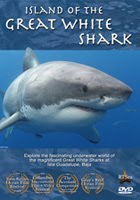
For those of you in the Los Angeles/Santa Monica area, Heal the Bay and the Santa Monica Pier Aquarium will be hosting a screening of Island of the Great White Shark on Wednesday, January 21st. Following the screening, I will be there to discuss the latest issues regarding these magnificent white sharks that inhabit Isla Guadalupe, Baja in the fall/winter months.
The film seems to resonant with both, the curious and the ocean/shark advocate. I was flattered to have a standing-room only crowd at a recent screening, and I look forward to a positive response at this upcoming event. Admission is free but on a first come-first serve basis, so be sure to arrive early.
Heal the Bay, one of Los Angeles' long-standing non-profit ocean conservation institutions, operates the Santa Monica Pier Aquarium. The aquarium's goals of raising awareness of our ocean environment, promoting conservation through stewardship and teaching marine science to the public, fit nicely naturally with the programs and missions of Heal the Bay.
For more program information, visit the aquarium's web site or call 310-393-6149.
Interesting artice in today's Los Angeles Times: In 2006, a fishing trawler sank off the southwestern tip of Catalina Island - one of the Channel Islands situated about 25 miles off the coast of Los Angeles/Long Beach. Sitting upright on the bottom, its haul of fishing net drapes over the ship like a billowing circus tent and has been responsible for the death of endless numbers of marine life, ranging from small fish to seal lions, dolphins and sharks. The sandy bottom around the base of the wreck is littered with the bones and skulls of many of the net's victims.
In come the Ocean Defenders Alliance, a Huntington Beach, CA-based non-profit committed to protecting offshore reefs and seabeds from dangerous man-made objects, particularly fishing nets which, when torn or lost at sea, often pose an ongoing hazard to marine life - as in the case of the sunken trawler at Catalina.
This past weekend, volunteer divers working with the Ocean Defenders Alliance made a series of deep dives, breathing a Nitrox blend to limit the possibility of decompression sickness, to cut away the derelict netting and haul it to the surface - not an easy task due to the depth, limited visibility, and shear bulk of the fishing net. As much as 800 square feet of netting was recovered, but organizers believe it will take many more dives to retrieve it all.
Congratulations to the Ocean Defenders Alliance for taking this proactive step regarding abandoned, derelict fishing nets - a worldwide problem that contributes to the death of many tens of thousands of marine animals. (Read entire L.A. Times article.)
In the United States, the Pacific Coast commercial fishing fleet has been steadily declining for years due to regulations, declining fish populations, and the continuing growth of aquafarming. This adjustment to economic reality has recently experienced an unexpected spike downward for those fishermen who take primarily salmon and crab.
Due to a record low in the number of returning chinook salmon to spawn, the federal government canceled the entire Pacific Coast salmon season. And there is the possibility that next year's season could also be called off. This forced fishermen to count on the harvest of dungeness crab to make up for the losses.
But lo and behold, the dungeness crab season is turning out to be one of the lowest on record. Scientists attribute it to a cyclical nature to crab populations - the cycle is approaching the bottom of a natural ebb and flow - but is compounded by excess fishing and ocean conditions which have disrupted the marine food chain. This year's catch is expected to be less than 25% of what was taken 4 years ago. The laws of supply and demand would dictate that fisherman could demand more per pound for this limited catch, but unfortunately the nation's current economic crisis has reduced demand to below regular market prices. Taken all together, many fishermen expect to be pushed out of business.
Commercial fishing is unfortunately learning the hard way as to the ultimate wisdom of depleting marine resources without having a sensible plan in place to maintain fish stocks. We have a long history of commercial fishing ports drying up and becoming virtual ghost towns through short-sighted thinking. But this new chain of events is an unfortunate nail in the coffin for a declining industry. It also serves as a warning as to what may lie ahead.
On Tuesday, January 6th, the Birch Aquarium at the Scripps Institution of Oceanography in beautiful La Jolla, CA hosted a screening of Island of the Great White Shark. At the conclusion of the film I had the opportunity to discuss the film with the standing room only audience. The pressing issue of conservation and the value of eco-tourism were discussed along with the importance of understanding the shark's role in maintaining a balanced marine ecology.
My sincere thanks to the Birch Aquarium and its staff for promoting and managing what turned out to be a very successful evening (a special thanks to Lydia Cobb, Marketing Manager and Jessica Crawford, Communications Specialist). After a series of media interviews arranged by the Aquarium, the day of the event arrived and I was treated to a behind-the-scenes tour of the Aquarium and had a chance to sit down and discuss shark research with several of Scripps' top shark research grad students. It was very encouraging to hear about their efforts to learn more about these amazing animals so that we can take the proper steps to ensure their survival.
The Birch Aquarium plays a unique and vital role as a conduit through which the Scripps Institution of Oceanography can enlighten the public to many of the important marine issues being studied by this world renowned research organization - from climate change to marine wildlife conservation. The institution was established in 1903 and became a part of the University of California, San Diego a few years later. With a fleet of research vessels and state-of-the-art research facilities, the institution is one of the leaders in its field and has produced generations of accomplished research scientists and educators across a wide range of oceanographic disciplines.
Again, my thanks to the Birch Aquarium. If you are traveling in the San Diego area, carve out a few hours and stop by for a visit. It will be time well spent.
Another piece of shark news that could prove to be a success if we all get behind it and push is the Shark Conservation Act (HR 81) recently introduced in the U.S. Congress. This piece of legislation closes a loophole in previous legislation - a loophole that was supposed to be taken care of by last year's HR 5741 which unfortunately stalled in the Senate until the session expired.
Re-introduced by Congresswoman Madeleine Bardallo (Guam), the Shark Conservation Act requires that all sharks taken in U.S. waters must have the fins naturally attached - Want the fins? Then you must take the whole animal.
Wait, you say! Isn't shark finning illegal in the U.S.? Well, yes and no. In Pacific waters, it is legal to transport fins as long as they were not finned aboard the vessel - a loophole that this legislation will close. The benefits of this legislation are two-fold:
It will prevent shark finning in U.S. Pacific waters and possibly impact the practice outside of U.S. territorial jurisdiction.
It will allow for better enforcement of existing regulations and improved management of the commercial fishing industry in the taking of sharks or shark-related products.
A more subtle impact will be that boats will be financially pressured to reconsider the commercial value of taking sharks when they must fill hold space with the lower valued carcass along with the higher valued fins. This could in time, reduce the commercial take of sharks all together.
The Shark Conservation Act must make its way through the halls of Congress and on to the Senate for final passage and implementation. To motivate your congressperson, you can make your voice heard through Oceana.org's Wavemakers web page which will forward your personal email to your elected representative. Here's the link.
Back in August, I posted information about Dr. Susan Lark, an online entrepreneur engaged in selling moisturizers that contained shark squalane (see previous post). Oceana.org took the lead in putting pressure on Dr. Lark and her organization to opt for a substitute squalane derived from olives.
Here's some good news I received today from Elizabeth Griffin, Marine Wildlife Scientist at Oceana.org: "It's taken nearly a year of constant pressure, but we've finally convinced Dr. Susan Lark to sell cosmetic products containing squalene derived from olives rather than deep sea sharks. More than 15,000 of you contacted Lark, telling her it was unconscionable to sacrifice already at-risk shark populations for the sake of beauty.
First she claimed her product was okay because the sharks used were bycatch of the orange roughy fishery. When we pointed out the error in this logic, she then claimed the source was "sustainably fished" sharks from the Mediterranean. When it became clear that we weren't buying her excuses, or her beauty products, she finally agreed to change her product line. We are happy to report that the first new product is currently in development."
Kudos to Oceana for their dedication, to all those who sent email messages, and to the Dr. Susan Lark organization for finally seeing the light by placing species endangerment ahead of personal beauty.
One step at a time, folks. But we're moving forward.
There is a mystery brewing in Southern California regarding brown pelicans that have local conservation groups baffled. These local sea birds that are often seen cruising in long lines low over the water's edge are now being found inland dead or dying, in a state of disorientation and extreme fatigue.
Wildlife experts say that these birds are subject to similar symptoms in the spring and summer months due to algae toxins like domoic acid, sometimes found in phytoplankton blooms or high algae growth fed by partially treated waste (see previous posting) - but not in January.
Bird rescuers have sent blood samples and carcasses to laboratories for testing and an answer will hopefully be found soon. Unfortunately, there is no "cure" for algae toxins like domoic acid; either the animal survives it or is permanently impaired or dies. Other theories range from low tolerance to toxins from previous exposures to ingestion of fire retardants and other chemicals as a result of rain runoff from areas damaged by recent fires.
"Pelicans have been hammered over the years by oil spills, DDT, domoic acid, fishing line, gunshots, starvation and parasites - we're experts at dealing with those problems," said David Weeshoff of the International Bird Rescue Research Center . "But right now, we're scratching our heads over the cause of this event. Not a good deal." (Read more.)
I just finished a delightful book I received over the holidays from my daughter:Chicken Soup for the Ocean Lover's Soul. Part of the famous series of "Chicken Soup" books with motivational stories and essays assembled by Jack Canfield and Mark Hansen, this volume was published in 2003 and includes ocean artist Wyland as a contributing editor, with pictures of many of his works included.
Using a wide range of contributors - from Dr. Bob Ballard and Dr. Sylvia Earle to the late Warren Iliff of the Aquarium of the Pacific and Wyland himself - the book covers topics including "Living in Harmony", "Courage and Adventure" and "Saving the Sea." While these books might be a bit syrupy for some, this volume does serve to remind us all of one very positive and uplifting thought: we are all connected to the sea; it is the ultimate mother of all life on this planet.
One quote by Jacques Cousteau used in the book, struck me as being very timely though it was probably said some years ago: "For most of history, man has had to fight nature to survive; in this century he is beginning to realize that, in order to survive, he must protect it." Chicken Soup for the Ocean Lover's Soul - a quick read and time well spent.
Along with shark fins for soup and bluefin tuna for sashimi, another aquatic animal that has been impacted by Asian consumer demand is the freshwater softshell turtle. With the boom in Asian economics, the demand for this oriental delicacy (and it's use as a homeopathic medicine) has skyrocketed to the point where populations of softshell turtles in Asian countries including China, Laos, Vietnam and Cambodia have all been wiped out.
So, who is meeting this escalating demand? Sunny, fun-filled Miami. That's right, Florida is one of the leading exporters of softshell turtles, shipping them to Los Angeles or San Francisco for export overseas. One Florida seafood dealer alone processes up to 20,000 pounds a week - approximately several thousand turtles.
Federal laws that protect endangered turtle species do not extend to Florida's softshell species and while states like Texas, Oklahoma, Alabama, and Mississippi have prohibited or severely limited harvesting of these turtles, the only regulation in effect in Florida is a temporary 20-turtle-a-day limit. With the number of licensed commercial fisherman in the state that still equals an annual harvest of more than a million turtles.
The battle wages between those who seek to prohibit or limit the commercial catch and the those who support the commercial industry and their need to catch a sufficient number so as to be profitable. Once again, it's the conflict of short term economic goals vs. sensible long term environmental policy. Remember, it's only man that considers the economic impact of limiting the harvesting of a limited natural resource; Nature does not care to hear the economic arguments. It only reacts to what is being imposed upon it.
"They've been around for hundreds of millions of years and have survived climate change and lots of other things," says Jeff Miller, Center for Biological Diversity. "And now we're about to eat them out of existence - in the blink of an eye, biologically speaking."
Covering a range of conservation and environmental issues, here are a few success from 2008, compliments of the World Wildlife Fund:
Sumatran elephant and tiger habitat protected in Indonesia, doubling the size of Sumatra's Tesso Nilo National Park.
U.S. Congress extended tax incentives for individuals and businesses to install renewable energy systems and build energy-efficient buildings.
United States became first country to prohibit import and sale of illegally-sourced woods - the loss of which has impacted forest animal habitats.
U.S. House of Representatives passed the Great Cats and Rare Canids Act, to protect lions, leopards, cheetahs and other imperiled species.
The House also passed important legislation to protect tropical forests and coral reefs. Similar legislation passed a key senate committee.
Now, turning to our oceans, here are some challenges we face in 2009:
Overfishing - We are still faced with losing most commercial fish species within 40 years (swordfish and tuna populations have already been reduced by a whopping 90%). The Magnuson-Stevens Act must be implemented. (Info on the M-S Act.)
Bycatch - Commercial fishing still discards up to one million tons of fish each year, not to mention the countless numbers of marine mammals, turtles, and more. (Previous post on subject.)
Sea Turtles - Even though listed as endangered or threatened in U.S. waters, sea turtles are still exposed to harm from fisheries and loss of nesting and foraging habitat. (More info on sea turtles.)
Sharks - The slaughter continues, up to 100 million sharks per year. While governments need to exercise greater effort in management and/or prohibition of species, continued efforts must be made to enhance public awareness and reduce demand for shark products. (Previous post on subject.)
Seafood Contamination - Mercury levels in many types of seafood is increasing. Government efforts must be increased to curb industry's use or disposal of this dangerous neurotoxin. (Mercury calculator for seafood.)
Climate Change - We are continually learning more about the man-made effects of global warming, not only in terms of increased temperatures, but in its many byproducts like ocean acidification. And we are finding that the effects, like changes in Arctic, are accelerating faster than previous models predicted. (Previous post on subject.)
Offshore Drilling - Many moratoriums on offshore drilling are set to expire soon. Before billions of dollars are spent to extract a diminishing resource, governments need to pressure the energy industries in refocusing their efforts. The U.S. needs a coherent energy policy based on long-term, not short-term, goals. (Previous post on subject.)
The RTSea Blog was started in 2008 and now includes over 950 entries available for media or academic background research use, including observations on a wide range of topical issues and events involving the oceans, sharks, and nature in general. After a brief break in 2012-13, there will now be more posts forthcoming.
Use keywords in the Search tool below or at the bottom of this web page to locate articles of interest.
Cinematographer/media consultant & producerRichard TheissandRTSea Mediaadministers this blog with the intent that information will be disseminated across the Internet and, in so doing, will illuminate others as to the serious challenges that lay before us in preserving and protecting our natural resources.
Search This Archive
Richard Theiss - DP/Media Consultant & Producer
Available for HD video assignments, media consulting, and speaking engagements. For contact information, click on the image above.

 Heal the Bay, one of Los Angeles' long-standing non-profit ocean conservation institutions, operates the Santa Monica Pier Aquarium. The aquarium's goals of raising awareness of our ocean environment, promoting conservation through stewardship and teaching marine science to the public, fit nicely naturally with the programs and missions of Heal the Bay.