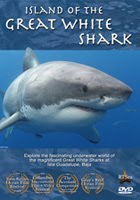
If you have shown even a passing interest in great white sharks, you have probably heard or read descriptions of these powerful sharks as ambush predators which feed primarily on seals and sea lions. And you may have seen images of white sharks on the hunt, leaping out of the water as they hope to catch an unsuspecting seal - striking images of one of the ocean's truly most magnificent predators.
In a recent scientific paper, Neil Hammerschlag, Ph.D. of the University of Miami's RJ Dunlap Marine Conservation Program and R. Aidan Martin, Ph.D. of the University of British Columbia examined the nuts and bolts of what transpires when a great white shark is in a predation mode. "Marine predator-prey contests: ambush and speed versus vigilance and agility," published in Marine Biology Research, details the optical and physical advantages and disadvantages for both predator and prey.
Camouflage, Vision, and Speed
The researchers studied great white shark predatory behavior at South Africa's Seal Island, famed for its spectacular breaching white sharks. They observed several elements that play into the shark's ability to affect a successful ambush. First, the time of day: we have heard that many sharks like to hunt at early dusk or sunrise. This is a time period that provides the shark with a workable degree of light to see prey at the surface, but also provides maximum camouflage using its natural counter-shading (dark coloration on top, light underneath). In low light levels, the shark's gray upper body reflects very little light and easily blends in with the dark rocky bottom below.
I have seen this personally where, during bright sun, the shark is illuminated with dancing rays of sunlight and can take on a slight metallic sheen to its skin. But as the sun falls and the dappled light fades, the shark's skin becomes strikingly flat and non-reflective - its cloak of invisibility now at work.
 The researchers also noted that the great white shark's ability to see a seal moving along the surface is linked to the shark's depth. A principle call Snell's Law restricts the shark's range of vision to a formula based on depth - a common depth exhibited by the sharks in gaining an ideal horizontal view of the surface (150 to 170m/490 to 550ft) is around 26 to 30m (85 to 98ft).
Finally, there is the great white shark's speed. The muscles of a great white are incredible storehouses of energy, capable of very powerful bursts that can hurtle the shark to speeds of 35km/h (22 mph) at the surface, over 1.5x the speed of breaching blacktip sharks and enough to lift a 2000 pound shark clear of the water. To reach that maximum velocity, the white shark requires a depth - a running start, as it were - of a little over 25m (82ft) and can cover that distance in less than 3 seconds! That leaves the seal with precious little time to escape.
An Opportunity for the Prey
Nature has certainly allowed the great white shark to evolve into an extraordinarily efficient hunter. But does its prey have anything up its sleeve? In the early dusk light, the seal's vision is limited to about 3m (9ft) in depth which can provide it with just a split second to spot an ambushing shark at top speed. However, with that small window of time, nature has provided the seal with a chance to escape. Seals are very agile in the water, with a very tight turning radius and the ability to change direction quickly. So if the seal is not injured in the initial charge, it can utilize its maneuverability to make a hasty getaway. The seal's vigilance and agility can give it an edge in survival. And as one can expect, those seals that are less experienced (ie: young) or slowed by illness or age are often prey for the great white shark because their awareness and agility is diminished.
We know the great white shark is a powerful hunter with capabilities that put it near the very pinnacle of the food chain. Hammerschlag's and Martin's study looks at the actual mechanics of those amazing abilities and makes for an interesting quick read. It proves, once again, how truly fascinating and magnificent these animals are.
Click here to download a PDF of the report.