Showing posts with label oil spill. Show all posts

Sunday, March 25, 2012

Oil Effects Carry On: new study shows subtle but deadly impact of spills years later

A recent study, jointly completed by the UC Davis Bodega Marine Laboratory (BML) and the National Oceanic and Atmospheric Administration (NOAA), indicates that the common chemical analysis of oil spills may be inadequate in measuring some of the more subtle effects and the consequences generated, which may not present themselves until years later.

Reported in the latest issue of CA & ES Outlook, a UC Davis publication, the study focused on an oil spill that occurred in San Francisco Bay in 2007 when the container ship Cosco Busan spilled 54,000 gallons of bunker oil after colliding with the Oakland Bay Bridge. Spawning habitats for the largest West Coast population of Pacific Herring were contaminated.

As reported in CA & ES Outlook, "Researchers accessed the health and viability of herring embryos in oiled and unoiled locations. Their findings, published in the Proceedings of the National Academy of Sciences in January, revealed that components of bunker oil accumulated in naturally spawned herring embryos, then interacted with sunlight during low tides to kill the embryos. Bunker oil is a thick fuel oil distilled from crude oil."

While we see the dramatic early effects of oil spills with oil-covered animals, oil slicks and tar balls; and we see the television advertisements from oil companies espousing how areas impacted by spills have now all but returned to normal; we must be aware of the subtle impacts that may not present themselves until much later. Even the tiniest of residual chemicals can have a profound effect on marine animal populations based on how embryos and larvae are impacted. This has the potential to hamper or even destroy coastal marine ecosystems and even commercial fisheries.

"Our research represents a change in the paradigm for oil spill research and detecting oil spill effects in an urbanized estuary," said professor Gary Cherr, BML director and co-author of the study. The general public must be attuned to the ongoing research that can contradict the publicity-seeking and self-serving positions of oil companies that claim areas, like the Deepwater Horizon oil spill in the Gulf of Mexico, are once again pristine.

Wednesday, November 2, 2011

The Montebello's Oil: California wreck is no longer a threat but a mystery lingers

A couple of years back, I had pitched a television show on potential environmental disasters - man-made situations waiting to turn into ecological nightmares unless we act now. One of the segments of the show was to examine the condition and future fate of the Montebello, a 457-foot oil tanker resting on the ocean floor off the central California coast.

In the pre-dawn hours, only fifteen days following the attack on Pearl Harbor, a Japanese submarine sent the Montebello to the bottom as it left Port San Luis. She came to rest in 900 feet of water, taking along her cargo of over 3 million gallons of crude oil.

Mystery has surrounded the Montebello; surviving crewmembers claimed she was struck amidships but no oil leaked from its wound and its current position on the sandy bottom perhaps tells a different story. In 1996, NOAA sent a submersible down to explore the wreck and found it in surprisingly good shape. It appeared that the freighter had been struck near the bow, which was separated from the rest of the ship when it struck the bottom. Fortunately, the holds or tanks that would contain the oil appeared to be intact.

In 2003, the Montebello was again visited, this time by scientists from the Monterey Bay and Channel Islands Marine Sanctuaries. And this time, the old girl was beginning to show her age. The threat of the ship giving up its cargo in the form of a massive oil leak became a very real issue. However, no one was quite sure of its deadly cargo - what type of oil was it that none had been detected in over 70 years?

The following year, the Oakland Trubune reported, "Scientists were vexed by the mystery: They didn't know the density of the oil that the Montebello had taken on, an important factor for predicting the likelihood of a leak. After reading a newspaper story, Richard Quincy [surviving crewmember from the Montebello] called marine sanctuary officials with the answer: At Port San Luis, the Vancouver-bound ship had taken on a load of Santa Maria crude - oil so thick it had to be heated just to flow."

One of the 1996 researchers, Robert Schwemmer was quoted as saying, "The historic record has not revealed any oil discharge or oiled beaches in the area. So, that leads us to believe it potentially has the oil. The water temperature's 41 degrees. So, the consistency of this oil is a tar ball or Jell-o."

The Montebello was an ecological time bomb. And the clock was ticking. . .

Now return to the present and the results of several weeks of underwater testing on the Montebello have just been announced. Using advanced technology to determine the density of the liquid inside the still-intact ship, along with drilling into the fuel tanks to sample what was inside, scientists and researchers from NOAA, the California Department of Fish and Game, and the U.S. Coast Guard have come up with a startling discovery.

"At the end of the day, the Montebello is filled with seawater," said Fish and Game spokesperson Andrew Hughan.

Seawater! So, just where did over 3 million gallons of crude oil go? In a recent article in the Los Angeles Times, writer Tony Barboza reported, "
The answer may never be known, but scientists have developed one scenario: Some of the oil leaked out and evaporated within the first few days after the boat went down. The bulk of it probably gurgled to the surface as the ship sank, drifting south and away from the shoreline, scientists suggested. Whatever was left inside might have washed ashore but, scattered so widely, it probably went unnoticed."

But can that be possible? Can oil, once reported to be the consistency of Jell-o, simply gurgle to the surface and evaporate? Granted, the oil becomes much for fluid when exposed to warmer temperatures - but 3 million gallons going unnoticed? Well, it's truly a mystery with what would appear to be a happy ending: no horrendous oil spill to blacken the beaches and destroy surrounding marine life in central California.

Jordan Stout, National Oceanic and Atmospheric Administration Scientific Support Coordinator, summed it up,
"We will probably never know what happened to the oil."

Read about the Montebello from the
Monterey Bay National Marine Sanctuary.
Read recent article on the Montebello's oil in the Los Angeles Times.

Sunday, July 3, 2011

Yellowstone River Oil Spill: 1,000 barrels pour into Montana river

When we think of oil spills, we first turn to the oceans - like the Gulf of Mexico's Deepwater Horizon or Alaska's Exxon Valdez spill. However, the transportation of oil is not limited to just the seas and spills can occur on land, impacting fresh water bodies of water in the process.

Late this past Friday, an oil pipeline that runs six feet beneath the Yellowstone River in Montana ruptured and before crews from Exxon Oil could manage to shut it off, as much as 1,000 barrels of oil spewed into the river, according to Exxon officials. Other oil company officials estimated the quantity of oil at about 42,000 gallons.

Due to record rains and a heavier than usual snowpack, the Yellowstone River is running fast and much deeper than normal, in fact it has caused some flooding as it runs from Montana to North Dakota, meeting up with the Missouri River. Moving at 5 to 7 mph, the oil plume was first reported to be 25 miles in length but later reports have suggested it has doubled that length.

Exxon response teams are using containment booms and absorbent sheets to clean up the spill as the oil makes it way into the river's marshland banks. No chemical dispersants have been suggested as of this writing - in reviewing several news reports, I did not find anyone venturing an opinion as to how a body of fresh water could handle oil broken down into micro-globules; whether there are organisms that can consume the oil as was always touted regarding ocean spills and dispersants.

The spill occurred near Billings and downstream 140 residents from the town of Laurel were evacuated for a brief time as strong, overpowering fumes and the fear of a possible explosion prompted city officials to take action.

The Associated Press reported,
"'The timing couldn't be worse,' said Steve Knecht, chief of operations for Montana Disaster and Emergency Services, who added that the plume was measured at 25 miles near Pompeys Pillar National Monument. 'With the Yellowstone running at flood stage and all the debris, it makes it dang tough to get out there to do anything.'"

Oil can have the same disastrous effect on animal and plant life as occurs in ocean spills. However, in this case, it is complicated by a fast-moving river at flood level, making containment more challenging. Residents will have to wait and see as to what becomes of the river and its ecosystem due to this spill, both in the short-term and long-term consequences.

Read about it from Associated Press/Yahoo.
Watch a video from Associated Press/The Washington Post.

Sunday, April 24, 2011

Attacking Oil: new research in dealing with the effects of oil spills

While developments in alternative energy - like solar, wind, and thermal - continue, the harsh truth is that it will be some time before these and other energy sources can make a considerable dent in our reliance on fossil fuels. And so the reality of someday having to contend with another spill, perhaps on the same level as the Gulf oil spill or worse, is very real.

Therefore, while science continues to look towards alternatives, it is also looking at ways to deal with the effects of spills on the environment. Chemical dispersants, while perhaps being able to actually disperse the oil, have not been given a clean bill of health, so to speak, when it comes to ancillary effects on the environment, particularly when used at the high levels administered in the Gulf oil spill. Scientists are trying to find more natural or organic methods to better treat oil in the soil, plants, and even on animal life, like birds.

Here are two interesting videos from National Geographic Daily News that highlight some of the research and progress that is being made in this approach. If successful, it could provide a means to better combat the effects of an oil spill. But these will never replace the need for more alternative fuels - just like methadone is only a temporary replacement for the heroin addict. Getting off the addiction is the ultimate and only definitive cure.


Friday, May 14, 2010

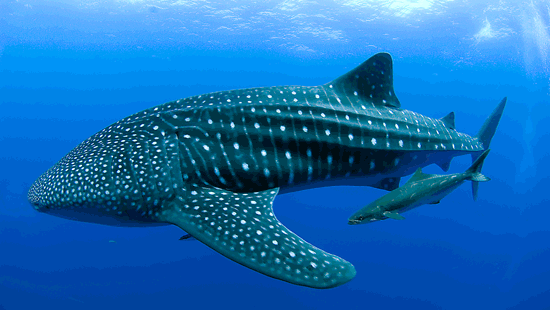
Whale Sharks and Oil Dispersant: research scientists weigh-in on the hidden risks

Many organizations and blogs have been keeping the Gulf oil spill front and center - and for good reason. The Shark Divers blog has posted several items of interest including this one, which covered an interview that I sat in on with members of the University of Southern Mississippi Gulf Coast Research Laboratory. While the mainstream news and general public watch for signs of oil on the shoreline, there are some serious impacts that can be occurring right now, out in the Gulf, below the waves.

Gulf Oil Spill - Prime Time for Whale Sharks at Ground Zero

Friday, May 14, 2010

We spent some time with Dr. Eric Hoffmayer, shark biologist at the University of Southern Mississippi Gulf Coast Research Laboratory and Dr. Joe Griffitt, aquatic toxicologist, to discuss the current oil situation in the Gulf of Mexico.

Dr. Hoffmayer has tracked close to 300 whale sharks (Rhincodon typus) in the Gulf since 2002. He is the preeminent whale shark biologist of the region and has concerns for the seasonal migration of these animals, some of which have come from as far away as the Caribbean.

As many as one third of his tracked animals are estimated to be at "ground zero" the very place upwards to 70,000 barrels of oil are pouring into the Gulf and 500,000 gallons of Corexit, a toxic dispersant, is being sprayed.

This map is an overlay of where the Gulf whale sharks most likely are and where the oil slick and dispersant is now.

"Most people have no idea we have whale sharks in the Gulf. It has been a terrific success story; we have just realized there are more animals out there then we originally thought," said Dr. Hoffmayer. "Because the public is unaware of that, the issue of this oil spill and these animals is just not on the front burner. This is critical whale shark habitat."

"We're hoping that these whale sharks might sense the oil and move out of the area. We have seen other species of sharks closer to shore under a sheen of oil, but until we get out there and tag a few sharks we just do not know what's happening, or even if they are moving."

Dr. Hoffmayer confirmed, "This is the peak season for whale sharks in the Gulf: May through September."

Meanwhile, we asked Dr. Griffitt to comment on Corexit, a dispersant being widely used by BP, and it's effects. "This stuff is designed to break up the oil into micro droplets. The concern is where it goes from there through the water column. Smaller oil particles get taken up through the food chain very quickly. The fact is we're in uncharted territory, no one knows what these amounts of dispersed oil and Corexit will do to bio-accumulation."

"No one is talking about pelagic species right now in the media," said Dr. Hoffmayer. "Or what this shower of smaller oil particles and dispersant might be doing to the wildlife - it will have a tremendous impact."

Dr. Hoffmayer plans to have his team attempt to tag and track whale sharks this season. "We are linked with people doing aerial surveys right now and they report whale shark activity to us."

Dr. Griffitt pointed out, "These smaller globules of oil will spend a lot of time in the ocean and once it mixes with dispersant this combo can be more toxic than the original substances. More study is needed."

Dr. Hoffmayer is currently seeking funding from all sources to get an expanded tagging and tracking program in place for 2010. Those seeking to help can contact him directly at:

Dr. Eric Hoffmayer Ph.D.
University of Southern Mississippi Gulf Coast Research Laboratory
228.872.4257
Eric.Hoffmayer@usm.edu

His website will be updating whale shark activity as it comes in and as the 2010 migratory paths are known. We will keep you updated.

Monday, May 10, 2010

Gulf Oil Spill: flow rate is questioned; just how big is it?

As the news from the Gulf of Mexico oil spill continues to seemingly go from bad to worse, I came across this widget provided by the PBS News Hour web site:


What is interesting and most disturbing about this widget is the ability to adjust the flow of oil based on the various estimates being provided by different companies or agencies. The number of 5,000 barrels per day that has been used in most news reporting is now being questioned, as it is being suggested that the number could be far greater.

Independent scientists and research groups have given estimates of 25,000 barrels per day (1,050,000 gallons daily). In fact, in a closed-door hearing today, a senior executive of British Petroleum stated that the number could get to be as high as 60,000 barrels per day or approximately 2.5 million gallons daily.

Read the PBS NewsHour article.

Also, if the size of the oil spill is a bit hard to fathom looking at a map of the Gulf of Mexico, Google Earth provides you with the ability to overlay the spill as its currently known over your city. You need to download the Google Earth software - it's free (click here) or try this link (click here).


The image above is what the spill currently looks like when overlaid on my hometown of Orange County, CA. It reaches from Los Angeles to San Diego and from Santa Catalina Island well into Riverside.

Friday, May 7, 2010

Gulf Oil Spill: real-time web news, politics, and scientific facts

Today, British Petroleum hopes to take careful aim and secure a hastily developed steel tower over one of the Gulf of Mexico oil spill's primary leaks. Once secured, the oil that accumulates inside will be drained out from above. No easy task and there is much concern as to whether the tower can withstand Gulf currents and remain in place.

There is a constant stream of news bites coming from the broadcast media and most every environmental or conservation group is issuing calls to action to repeal offshore oil drilling permits. Rather than presume that I have anything more illuminating to contribute, I will leave you with three interesting information sources:

NEWS:
Real-Time Gulf-Crisis Web Site: Set up by the Center for Biological Diversity (CBD), this web site compiles breaking news reports on the Gulf oil spill throughout the day, in addition to providing an updated listing of FAQs. CBD is a proactive organization that uses the courts to produce results - so you won't find much love for oil companies or ineffective government agencies here but it's a good one-stop-shop for the latest news.

POLITICS:
Interesting video segment from Keith Olbermann/MSNBC that documents some of the political history behind U.S. offshore drilling including Cheney/Halliburton and Interior Secretary Salazar/oil industry connections and even info about BP, years ago, passing on additional technological backups that could have prevented the oil blowout because they were deemed too costly - before BP reported record profits.

Visit msnbc.com for breaking news, world news, and news about the economy

SCIENCE:
We don't need to be rocket scientists to understand that oil is not good for the environment, but where is the objective science that measures and confirms that assumption? SeaWeb has issued a special report on the effects of oil, listing a variety of scientific studies and reports in abstract (ie: summary) format - you have to search for the complete article, although many are freely offered on the web via links. The studies are listed in categories covering the impact on humans, marine mammals, marine ecosystems, corals, and more. Click here to download the report in PDF.

We will all watch the events in the Gulf unfold and hope that the leak will be arrested soon. But the impact it will have on the Gulf of Mexico's ecosystems and shoreline economies will be felt for perhaps decades. Long after the last drop of oil has been mopped up, we need to keep the pressure on our elected officials in re-evaluating strategies that involve more drilling, when developing alternative energy sources should be our number one priority.

Monday, May 3, 2010

Alternative Energy: after the Gulf of Mexico, what next?

With the world watching events unfold in the Gulf of Mexico regarding the British Petroleum oil spill - from threatened wildlife, shattered shoreline economies and fisheries to a flotilla of agencies involved in confining, dispersing or arresting the oil leak - we are reminded in a very upfront and real way the price both society and the earth pays for our dependence on fossil fuels.

These are the occasional slaps to face that remind us of the risks. Unfortunately, the CO2 emissions and other pollutants that this energy source unleashes on the planet are much more subversive and subtle, at least to most of us. We live with the belching exhaust, the brown haze, and the more and more frequent fluctuations in temperature and weather until the accumulation reaches a critical point wherein the effects are definitely quantifiable but the consequences may be long-lasting even with our best remedial efforts.

Singular profound events have a way of grabbing our attention. And not all policy makers or business leaders have a deaf ear to the problems we face.

My friend and fellow diver, Patti Balian, sent me a link to a video on CNN where a discussion panel is talking about the critical need for alternative energy sources (click on the image below). Included on the panel is the president of the Maldives, an island nation that is literally faced with extinction because of rising sea levels (the islands are less than two meters about sea level); the CEO of Puma; and a representative of The Climate Group from China. Also included in the group is an appearance by Avatar director James Cameron. It's an interesting brief discussion that focuses attention on the future needs for alternative and/or renewable energy.


As the video reminds us, while our attention and emotions are fixed on the Gulf of Mexico, our minds and our actions must be fixed on the future. In the Gulf of Mexico, eventually the oil spill will stop, the shorelines and the local economies will recover - although it will take decades - and the lawsuits and liabilities will all be resolved.

But what next? Will we learn anything from this or slip back into the status quo, only to await the next re-run? I hope not.

Wednesday, April 28, 2010

Gulf of Mexico Oil Spill: energy has consequences beyond the shoreline

One of the leading environmental stories has been the recent explosion, fire, and sinking of the Trans Ocean/BP floating oil rig in the Gulf of Mexico and the subsequent oil spill that has been expanding by approximately 42,000 gallons of oil each day from an oil head 5,000 feet deep. According to the latest news reports, efforts are being made to stem the flow of oil, using ROVs to activate what is called a blowout preventer - a system of valves situated at the well head - but, as of this posting, they have not been successful. Alternatives include drilling relief lines to reduce the pressure, but that would take several months to complete.

In the meantime, the spill continues to spread and although a high pressure weather ridge, producing offshore winds, once slowed its advance, according to the Los Angeles Times, the first oil should reach the Louisiana shoreline by Friday. To many within the general public, particularly those living in the Gulf states that lie in the path of the oil spill, that's when it will become all too real. But what about the environmental impact right now?

Although the NOAA has reported that the spill is shallow (most of it apparently appears to be on the surface), it is coming from the bottom of the ocean floor up - as opposed to right from the surface, as with an oil spill from a ship. Does this have an impact on marine life - fish, plankton, etc. - as it makes its way up to the surface and then spreads out? While we are concerned with oil fouling local beaches, what about the migratory animals that might be moving through the oil far out at sea, well beyond our vision and, perhaps, our concern?

While efforts continue to stop the oil at the source, BP (British Petroleum) intends to conduct an oil burn-off, whereby sections of the oil spill will be isolated, condensed, and set fire. The burned oil will either sink or be removed from the surface. What is the environmental impact of burned oil on the seafloor bottom if it cannot all be collected? Unfortunately, any oil spill of any magnitude is an environmental disaster and as long as we continue to drill for oil - or expand ocean drilling, as proposed by the current U.S. administration - then we must accept the possibility of spills and the consequences that ensue.

This is the trade-off we struggle with. As we promote alternative forms of energy, there is no clear cut, totally environmentally-safe solution. Wind and solar are promoted as viable alternatives, but some conservationists say that expansive solar panel and wind tower farms are harmful to the environment. There are city ordinances that limit or prevent the use of wind and solar devices on individual buildings and the current cost is prohibitive for most residents. Hybrid or all-electric vehicles are advocated, but how will the extra demand for electricity be met? More nuclear or coal power plants?

As the politicians have said, we have an addiction to oil. But in fact, we have an addiction to energy. It runs your car, your lights, and the computer you are using to read this blog. And so,
from wherever we get it - fossil fuels, wind, solar, nuclear, or something else, there will negative consequences; energy is just that kind of two-edge sword. We must do everything we can to prevent broad-based environmental disasters such as what is occurring in the Gulf of Mexico (Can oil companies channel their considerable technical knowledge toward the design of auto-shutoff valves, which could have prevented the blowout or the subsequent leakage?). And we must re-evaluate our entire energy system infrastructure and how energy is consumed at the user end.

No easy task. But do we have a choice?

Sunday, April 25, 2010

Oil Rig Disaster: potential harm to whale sharks

President Obama's announcement several weeks ago, wherein he would consider issuing offshore oil drilling licenses along the southeastern seaboard and portions of the Gulf of Mexico, drew criticism from many conservation groups as it appeared to be a reversal of his position during his presidential campaign. From a public relations standpoint, once you take on a controversial position, the last thing you need is to add fuel to the fire. Or should I say fire to the oil.

As you probably know, a massive floating oil rig off the coast of Louisiana suffered an explosion and fire, sank and, as of yesterday, is reported to be leaking oil from some yet to be defined source underwater.

Here's a post from SharkDivers, bringing up the issue of the oil threat to whale sharks that cruise the area. Unfortunately, this could be only the beginning. . .


Oil Spill in the Gulf - Whale Shark Impact?

Sunday, April 25, 2010

For the past two years we have been covering whale shark aggregations off the coast of Morgan City, Louisiana.

Upwards of 40-100 animals at a time have been sighted here year after year and have become both industry and major media news.

Scientist Eric Hoffmayer has been studying these groups as far out as 100 miles from shore and that's where this week's news from the Gulf takes a decidedly nasty turn.

The Swiss-based Transocean Ltd's Deepwater Horizon oil rig exploded and sunk last week, leaving many in the region to worry about ongoing oil seeping from the wellhead at 5000 feet. The worst case scenario has happened and now experts agree close to 1000 barrels a day are leaking to the surface or close to 42,000 gallons of oil.

Oil clean-up crews have dumped over a million gallons of chemical oil dispersant into the region and more is sure to come in an effort to break up the oil on the surface. As whale sharks feed on the surface this oil and chemical dispersant does not bode well for these peaceful giants of the Gulf.

Tuesday, April 7, 2009

Offshore Oil Drilling: Santa Barbara County readies a ban

In California, Santa Barbara County supervisors are preparing to reinstate a "ban" on offshore drilling, reversing a controversial decision made 8 months ago. The county will deny permits for onshore processing, which effectively halts any new offshore drilling - the actual drilling being something the county has no jurisdiction over. The new position reflects a change of heart (and a change in the board's make up) in favor of alternative energy sources before drilling is even considered.

"I feel strongly that we've been a national leader in conservation and alternative energy," said board member Doreen Farr. "That's the direction we need to go. We can't drill our way out of this."


But not everyone is in agreement. Many Santa Barbara County residents have no problem with tapping into undersea resources, contending that evolving technology has minimized the risk of catastrophic spills.
"It's irresponsible not to develop offshore drilling and production, with a serious eye to making certain it's safe -- which it can be," said Joni Gray, a supervisor who represents the Santa Maria and Lompoc areas.

The new proposed resolution will be considered next week, the timing being in conjunction with an Interior Department hearing in San Francisco on offshore drilling. While there are those who advocate that offshore drilling technology has improved, the memory of the disastrous 1969 Santa Barbara oil spill is still fresh in the minds of many.