Wednesday, February 15, 2012

Bomber Worms: new species of deep sea worm has unique evasive trick

While politicians talk of returning to the moon to build bases of operation, marine scientists continue to discover bizarre aliens right here at home in the inky black depths of the sea - a world with as many mysteries as that of the cosmos.

Case in point: Dr. Karen Osborn of Scripps Institution of Oceanography, along with colleagues from the Monterey bay Aquarium Research Institute, recently found a new species of deep sea worm while using a remotely operated submersible (ROV) off the California coast. At a depth of over 8,800 feet, a new member of Swima worms was filmed and several specimens were taken for study topside.

Very strange little critters who can swim through the water with the continuous, undulating beating of long bristles that run the length of their bodies. The worms have the ability to bioluminate but also have a darkened gut so as to hide the bioluminesence of their consumed prey. Therefore, they know when to turn on the lights and when to hide in the dark to avoid attracting unwelcome predators.

However, should they find themselves threatened, these worms are also able to release small bioluminescent "bombs" in the water to distract predators while they make a hasty getaway. The bombs are small appendages attached near the worm's head. The worms are nicknamed "bomber worms" because of this unusual ability.

The bombs are only 1-2 millimeters in length, making them difficult to see with the ROV's cameras. But once brought to the surface, this clever evasive maneuver became clear to the researchers.

"So we bring the animals up to study them," Dr Osborn said. "If you transfer the animal into a small tank, and harass it a little bit with forceps - kind of bump it anywhere on the body - it will release one of these bombs. As soon as [the bomb] is released it starts glowing green and the animal swims away."

Having grown up with the space program and seen the scientific gains in knowledge and the ancillary material benefits in technology combined with the thrill and awe of discovery, I must admit a certain sense of childhood excitement at the prospect of returning to the moon. But exploring the depths of the oceans right here on Earth can fulfill many of those same goals and aspirations, with the added benefit of learning more about the planet's largest environment - an ecosystem that needs to be better understood in all its complexity if we expect to help preserve and protect it.

Observed Dr. Osborn, "This group of really fantastic animals emphasizes just how much we have to learn about deep sea organisms and deep sea biodiversity."

Source: BBC Earth News

Tuesday, February 14, 2012

U.S. Budget & Science: pluses and minuses, commercial interests favored

In the United States, with the release of President Obama's proposed budget for the fiscal year of 2013, many branches and departments within government must now await to see what the final outcome is - whether proposed cuts are sustained by Congress or whether increases get cut back. If past experience from the last few years and initial comments from Republican leaders are any indication, it's going to get messy.

Overall, for science, the proposed budget provides a modest increase of about 5 percent for non-defense research and development. However, priorities - and budget dollars - favor those areas that have economic or commercial implications.

According to reporting by Nature.com,
“'Overall, the budget sustains an upward trend,' says John Holdren, director of the White House Office of Science and Technology Policy in Washington DC. 'Because of fiscal restraints, it’s not at the rate we preferred.'”

The National Oceanic and Atmospheric Administration (NOAA), receives a 3 percent increase with a portion of that going to further develop a program of polar-orbiting weather and environment satellites that has been plagued by delays and cost overruns.

An assessment of spending and cuts, cited by ScienceInsider, points out the strategy or method-to-the-madness wherein departments that have an immediate impact on economic or commercial interests retain or increase funding. And the programs or projects which get cuts are those that might, in essence, bring up bad news, like threatened species, and would require remedial action (and therefore more expenditures).


"NOAA's National Ocean Service (NOS), which includes the agency's marine sanctuary network and estuarine research reserves, would see a 4% cut to $458.5 million, down from $477.9 million this year. The NOS's conservation and ocean assessment programs would take a $10 million cut, to $166.1 million, while the marine sanctuary program would lose $1 million, bringing it to $46.6 million."

"The National Marine Fisheries Service (NMFS), which manages fisheries within the 322-kilometer Exclusive Economic Zone off U.S. shores, would get an 8% increase to $857.8 million, up form $794.2 million this year. But programs aimed at studying and protecting threatened species would take a $6.4 million cut, to $170 million, and habitat conservation and restoration programs would fall by $7.2 million, to about $36 million."

Another example of preference toward economic interests can be seen in NOAA's 2012 interim catch limits set for Gulf of Maine cod. To avoid having the spawning biomass get below 7,300 metric tons - which would push the population to a tipping point of collapse, a catch limit was set at 6,700 metric tons. However, the Conservation Law Foundation has compiled scientific recommendations that put the appropriate limit at 4,000 metric tons - a limit that is hotly contested by commercial fishery groups as too low to sustain their fleet.

Additionally, larger and more influential industrial fishing fleets are getting a distinct advantage over smaller, local fishermen with NOAA's "catch share system" which allows the larger boats to work inshore rather than limited to farther out at sea.

According to Massachusett's Gloucester Times, "In November, before the arrival of the cod crisis, Gov. Deval Patrick, backed by the congressional delegation, filed socio-economic research evidence showing that the fishery was consolidating into an economic disaster through the National Oceanic and Atmospheric Administration's catch share system, which is steering more and more permits and quota into the hands of fewer and larger businesses, and away from smaller, independent boats. NOAA's own figures show that Gloucester's fleet lost some two dozen of its estimated 96 boats in the 2010 to 2011 fishing year alone."

It's to be expected that during this difficult economy, with its slow and fragile recovery combined with calls for deficit control, many of the areas of interest to conservationists would be subjected to a lack of political commitment. Areas that support industry and possible job growth are bound to get all the attention.

But the influence peddlers who prowl the halls of Washington can often succeed in shuffling priorities and budget dollars for short-term gain, while non-profit environmental and conservation organizations and scientific research groups scrounge for every nickel they can get their hands on. And it's those very groups, working on behalf of the planet, which are looking at long-term consequences that will not only save plant and animal species and whole ecosystems but, as a result, commercial industries as well. If we, as constituents, choose to raise our voices to our elected officials, it should be in support of those groups and those issues that have the greatest impact on our long-term future as a civilization.

Trying to be guardedly optimistic regarding the proposed budget, Scott Slesinger, legislative director for the Washington DC-based Natural Resources Defense Council, said, “They did a pretty good job in making sure we are not hurting our environment and conservation programs.”

We shall see.

Source: Nature.com
Source: Gloucester Times
Source: ScienceInsider

Sunday, February 12, 2012

Sharks Facing Challenges: slow changes in market demand and a rise in illegal fishing

Shark conservation continues to make progress and continues to run up against serious challenges simultaneously. It's a long road that will need to be traveled to reach the ultimate goal of seeing decimated populations of iconic shark species begin to return to some level of normalcy, but it's a trip worth taking.

One of the biggest challenges the movement faces is demand for shark products, particularly shark fins. The shark fin market is centered in Asia where a long cultural history wrapped around the use of shark fin soup as a past symbol of royalty and prestige, today exists to exemplify new wealth and a growing upper middle class. Asian culture has also been a protective and sometimes isolated one and so outside admonitions, under threats of being labeled "Asia bashing", can often fall on deaf ears.

What has been encouraging is evidence of a slow change taking place within Asia itself. Fueled by conservation messages coming from Asian environmental groups, the press, and international organizations like WildAid, more and more restaurants and hotel resorts in places like Singapore and Kulala Lampur are refusing to serve shark fin soup.

Becoming a more frequent story in the Asian press, as reported by the Singapore-based AsiaOne News, "
Sharks are slowly but surely winning the battle to keep their fins as the Chinese traditional dish is no longer a must-have at reunions and wedding dinners. Playing a big part is the Shangri-La chain, which declared that its 72 luxury hotels worldwide would stop serving the controversial dish from this year. [Director of communications for Shangri-La, Rosemarie] Wee said Shangri-La decided to join international efforts to stop the harvesting and trading of shark fins, which had severely depleted the population of the fish."

Addressing market demand, changing a people's taste for shark fin soup - or all shark-related products, for that matter - is a slow process and it must be done very delicately with countries that do not respond well to external pressure or influence as it is often perceived as interference. Public relations campaigns often seem to focus on a younger audience, the next generation of consumers, that seem to be more receptive to new ecological thinking ranging from shark extinctions to over-population to fossil fuels and climate change.

At the other end of the spectrum is another powerful nemesis and that is the economic incentive behind shark products and the tenacity of those involved in the business to keep things as status quo as possible. While recent political advances in anti-shark fin legislation or the designation of shark sanctuaries or protected zones has put some pressure on the commercial shark fishing distribution network, the more these businesses find it difficult to continue legally, the more we will begin to see illegal activities flourish.

According to Israel's Haaertz.com, illegal shark fishing in the Mediterranean is on the rise. With 42% of the 70 shark species found in the Mediterranean to be in danger of extinction, shark fishing is illegal in Israeli waters. The Israel Nature and Parks Authority (INPA) has been apprehending fisherman who were illegally catching sharks and selling them along the Gaza strip and in Tel Aviv. With financial temptation overpowering legality, many are concerned as to whether enforcement will be able to keep up.

Haaertz.com reported, "[INPA supervising director Ohn]
Valency says that the authority doesn’t have enough supervisors to stop shark fishing. In recent weeks various organizations have accused European Mediterranean countries of failing to act forcefully to stop shark fishing."

And with Israel we are looking at only a small part of the Mediterranean coastline. There are some major European players working throughout the Mediterranean - countries like Spain, Italy, and Portugal are heavily involved in commercial shark fishing - clearing out sharks at an alarming rate from this nearly closed body of water. (European nations supply a third of all shark fins to Hong Kong, arguably the shark fin processing capital of the world.)

So, progress is being made but we can expect to see a rocky transition as market demand slowly erodes while the industry does all that it can to perpetuate the business. This will push some participants underground and enforcing state, national or international rules and regulations will be put to the test, straining available resources.

Marine biologists often talk about declining fish populations reaching a critical "tipping point' that can signal the total collapse of a population and its ability to recover. As the conservation work continues on behalf of sharks, the commercial shark fishing industry could someday face its own tipping point. Let's hope that happens before the sharks face theirs.

Source: AsiaOne News
Source:
Haaretz.com

Going Green by Design: Bangkok exhibit shows future of nature-sustainable products

Green or nature-sustainable thinking in design and products is not just a hot topic among major industrial nations in the West; it's also finding its way into countries like Thailand, as evidenced by the exhibit "Everything Forever Now: Designs for a sustainable future" currently on display at the Thailand Creative & Design Center (TCDC) in Bangkok.

Some of the exhibit's many highlights include a bicycle made from nylon powder, a lamp powered by moss, benches made from seaweed, and artificial leather made from leather tannery discards.

"In recent years there has been a shift in the way that designers approach the idea of sustainable design. Now they view it less as a problem, and more as a fact of life – and certainly as an opportunity to rethink what and how we make things, and how we might go about our lives in a more effective and positive way," explained the TCDC website.

A bike, made primarily from nylon powder that is formed into a resin, streamlines the manufacturing process with less raw materials involved and is 65% lighter than an aluminum bicycle with less maintenance required. The manufacturing technique was actually borrowed from space satellite construction, called additive layer manufacturing, whereby all the components are formed as a unit at the same time.

Biophotovoltaics is the science behind a small, glass-topped table designed by Cambridge University which can power a small lamp. The table contains living moss which, through energy produced by the plant's photosynthesis during the day, can charge a small battery that powers the lamp in the evening hours.

To further make a point regarding recycling what would normally be discarded materials, many of the walls surrounding the exhibit are made from discarded milk cartons, processed into a building material that is toxin-free, flame-retardant, and resistant to moisture and termites.

The TCDC exhibit is an example of science working its way into the design and manufacturing world where the economics and practicality of new processes and products could very well shape our future into a more nature-friendly one.

"Whether designing for longevity, building self-sufficient communities, improving the efficiency of infrastructures or developing new materials, the new guard of green designers quietly promises one thing: to deepen and improve our relationship with the environment, both now and well into the future," said TCDC.

Source: TCDC website
Source: Thailand's The Nation

Sharks & Oxygen Depletion: the final word, hopefully, from a shark scientist

Here is a long but valuable post script to my comments at the start of the month regarding the pseudo-scientific concept that without sharks the Earth would lose it's oxygen. My shark advocate colleague, David Shiffman (aka WhySharksMatter), weighed in with his detailed scientific perspective (see below). So I hope this will bring some closure on the subject.

For those shark advocates who have supported this idea, I hope that you will re-assess your position and stick to scientifically-proven facts; there are enough of those to make a strong case for shark conservation. And for those who are mildly curious about sharks, please know that there are serious implications to the extinction or near-extinction of major shark species, whether sought after as a commercial item or simply a product of unfortunate by-catch. But finding yourself trapped in a planetary vacuum is not one of them.

Great post, David. Thanks!


“Sharks create oxygen”: A scientific perspective

I want to apologize to our regular readers for stating something that should be incredibly obvious. Sharks are in no way connected to the global supply of atmospheric oxygen. If every single species of shark went extinct, there would be a variety of negative ecological effects, but a reduction in the global supply of atmospheric oxygen would not be among them. There is not a shred of scientific evidence supporting the idea that the loss of sharks would affect our oxygen supply- not a single scientific paper, not a single technical report. I’ve attended a dozen scientific conferences focusing on marine ecology or shark biology (including three international conferences) and I’ve never seen or heard of anyone presenting or even discussing this. To the best of my knowledge, not a single person who has authored a scientific paper or technical report supports this idea. Despite the complete lack of any kind of credible evidence, and despite many recent blog posts thoroughly debunking it (see here here here here here here and here ), this pseudoscience just won’t die.

The premise of the sharks and oxygen claim is as follows:

A) Sharks, many of which are apex predators, are important in regulating marine food webs;
B) Phytoplankton, which create oxygen through photosynthesis, are in marine food webs;
C) Therefore, without sharks, phytoplankton populations will crash and we won’t have any more oxygen and we’ll all die.

A and B are reasonable enough- we know that under certain circumstances, apex predators can play important roles in structuring and regulating food webs, and we know that phytoplankton produce oxygen (though how much oxygen phytoplankton produces is another debate entirely). It’s part C of the sharks and oxygen claim that’s the problem.

This flawed leap in logic, like many other bits of pseudoscience, is loosely based on reality- specifically, the concept of the “trophic cascade”. To explain a trophic cascade, consider a simple hypothetical food chain where grass is the primary producer, goats consume grass, and chupacabras consume goats. Trophic refers to “trophic level”, an alternative term for a step of a food chain. Grass would be trophic level 0, goats would be trophic level 1, and chupacabras would be trophic level 2. The cascade refers to ripple-like effects that travel throughout a food chain despite initially affecting only one level- for example, a change in chupacabra populations could eventually affect goat populations, which would eventually affect the grass.

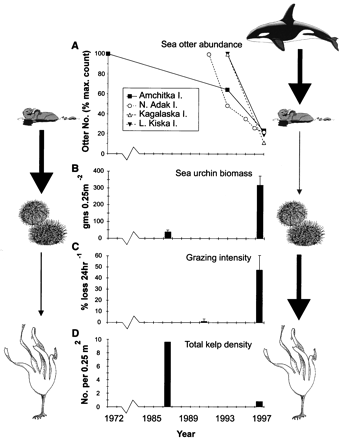
One classic example of a marine trophic cascade comes from Estes et al. 1998. In the original kelp forest system, kelp provided habitat for countless species of fish. Sea urchins ate kelp, but their numbers were kept in check by sea otters. Once orca whales began preying upon sea otters, sea otter populations decreased. With fewer sea otters eating them, sea urchin populations increased- and ate all of the kelp.

Figure 1 from Estes et al. 1998. " (A) Changes in sea otter abundance over time at several islands in the Aleutian archipelago and concurrent changes in (B) sea urchin biomass, (C) grazing intensity, and (D) kelp density measured from kelp forests at Adak Island. Error bars in (B) and (C) indicate 1 SE. The proposed mechanisms of change are portrayed in the marginal cartoons—the one on the left shows how the kelp forest ecosystem was organized before the sea otter's decline and the one on the right shows how this ecosystem changed with the addition of killer whales as an apex predator. Heavy arrows represent strong trophic interactions; light arrows represent weak interactions."

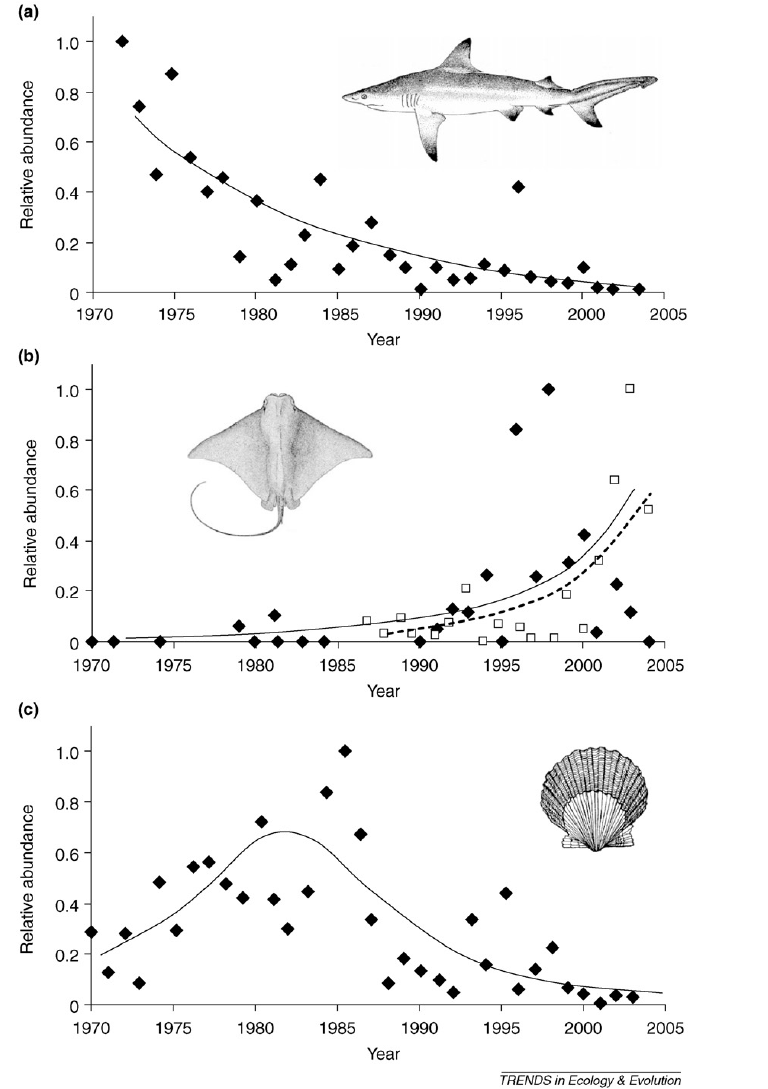
A similar trophic cascade involving sharks was reported in Myers et al. 2007, though these conclusions are still considered controversial among the scientific community. According to this paper, in the Outer Banks, a decrease in shark populations led to an increase in the populations of these sharks’ prey (including cownose rays), and increased cownose ray populations led to a decrease in their prey (including scallops, which used to be the basis for an important coastal fishery).

Figure 1 from Heithaus et al. 2008, a review of shark ecosystem effects, referencing the Myers et al. 2007 conclusions. "The removal of marine predators can result in cascading effects through communities. As (a) catch rates of large sharks, such as blacktip sharks (Carcharhinus limbatus), declined during research surveys along the east coast of the United States, (b) cownose rays began to increase, leading to eventual declines in (c) catches of North Carolina bay scallops (Agropecten irradians). Population densities are expressed as proportions of the observed time series maximum. Trend lines are best fits from generalized linear (a,b) or additive models (c). In (b), filled symbols and line denote Delaware Bay surveys, and open symbols and dashed line are Pamlico Sound, NC, surveys. Field experiments confirmed that scallop declines resulted from increased ray predation [5

There have been numerous models and observational studies concerning the ecological effects that would result from the loss of apex predators (a partial list can be found in my sources below). Not a single one mentions even the remote possibility of a decline in the global supply of oxygen as a consequence of overfishing sharks. If you encounter someone promoting this (or any of a huge variety of pseudoscience claiming to be based on real science), ask them for a copy of the peer-reviewed scientific paper which supports it.

Technically speaking, just because no one has ever written about this phenomenon applying to sharks doesn’t, in of itself, mean that it doesn’t apply to sharks. However, there’s a very good reason why the loss of sharks won’t affect phytoplankton. Trophic cascades tend to occur in simple ecosystems. In the kelp forest, basically only one type of organism eats kelp from the base (sea urchins) and basically only one type of organism eats sea urchins (otters). Sharks fit into different ecosystems differently, and many of those ecosystem are quite complex, so the claim that the loss of sharks will have a uniform global effect is inaccurate at best.

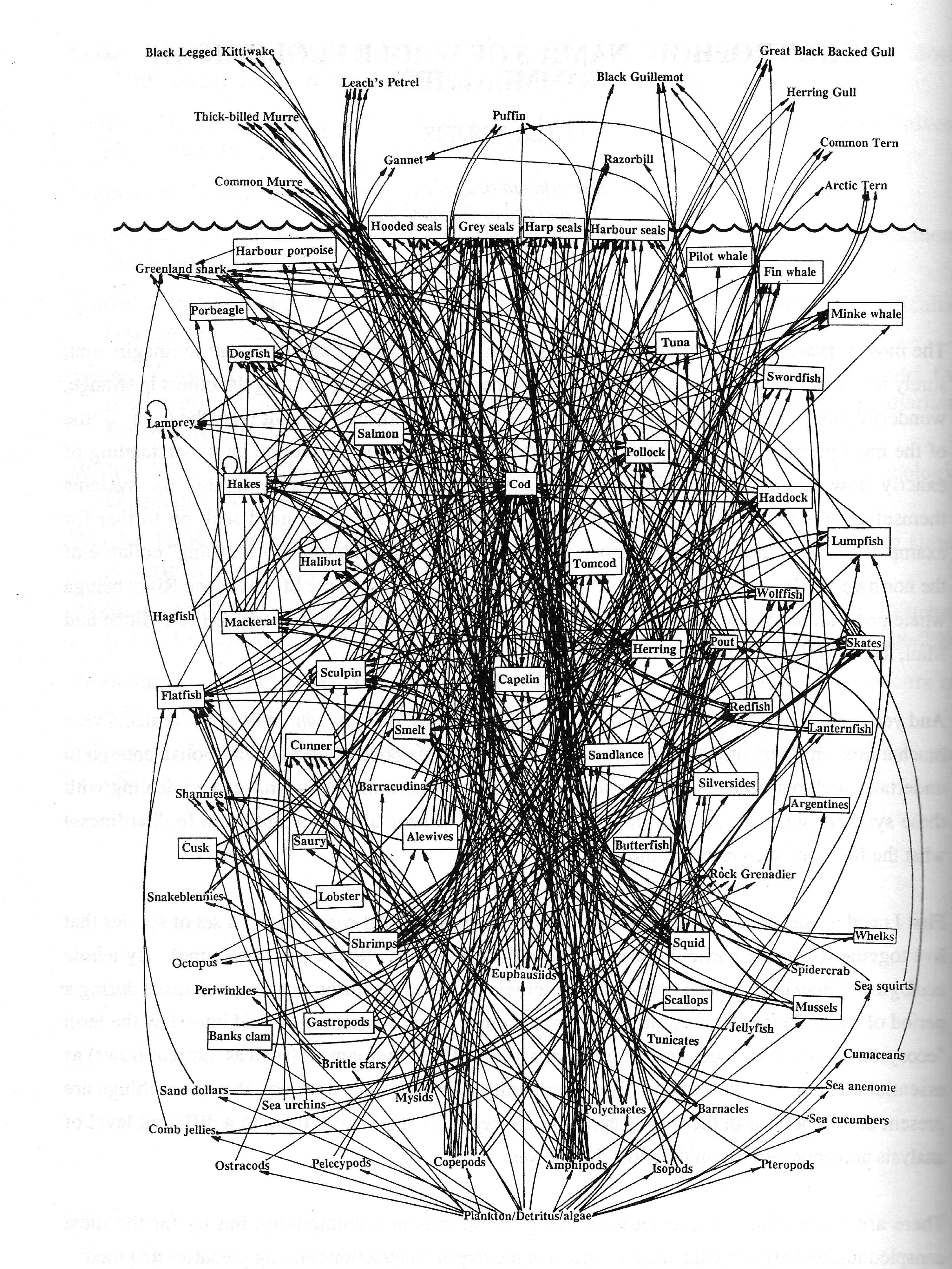
Research from coral reef ecosystems shows than when predator/prey interactions are more diffuse (for example, a system might have many herbivores, many secondary consumers, etc.) , trophic cascades don’t occur. Sharks may eat some herbivores, but they also eat animals that eat those herbivores, so the ecological effects would be less direct. Additionally, even if one prey species experiences “predation release”, other species with similar ecological niches are not affected in the same way. In a complex ecosystem, sharks can be considered to be “trophically decoupled” from phytoplankton- their populations will not affect those of phytoplankton because the trophic relationships are diffuse and complex. Most marine ecosystems are quite complex, as seen below:

A cod-based food web in the North Atlantic, a region of the ocean with relatively FEW species. Image from David Lavigne, National Science and Engineering Research Council

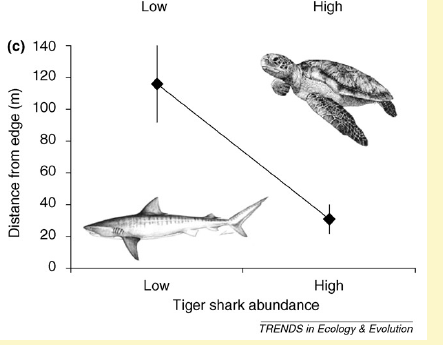
In fact, emerging research in the field of fear ecology has shown that the most important effects resulting from the loss of sharks in an ecosystem may actually be indirect and related to behavior rather than population structure. In other words, sharks may exert more of an influence on an ecosystem by causing organisms in that system to alter their behavior to avoid being eaten. A great example of this comes from Dr. Mike Heithaus’ work in Australia. He found that animals like dolphins, sea turtles, and dugongs (relatives of manatees) will alter their preferred foraging ground during times of the year when large tiger sharks are present. They will forage in areas with less food but less chance of encountering a tiger shark.

Figure 2 from Heithaus et al. 2008. "Risk effects of tiger sharks on megagrazers in Shark Bay, Australia....Green turtles in good body condition (assumed to indicate a good energy state) shift to safe microhabitats with nutrient-poor seagrass when sharks are common"

Many species of sharks have been dangerously overharvested, resulting in alarmingly rapid and severe population declines. The loss of sharks can result in disruptions to the food web, resulting in ecological (and in many cases economic) problems. Conservationists are correct to be concerned about the loss of sharks and the effects this will have on our oceans, and we can and should work to protect these animals. However, sharks have absolutely nothing whatsoever to do with the global oxygen supply. There is absolutely no evidence in favor of this claim, and lots of evidence against it.

Spreading inaccurate claims in support of a worthy cause can only harm that cause by reducing credibility with the public and with policymakers. There are enough real reasons to protect sharks that we shouldn’t need to make up nonsense with no factual basis. I call on all responsible conservationists and advocates to stop perpetuating this pseudoscience.

Source: Southern Fried Science

Thursday, February 9, 2012

Nature's Indomitable Spirit: New Zealand wilding pines, a reminder about the will to survive

Was just finishing a short opinion piece by Brian Taylor for New Zealand's Otago Daily Times about how best to deal with the wilding pines that spread throughout both the north and south islands. Wilding pines, also referred to as wilding conifers, are invasive species of pine trees, the result of a combination of early settlers stripping indigenous scrubland for agriculture and cattle grazing which provided a fertile base for various imported pine tree species to explode across the valleys and hillsides.

With New Zealand spending millions of dollars annually to try to stem the tide of the ever-expanding wilding pines, Taylor was questioning the wisdom of current strategies. Yes, the pines are an invasive species that is altering the natural landscape and the result is both an economic and environmental threat, but it's a result due in part to man providing the trees with the initial foothold. Taylor questioned whether current land management use - grazing and burning techniques to maintain economically important grasslands - would forever be at odds with wilding pines and whether there could be other natural buffers developed to help manage the pines' growth and expansion, rather than the felling of mature trees and removal of seedlings which has not yielded hoped for results.

Interesting article but what caught my attention most of all was Taylor's description of nature's tenacity, as it is applicable to all environments - land or sea, plant or animal.

"Mother Nature can be a rather intractable old matriarch, and no matter how strenuously Man tries to thwart her advances, she will invariably be the clear winner in a marathon. After all, she has been around far longer than mankind and has not survived millions of years by simply taking a back seat when threatened. She is a formidable contestant, smart, very smart in fact, versatile, highly adaptable, and loves a challenge. When the chips are down, she will always be one jump ahead, ever ready to override our mistaken endeavours by taking control of regeneration her way.

She abhors nudity and will make sure that all of her domain remains well covered. There will be no bare spots for her, no sir. Pull out a weed and see what she does, she will plant another one straight back and will continue to do so as long as we constantly annoy her by perpetuating our misguided attempts at laying the ground bare."


Taylor is describing nature's will to survive. Despite all that can be heaped upon it, whether through natural occurrences or man-made interference, nature will do what it can, do whatever is necessary to carry on. It will adjust; it will adapt. But what we must keep in mind is that to evolve and continue its existence, nature can make some cold, harsh decisions - such as extinctions if that's what it takes. And that can involve the loss of the smallest insect all the way up to the largest mammals in the sea. And it can include us just as easily. For all our accomplishments and all our self-importance, if we push nature too far, it can shake us off like a bad case of fleas.

After pondering whether New Zealand could adopt land management policies that work with nature rather than continually fighting it, Taylor closes with a thoughtful reminder about ecological perspective - in whose playground we are briefly being allowed to roam.


"We live in a mere moment of time in the history of the planet. It has constantly evolved throughout the ages, and will continue to do so long after we have gone. We are able to exist on earth only because nature provides us with all our needs for survival. Yet in this modern world of rapidly diminishing forest cover, some are still prepared to promote the age-old slash and burn mentality - in this case, 'for the good of the view, rather than for the good of the planet'.

Maybe it is time we reconfigured our response strategies and embraced greater biodiversity, which is, after all, the key to a balanced and healthy ecosystem."


Here, here.


Source: Otago Daily Times

Wednesday, February 8, 2012

Underwater Noise Abatement: good news/bad news for marine life

Possible good news/bad news for ocean noise pollution. First the bad news. A research study from the New England Aquarium in Boston provides the first documentation of harmful stress on whales due to elevated noise levels from ships.

A "Before & After" Research Opportunity
The issue of ocean noise pollution has been around for some time and hotly debated depending on whose side you're on. Construction noise from oil drilling platforms or other such ocean-based structures, sonar signals from naval vessels, even underwater explosions as part of oil and gas exploration - all have been subject to intense scrutiny and more from various environmental groups (there are lawsuits currently against the U.S. government regarding submarine sonar sounds).

But sometimes having the definitive proof can be challenging. To measure the effects of noise pollution you need, as a basis of comparison, a period of little or no sound and an examination of the health of animals within that environment. Then compare it to a noisy environment. Those set of circumstances don't come along every day. Until September 11th, 2001.

Northern right whales are a highly endangered whale, due to years of whaling pressure followed by intense shipping along the whale's coastal migratory routes up and down the east coast of the U.S. With the advent of September 11th, for national security concerns, shipping was sharply reduced following the attacks. This provided a window of opportunity for New England Aquarium researcher Rosalind Rolland to study the condition of the whales during a "quiet" period. And how do you do that? Why, by studying whale poop, of course.

Researchers can measure stress levels in whales by examining stress hormone levels found in the whales' waste - fecal balls that float to the surface. Rolland's team measured significant reductions in stress hormones during the lull in shipping following the terrorist attacks. Stress levels were again high when shipping activity returned to pre-9/11capacities.

"We showed whales occupying oceans with high levels of ship noise have a chronic stress response. We knew whales changed the frequency of their calls to adapt to the ship noise, but this work shows it is not merely an annoyance – it is having a physical effect," said Rolland. "Instant responses to stress – like running away from a tiger – can be life-saving. But if it becomes chronic, it causes profound depression of the immune system, making them vulnerable to disease, and it depresses reproduction."

With the cause and effect evidence at hand, the question is what do we do about it? Shipping is far too vital of an economic enterprise for many nations to simply decide to curtail it on behalf of the whales, regardless of how that would please marine mammal advocates.

"The positive aspect to this particular issue is that it is a solvable problem," Rolland said. She believes that much of the problem can be addressed by making the engines more efficient. As an example, a lot of design has gone into making submarine screws (propellers) more efficient and quieter, thereby providing a tactical edge militarily. If that same engineering effort could be put towards conventional ships, a marked reduction in overall noise levels could be achieved - along with fuel saving benefits in the process. It's possible; however, it will take some time. The Guardian reports that there are approximately 50,000 ships at sea on any given day. That's a lot of vessels in need of costly retrofitting.

"Amazingly, there are currently no accepted international standards regarding noise pollution in our seas," said Danny Groves of the Whale and Dolphin Conservation Society. "Not enough is being done to reduce noise in our oceans Very little is known about its long-term effects and more research is needed." Hopefully, the New England Aquarium's research data will help the cause.

Possible Good News for Noise Abatement
The construction and operation of oil platforms or other offshore structures, like wind turbines, can produce noise levels that are harmful, if not outright deadly, to marine life. The process of driving in pilings with the construction of energy platforms can produce sound waves of such intensity that they can kill fish. The initial pressure wave from, say, a pile driver compresses the air in a fish's bladder. With the passing of the pressure wave, the air suddenly expands, rupturing the bladder and causing other organ damage. However, ongoing research is using that same compression of air to provide a possible solution: bubble curtains.

A little over eight years ago, the California Department of Transportation (Caltrans) utilized a wall of bubbles to dampen the impact on surrounding marine life from piles being driven for a retrofitting of the San Francisco-Oakland Bay Bridge.

According to marine biologist Bud Abbott, who was working as a consultant on the Caltrans project, the bubble curtains work by altering the pressure wave's intensity, "When a pressure wave hits an air bubble, it will compress the bubble, then it will expand again, so energy is lost. Sound travels faster through water than air. It slows down as it hits the air bubble."

Although some scientists debate the extant to which energy is lost, Abbott says the curtains alter the pressure wave, changing it from a sharp, destructive force to a smoother, less destructive wave pattern.

According to National Geographic Daily News, an offshore turbine farm being built in the Baltic Sea by a consortium of German energy companies will incorporate bubble curtains to reduce construction and operation noise to government-mandated levels of no greater than 160 decibels at approximately a half mile. Additionally, Shell Oil is looking into the use of bubble curtains to provide some measure of protection for Arctic marine life, including some endangered marine mammal species, as part of their licensed permits to build and operate energy facilities in the Arctic.

Mitch Winkler, manager of the Arctic Technology Program for Shell International Exploration and Production, said,
"We are focusing on the use of air bubbles and their impact on sound waves as a means of reducing the sound transmitted from stationary sources. We are targeting a reduction in the amount of noise by as much as ten decibels."

While the U.S. Marine Mammal Protection Act has specific noise level limitations designed to protect marine mammals, many environmental groups, while applauding the efforts toward noise abatement, feel there are even graver threats to Arctic ecosystems from oil and gas companies.

"We're certainly in favor of using and testing any new methods of reducing sound from human activities underwater," said Brendan Cummings, senior counsel for the Center for Biological Diversity. "[The concept of] "bubble curtains is raised pretty frequently, although there are few real-world applications of it. But there are far bigger problems than the noise impacts, including the simple fact that there is no technology, methodology, and—most important—no infrastructure in place to deal with an oil spill in the Arctic."

True. Drilling in the Arctic is fraught with ecological hazards and it is an ongoing political tug-of-war between environmental concerns and current pressing energy needs, even while alternative energy systems continue to develop and expand. However, for the construction and operation of any offshore facility in the world - oil, wind, or otherwise - at least there is one form of technology that appears hopeful in providing marine mammals with some measure of protection.

Source: The Guardian
Source:
National Geographic Daily News

Sunday, February 5, 2012

Marine Mammals & Human Impacts: new study details a higher risk of extinction

New research from an international team of researchers indicates that humans pose a higher risk of extinction for marine mammals. Now, for many ocean conservation advocates I can hear the collective "Duuuuuh" right now, complete with eyes rolling round in their sockets. But wait. This particular study, "Drivers and Hotspots of Extinction Risk in Marine Mammals" published in the journal Proceedings of the National Academy of Sciences USA, has the potential for catching the attention of international ocean management organizations because of the methodologies used by the researchers to draw their conclusions.

There are computer models that have been successfully used to determine the status of terrestrial mammals. These predictive models incorporate a variety of factors including habitat, body mass, rate of reproduction, social group size, and more. Each factor is weighted based on the particular species. All have an impact on how well a particular species survives and what their future may have in store when certain factors change, such as pollution, loss of habitat, or climate change.

Marine mammals currently include 128 different species from whales and dolphins to seals and sea lions to manatees and dugongs. And right know the status of nearly 40 percent of them are unknown due to a lack of data. Even with that limitation, the IUCN Red List considers 25% as endangered. However, this new study's predictive model pushes that figure closer to 37 percent.

While factors such as a slow rate of reproduction, a small geographic area of distribution, or a tendency toward small social groups, when combined with environmental factors could have an effect on predicted risks of extinction, according to Dr. Ana Davidson, lead author from the University of New Mexico, “species’ traits were the most impor­tant pre­dic­tors of risk over­all, under­scor­ing the impor­tance of under­stand­ing species’ basic biolo­gies and ecolo­gies, which is unfor­tu­nately lack­ing for many marine mam­mals, even some of the most well-known groups like dolphins.”

A press release issued by the University of New Mexico reported,
"Using their pre­dic­tive model, the team also gen­er­ated new maps of species at risk. They illus­trate that at-risk species mostly occur in coastal regions and in pro­duc­tive areas of the open ocean, which are also areas sub­ject to high lev­els of human impact. The mod­els iden­ti­fied 13 global hotspots where high num­bers of at-risk species occur, and show how they over­lap with lead­ing human impacts on the world’s oceans (fish­ing, ship­ping and pol­lu­tion, and cli­mate change) and Marine Pro­tected Areas."

We found that three-quarters of marine mam­mal species expe­ri­ence high lev­els of human impact in their envi­ron­ment, and these include the cumu­la­tive effects of numer­ous fac­tors, includ­ing fish­ing, ship­ping, pol­lu­tion, sea sur­face tem­per­a­ture change, ocean acid­i­fi­ca­tion, inva­sive species, oil rigs, and human pop­u­la­tion den­sity,” said Dr. Ali­son Boyer, another researcher from the Uni­ver­sity of Tennessee involved in the study.

This new research adds to a growing body of work that supports the concept of Marine Protected Areas and other recognized marine parks or sanctuaries, while also recognizing the need for more international management policies. There is much to be learned about marine mammals, more than most people think. However, studies like this make the case that we cannot just sit on our hands and wait for data on each and every species to arrive. Predictive models that have been shown to be of value on land can also show that time is running out for marine mammals as well if decision makers choose to hesitate and strong preventative measures are not taken.

Source: UNM Today

Thanks to Mike DeGruy: an explorer's enthusiasm, gone too soon

This past Saturday in Australia, the ocean conservation and the motion picture community lost two of its great adventurers. Mike DeGruy of Santa Barbara, California, and Andrew Wight of Victoria, Australia were killed when a helicopter owned by Wight crashed just after take-off in North South Wales. The two were reportedly preparing to scout locations for a documentary film they were working on when the helicopter came down. An investigation by Australian authorities is underway to determine the cause.

That's the news, the cold hard facts. And it's a tragic loss on two levels. Of course, for the families and close friends of Mike and Andrew, their deaths are painful and made more so by the sudden nature of it; two men doing their job in an aircraft that was probably in the middle of a very routine maneuver, something done hundreds of times before. Although both were adventurers and filmmakers and, by definition, a certain measure of risk is often involved in their work, their long and established careers were testaments to calculated risk. So, an accident like this - while it could be said, they were doing what they loved - it's no less painful and unexpected to those close to them.

In addition to the personal loss, is the void it leaves in the ocean conservation and nature filmmaking communities. Andrew Wight, 51, is a well-respected Australian writer and film producer, most recently for the 2010 film, Sanctum, which was executive produced by James Cameron. Their professional relationship had grown and Andrew was working with Cameron on future projects as the head of the Australian office for Cameron's 3D production arm, Cameron Pace.

Mike DeGruy, 60, has a distinguished career in ocean studies, starting from his early years with the Waikiki Aquarium as Curator of Invertebrates followed by work in the Enewetak Atoll and Palau, which lead him into making ocean-related films for the BBC, PBS, and National Geographic. Eventually, Mike's enthusiasm and personality made its way in front of the camera and he became an energetic host on many nature television productions.

I first met Mike several years ago and while I wouldn't count myself as a close friend, I always found him warm and personable every time we crossed paths. We would start swapping film experiences and as the conversation would continue, they would get a little more blue and funnier as we would try to out do each other with the raunchiest story. As someone who sees the value of communicating ocean science to the broadest possible audience, this is what I found so infectious with Mike and what made him an ideal on-camera spokesperson whether it was about sharks, squid, or deep sea mysteries. Mike had energy and could communicate the fun and wonder of the seas to a viewing audience and, later, to live audiences through speaking engagements across the globe.

We would always end our meetings with his open invitation to stop by his Santa Barbara office. I think he wanted to one-up me one more time with a story and I would have been glad to indulge him. It was always on my "to do" list but I never got around to it and it's an opportunity that I will sorely miss.

Ocean exploration and conservation need voices like Mike's and Andrew's - voices that can enthrall and educate listeners and viewers, to literally get people pumped up about exploring and protecting the seas. In my limited experience, that is how I will remember Mike, someone whose passion for the oceans and telling a good yarn was apparent to all who came in contact with him. Thank you, Mike.

Sure, ocean conservation and the world of wildlife filmmaking will continue on and there will be new, fresh faces who will spread the word about protecting planet Earth. But it will be done only on the shoulders of those who came before - people like Mike DeGruy and Andrew Wight: adventurers, explorers, storytellers all.


Source: News.com.au
Source:
MikeDeGruy.com

Wednesday, February 1, 2012

Shark Conservation: in a complex world, only hard facts truly serve the cause

Nature is a very complex, interwoven web of plant and animal species, ecological and environmental relationships, and an endless multitude of actions and reactions. To survive, it is constantly changing, adjusting to shifts in conditions - sometimes slowly and sometimes dramatically. Therefore, to predict the totality of change that occurs with the loss of a species is, to say the least, challenging. We like are answers neat and tidy. We are prone to look for silver bullet solutions, one size fits all remedies, and we have a tendency to view consequences in linear domino-like chains.

However, when you speak with ecological scientists, they think in terms of trophic cascade when considering man's impact on the environment. Changes are not simple and the ultimate outcome - particularly when nature is constantly trying to adjust for the sake of survival - becomes extremely hard to predict. It can be done but it requires complex modeling and varying degrees of confidence, and is often couched in the realization that other mitigating factors can alter the outcome of a particular situation for better or worse.

In the area of shark conservation, to stress the urgency of their cause sometimes passionate shark conservationists will predict outcomes involving the loss of sharks that don't necessarily take a variety of factors into account. They are fervently trying to make a point and will sometimes use an "A equals Z" approach that I find can be counter-productive because it strains credibility. One such equation is that without sharks the planet will lose most of its oxygen. To borrow a popular Hollywood expression about excess, they are "jumping the shark" in trying to make a simple statement about the ramifications on the environment if sharks were pushed to the edge of extinction. It's meant to alarm people but it pushes the envelope of rational, science-based discourse beyond the boundaries of common sense. And the result is you can lose the very person you are trying to convert.

Two blogging colleagues in the shark conservation field - Da Shark of the blog, The Best Shark Dive in the World, and Shark Diver of Underwater Thrills:Swimming With Sharks - take great exception to the shark vs. oxygen theory. Their writings can reveal, shall we say, a colorful and blunt temperament at times but they make some solid points in several recent posts on the subject. It makes for some good and entertaining blogosphere reading.

Certainly, sharks need to be conserved and protected as they play a critical role in maintaining the balance of a marine ecosystem. But they are not the only players in the game. At the very least, sharks are emblematic of what is happening to a variety of important species, from tuna to wolves to polar bears. And collectively, the totality of losses can produce negative impacts that can push some of nature's systems and capabilities to perilous tipping points, exceeding it's ability to adjust or recover.

But we must be careful as to just how far we wish to go in capturing the attention of a yet unengaged audience. If we lose our oxygen from the loss of sharks, then do we keep or even gain more oxygen by saving all sharks? Does that mean that the effects of fossil fuels will be negated or that ocean acidification becomes yesterday's news? How the marine ecology of, say, Fiji would be impacted by a severe decline in the island's reef shark population could be quite different from that of the Bahamas, or the loss of pelagic sharks in the Pacific could have different repercussions in the Atlantic. It becomes a very complicated image when we try to look at the big picture and so comprehensive conclusions must be measured and well thought out.

Shark conservation is necessary and important because it shines a light on our ignorance and indifference and identifies an important player in nature's cast of thousands. However, if we are to get people on board to the plight of sharks and other species or environmental threats - whether on land, in the sea, or in the air - our efforts must be based on the solid and, admittedly, often complex evidence that science can provide. It is a complicated world we live in and simplistic declarations of doom do not serve the cause, no matter how sincere the intentions.