Showing posts with label oil pollution. Show all posts

Sunday, April 22, 2012

Arctic Oil Drilling: complex issues from all sides

As a rule, I typically do not accommodate guest posts that are thinly veiled advertisements.  However, Elaine Hirsch of Online Schools did an admiral job in restraining herself and staying on point with a look at the complexity of issues surrounding oil drilling in the Arctic region.  There are a variety of environmental, logistical, and economic concerns associated with it.  Charting a sane course in the years to come, could be a tricky proposition.  
Drilling Systems May Be Online, but Not Everyone Onboard
From CNN to every environmental science class in every accredited online school, arctic drilling is part of the modern public consciousness. While many believe it is the answer to the pains caused by high energy costs, others belief it will destroy the natural beauty that still remains pristine while tucked away in the north.
On April 18, 2012, Exxon and the Russian oil company OAO Rosnef presented to New York City financiers the financial details of their 3.2 billion dollar agreement to begin drilling for oil in the Russian portions of the Arctic Ocean and Black Sea. According to a report issued by Bloomberg Media, this agreement gives Exxon the right of access to billions of barrels of oil in the Russian sectors listed above, while Rosnef receives the right to invest in oil projects in Texas and the Gulf of Mexico. In light of this agreement, of which Arctic drilling is a crucial part, it may be worthwhile to assess the costs and benefits of Arctic drilling. The controversial procedure will only be used more frequently in the future as the world’s energy needs continue to grow.
One of the primary objections to Arctic drilling is the environmental impact it may have. However, assessing this is challenging particularly because, according to the European Consortium for Ocean Research Drilling, the Arctic Ocean has yet to be exhaustively studied. The amount of data scientists have, with regard to its baseline ecosystem conditions is extremely small. Additionally, because the Arctic Ocean is not well-charted, any sort of ocean Arctic drilling project (80% of oil in the Arctic has been found under water, rather than land) first needs to undergo extensive site studies for its suitability, environmental safety, and, of course, for how much oil may be present. As a result, any Arctic drilling project has high start-up costs, assuming that all environmental concerns are properly addressed. 
Additionally, drilling in the Arctic Circle poses significant challenges aside from the simple expense of assessing environmental impact. Due to its location, special consideration has to be made for workers, since the area is extremely cold and inhospitable for normal human habitation. This problem is exacerbated by the fact that the Arctic Circle is predominantly dark for half the year. During the deep winter months, or September to March, many locations within the Arctic Circle are dark twenty-four hours a day. Finally, much of the Arctic Circle is composed of ice, some of which melts in the summer and re-freezes in the winter, making it challenging to construct permanent drilling stations in such an environment. 
That said, according to an article published by Money Morning, due to overall global warming, some of these problems are becoming ameliorated – based on scientific evidence, the Arctic Circle is indisputably less icy and warmer than in was when records began to be kept in 1979. As a result, some areas in the lower Arctic Circle are now water year-round, and more areas have less ice less of the year. Scientists estimate that by the year 2050, there will be no permanent ice cap at the North Pole – in the summer, it will turn to liquid. This makes the job of drilling for oil far easier, and may encourage what is already becoming a scramble to the Arctic to find resources. 
As also reported by Money Morning, the advantages of pursuing oil in the Arctic are simple: not only do many countries have access to portions of the Arctic Circle, the amount of confirmed oil currently available is 240 billion barrels, spread across four hundred different locations. Moreover, further exploration promises to yield discovery of many billions of barrels more. The amount of money that can be made in such projects is staggering. 
For example, it is estimated that Russia, which is perhaps the most permissive country in allowing Arctic drilling projects, is propping up its economy with the practice. Currently, two-thirds of its exports are from oil, while one-third of its GDP is based on oil sales. Additionally, Greenland is using the prospect of Arctic oil as a method for gaining financial independence from Denmark by permitting international conglomerates to drill on its land and water. There are rumors that once Greenland becomes financially independent, it will then seek political independence from Denmark as well. Clearly then, the Arctic Ocean, as it continues to melt and it’s resources continue to be discovered, will be a major factor in further worldwide financial and political machinations.
However, not all international organizations are onboard with this behavior. As reported in a recent article run by the Guardian, Lloyd’s of London (the large London-based insurance company) warns all companies and countries to step back and consider their actions with regard to the Arctic. As most famously demonstrated by the British Petroleum oil spill in the Gulf of Mexico in 2010, the environmental, financial, and political fallout from a botched extraction can be enormous. And it may be entirely more problematic in the Arctic. Lloyd’s of London notes that because of the overlapping jurisdictions of the Arctic Circle, the unclear environmental impact that a spill may have, and the presence of several ecosystems within the Arctic Circle, it is difficult to assess what the damage would be were a spill to take place, and how many countries would be affected. Moreover, were a (relatively) small company to spill, it would almost certainly be bankrupt, while a larger company would be severely hampered. Lloyd’s of London has said that the risk assessment of Arctic drilling is currently difficult to manage – meaning that obtaining insurance for drilling may currently be difficult or impossible – and that further research and study needs to be done before the process can be deemed safe. Therefore, even as more companies and countries enter the Arctic in search of oil and prosperity, the extraction process remains controversial and fraught with peril. 
Drilling in the arctic is a difficult subject to tackle as both prosperity and conservation are of paramount concern in modern society. However, keeping the debate nonpartisan and moving forward will ensure that the debate will be looked at clearly and the best decisions will be made.

Tuesday, April 19, 2011

Key Ocean Events This Week: Gulf oil spill anniversary & Earth Day 2011

For ocean conservation, this is a week of remembrance, concern, commitment, and hope.

Deepwater Horizon
It was one year ago, this Wednesday, that the Gulf of Mexico was rocked by an explosion at the Deepwater Horizon oil platform which signaled the start of an agonizingly drawn out event: the 2010 Gulf Oil Spill. Over the course of three months, nearly 5 million barrels of crude oil spewed into the Gulf; killing sealife, invading fragile coastal wetlands, and leaving untold quantities of oil strewned over the bottom of the seafloor. And added to that was the questionable use of massive quantities of dispersants, forming a toxic soup that removed large quantities of oil from visible sight but could very well have done lasting damage to marine ecosystems at the micro level.

One year later, we commemorate this anniversary with caution and concern - and even a measure of guarded optimism. Dr. Carl Safina, who spent a considerable amount of time in the Gulf assessing the initial damage and the potential long-term implications for both the Gulf economy and ecology, said recently,
"A lot of questions remain, but where we are now is ahead of where people thought we'd be. Most people expected it would be much worse." As reported in TIME magazine, like the microbes that saved mankind from marauding Martians in The War of the Worlds, oil-eating bacteria played a similar role in the Gulf, consuming vast quantities of oil.

"Scientists from Lawrence Berkeley National Laboratory; University of California, Santa Barbara; and Texas A&M University traveled to the site of the blown well and found that microbes had digested much of the oil and methane that remained in the water," said TIME reporter Bryan Walsh. "By autumn, the levels were back to normal. 'It's very surprising it happened so fast,' John Kessler, an oceanographer with Texas A&M, told me earlier this year. '"It looks like natural systems can handle an event like this somewhat on their own.'"

But not all of the oil is gone and many scientists believe it will take years to fully assess the damage. What impact the dispersed or broken-down oil and trace elements will have on the basic building blocks of the Gulf ecology - the microscopic plankton, the larval fish and other sea creatures, the plantlife, and overall water quality - may not fully present itself for years or even decades.

It may well be that, unlike other areas of the world where major oil spills have occurred, the Gulf of Mexico may have a unique resilience. But it cannot be taken for granted. We must look at the dangerous method of deepwater oil drilling as an indication of the level of our oil addiction and realize that, as with a hardened drug addict, when our addiction-fueled actions become so desperate as to threaten ourselves and the world around us, then we must realize that we are at the edge and must pull back and chart a new and smarter course.

Earth Day 2011
Two days after the Gulf Oil Spill anniversary, comes a reason to celebrate and be optimistic for our future. Earth Day is April 22 and, from its beginnings in 1970, it has grown from a perhaps Woodstock-generation celebration of the planet to a sophisticated event designed to make young and old aware of our connection with the planet and ourselves.

It has grown into a network of individuals and organizations working together, at least for a brief moment each year, to bring greater awareness to environmental issues and to get something accomplished, no matter how small or how grand in scope. And that's where the optimism comes in.

Earth Day does not sugar coat or gloss over the global issues we face just for the sake of holding hands and singing Kumbyah one day out of the year. Through the Earth Day network and website, they work towards mobilizing people, particularly children, to take action. One of its key efforts is the Billion Acts of Green whereby people commit to doing something "green" to protect the planet. One less single-use plastic bag, one less lightbulb left burning, one less tuna or swordfish consumed in a restaurant - all can have a cumulative effect.

While Earth Day is only two days away, there is still time to check out the Earth Day Network website and see what events are taking place in your area or how you can get your local school or other organizations involved through the course of the year.

The leaders of Earth Day know it's just a day. What we do the day after - whether in the Gulf of Mexico or at your local beach - that's what counts for future generations and the planet itself.

Read more about the Gulf recovery. Visit the Earth Day Network.

Tuesday, May 18, 2010

What Next?: Gulf oil spill legacy signals need for new energy paradigm

The oil spill in the Gulf of Mexico is the unwanted gift that keeps on giving. I awoke this morning to televised news reports of tar balls being found in the Florida Keys. While not totally unique to this area, these tar balls will be sent to labs for analysis to determine whether they are from the current Gulf oil spill. If so, it represents evidence of the oil reaching the Loop Current that could ultimately deposit oil as far away as the Atlantic Ocean coastline off the Carolinas.

Several scientific and tracking organizations, like SkyTruth, have reported that the oil spill will enter the Loop Current - which runs from the mid-Gulf, around Florida and up the east coast - if not now, then eventually. This current not only adds another later of complexity to the catastrophe in the Gulf, but it also reminds us of the consequences of our age-old attitude regarding the oceans: that it is a vast open resource - a source of limitless bounty and capable of handling endless abuse. Such thinking is total folly.

To the media and much of the general public, the biggest concern is what we can see: oil splashing up on the shore, oozing into the marshlands, and coating shorebirds - these are the visible signs that something has invaded our backyard. Unfortunately, if these events do not occur, or at least not in great magnitude, then we have a tendency to think we dodged the bullet.

Initially, weather played a role in delaying or keeping the oil at bay, far offshore. And the interplay of the onshore/offshore winds even got some people to wonder where the oil was or whether the spill was as disastrous as claimed. But there is close to 6 million gallons of oil (a conservative figure; other estimates run into the hundreds of thousands) that has leaked into the Gulf and it has to be somewhere.

I have to admit, when I first heard about the Loop Current, I imagined a current hugging the coastline around the eastern Gulf of Mexico. As it turns out, the current starts in the middle of the Gulf - behind, or south, of the site of the spill - then proceeds towards the tip of Florida, where it whips around the tip then stays close to the east coast shoreline. So, if we breathe a sigh of relief that the oil has, to a large extant, stayed offshore, it's ironic that any movement away from shore means it is heading directly into the current to spread an even wider and unexpected path of pollution.

There have been some reports of a large swath of oil moving below the surface, relatively undetected. These reports have been questioned by some government agencies and so further investigation continues, but it would not surprise me if there is a political media person somewhere saying that the longer the oil goes missing, the better. Again, out of sight, out of mind.

But there's no escaping the fact that we are talking about millions of gallons of oil.
  • Oil that has settled on the bottom? That would be disastrous for marine life as the oil would work its way into the fundamental base food chain that impacts a variety of shellfish and other bottom feeders.
  • Oil that has dissipated or spread itself into a thin micro-globular layer? There it can be ingested by plankton, spread across sensitive coral, or enter the atmosphere through evaporation.
  • Or how about broken down by hundreds of thousands of gallons of dispersant (a toxic brew unto itself) to be eaten by hungry microbes which, in turn, would consume oxygen in the process, thereby degrading water quality.
There is no getting around it - whether we can see it or not, oil and water (in this case, sea water) don't mix.

My growing concern and question is: What will the decision-makers learn from this? What will the oil companies? And perhaps most importantly, what will we learn from this?

If anything, the Gulf oil spill highlights the complexity and multi-disastrous impact such an event can have on marine ecosystems near and far. What will it take to finally make definitive steps away from fossil fuel - our national, in fact global, addiction? As a society we are definitely in the throes of an addiction. We know that it is bad for us, we know that it harms the environment, we know that it produces lopsided economic dependencies - but we do nothing of any lasting consequence. That's textbook addiction.

Hopefully, British Petroleum will contain and stop the oil leak soon. We will have to live with degraded marine environments throughout the Gulf and perhaps along the southeast coast. And seafood commercial fisheries will be cut off from the stocks that they have plundered for years to meet demand. Tourism will suffer and seafood prices will rise. Gasoline prices too, perhaps.

But what will we do next? It has been said that the drug addict, regardless of his or her past bad experiences, must decide that they have now hit rock bottom before they can change their lives. Are we there yet?

Friday, May 14, 2010

Whale Sharks and Oil Dispersant: research scientists weigh-in on the hidden risks

Many organizations and blogs have been keeping the Gulf oil spill front and center - and for good reason. The Shark Divers blog has posted several items of interest including this one, which covered an interview that I sat in on with members of the University of Southern Mississippi Gulf Coast Research Laboratory. While the mainstream news and general public watch for signs of oil on the shoreline, there are some serious impacts that can be occurring right now, out in the Gulf, below the waves.

Gulf Oil Spill - Prime Time for Whale Sharks at Ground Zero

Friday, May 14, 2010

We spent some time with Dr. Eric Hoffmayer, shark biologist at the University of Southern Mississippi Gulf Coast Research Laboratory and Dr. Joe Griffitt, aquatic toxicologist, to discuss the current oil situation in the Gulf of Mexico.

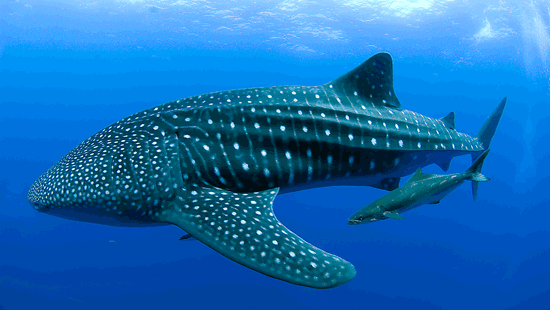
Dr. Hoffmayer has tracked close to 300 whale sharks (Rhincodon typus) in the Gulf since 2002. He is the preeminent whale shark biologist of the region and has concerns for the seasonal migration of these animals, some of which have come from as far away as the Caribbean.

As many as one third of his tracked animals are estimated to be at "ground zero" the very place upwards to 70,000 barrels of oil are pouring into the Gulf and 500,000 gallons of Corexit, a toxic dispersant, is being sprayed.

This map is an overlay of where the Gulf whale sharks most likely are and where the oil slick and dispersant is now.

"Most people have no idea we have whale sharks in the Gulf. It has been a terrific success story; we have just realized there are more animals out there then we originally thought," said Dr. Hoffmayer. "Because the public is unaware of that, the issue of this oil spill and these animals is just not on the front burner. This is critical whale shark habitat."

"We're hoping that these whale sharks might sense the oil and move out of the area. We have seen other species of sharks closer to shore under a sheen of oil, but until we get out there and tag a few sharks we just do not know what's happening, or even if they are moving."

Dr. Hoffmayer confirmed, "This is the peak season for whale sharks in the Gulf: May through September."

Meanwhile, we asked Dr. Griffitt to comment on Corexit, a dispersant being widely used by BP, and it's effects. "This stuff is designed to break up the oil into micro droplets. The concern is where it goes from there through the water column. Smaller oil particles get taken up through the food chain very quickly. The fact is we're in uncharted territory, no one knows what these amounts of dispersed oil and Corexit will do to bio-accumulation."

"No one is talking about pelagic species right now in the media," said Dr. Hoffmayer. "Or what this shower of smaller oil particles and dispersant might be doing to the wildlife - it will have a tremendous impact."

Dr. Hoffmayer plans to have his team attempt to tag and track whale sharks this season. "We are linked with people doing aerial surveys right now and they report whale shark activity to us."

Dr. Griffitt pointed out, "These smaller globules of oil will spend a lot of time in the ocean and once it mixes with dispersant this combo can be more toxic than the original substances. More study is needed."

Dr. Hoffmayer is currently seeking funding from all sources to get an expanded tagging and tracking program in place for 2010. Those seeking to help can contact him directly at:

Dr. Eric Hoffmayer Ph.D.
University of Southern Mississippi Gulf Coast Research Laboratory
228.872.4257
Eric.Hoffmayer@usm.edu

His website will be updating whale shark activity as it comes in and as the 2010 migratory paths are known. We will keep you updated.