Do pelagic predators hunt in random patterns or with some more organized approach that actually has some mathematical significance? Underwater Times picked up on an article in ScienceNews, about a study showing that fish like tuna, billfish, and some sharks exhibit a mathematical logic in their movements, called a Lévywalk or flight.
In tracking various ocean predators, the researchers noted foraging patterns that were not random - moving here and there without any particular method to their movements - but more deliberate, punctuated with long movements and demonstrating evidence of mathematical fractals.
A fractal is a mathematical pattern that is used to describe the shapes of many things, from snowflakes to the shapes of leaves. No, snowflakes and leaves don't have intelligence, at least not intelligence that necessarily demonstrates free will. But in analyzing the foraging patterns of their test subjects, the researchers detected a level of mathematical thinking or intelligence that was not purely random-based, which was the prevailing theory in the past.
"Many of the animals displayed Lévy behavior at least some of the time, researcher David Sims and his colleagues report — 'the strongest evidence yet that these Lévy patterns are exhibited by wild animals,' he says. Lévy behavior showed up more often in waters where plankton, fish and other food was scarce. In regions with plentiful food, random motion dominated. This observation, says theoretical physicist Gandhimohan Viswanathan, fits with earlier suggestions that 'animals may use a Lévy flight motion to improve their chances of finding prey.'” This kind of research can provide more insight into migration and other feeding patterns based on availability of food. Perhaps in the future we can better understand or anticipate the actions or movements of some species or their ability to adapt when environmental conditions change.
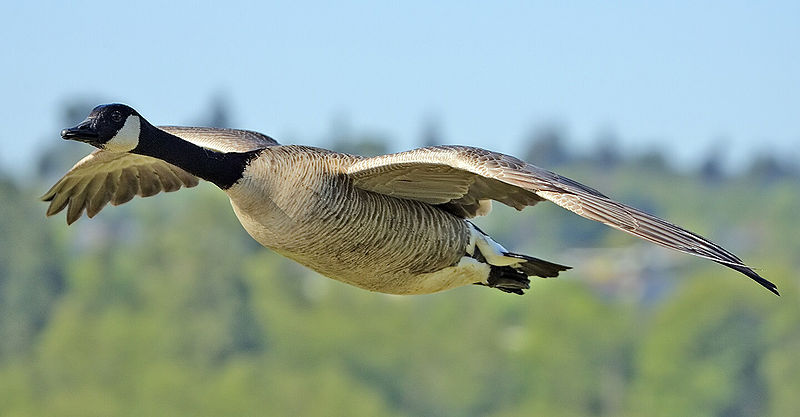
I was watching a charming movie on cable today, one I had seen when it first came out in the theaters some years back: Fly Away Home. It's a father-daughter drama that incorporates some of the interesting studies that have been done in training orphaned Canadian Geese to learn their migratory routes. Ultralight airplanes have been used to teach the geese to follow the plane and memorize the long route from Canada to the Carolina wetlands in the U.S.
What's particularly interesting is the intelligence these birds are able to display, actually learning the visual landmarks over a 2000 mile route so that they can return again and again. Do you think you could memorize aerial landmarks in one pass over a 2000 mile stretch? And yet this is a bird with a brain the size of a small grape! (See movie trailer.)
Just another example of amazing animal intelligence and the importance for man to understand animal smarts on its own terms - not to judge or compare it to human intelligence. Animals have evolved intelligence supported by senses that relate to feeding, breeding, and basic survival. From that some social interactions and relationships develop but, again, we must be careful not to ascribe human characteristics to it. It's a different animal, literally.
I have seen this misplaced humanizing with other "wild animals." Take sharks, for instance. These are animals with a wide aware of astounding sensory capabilities but with a relatively small brain (a rather fragmented or un-centralized brain actually, when compared to other land animals). In the presence of humans (ie: divers), sharks can demonstrate behaviors that we might regard as human-like interactions or relationships. That can be a mistake.
It is important that we appreciate animals for what they are and how they evolved; different from us, the end result of their successful evolution within their environment, and often superior to us in many ways within that environment.
The RTSea Blog was started in 2008 and now includes over 950 entries available for media or academic background research use, including observations on a wide range of topical issues and events involving the oceans, sharks, and nature in general. After a brief break in 2012-13, there will now be more posts forthcoming.
Use keywords in the Search tool below or at the bottom of this web page to locate articles of interest.
Cinematographer/media consultant & producerRichard TheissandRTSea Mediaadministers this blog with the intent that information will be disseminated across the Internet and, in so doing, will illuminate others as to the serious challenges that lay before us in preserving and protecting our natural resources.
Search This Archive
Richard Theiss - DP/Media Consultant & Producer
Available for HD video assignments, media consulting, and speaking engagements. For contact information, click on the image above.

 Do pelagic predators hunt in random patterns or with some more organized approach that actually has some mathematical significance? Underwater Times picked up on an article in ScienceNews, about a study showing that fish like tuna, billfish, and some sharks exhibit a mathematical logic in their movements, called a Lévy walk or flight.
 snowflakes to the shapes of leaves. No, snowflakes and leaves don't have intelligence, at least not intelligence that necessarily demonstrates free will. But in analyzing the foraging patterns of their test subjects, the researchers detected a level of mathematical thinking or intelligence that was not purely random-based, which was the prevailing theory in the past.