Showing posts with label Jaws. Show all posts

Monday, September 10, 2012

Ron Taylor: adventurous filmmaker who fascinated us with the world of sharks

This past Sunday in Australia, the film and conservation communities lost a well-respected member.  Ron Taylor passed away at age 78, after a two-year battle with leukemia.  With his wife, Valerie, the two were internationally renown for their work over the years with sharks. 

Ron first came to prominence with his work on the early shark film, Blue Water, White Death - one of the first films to focus on the great white shark at a time when those magnificent predators were shrouded in mystery.  Ron was a still photographer and cast member in that classic documentary. 

What really propelled Ron and Valerie's collective careers was the work they did for Steven Spielberg's Jaws.  Having seen some of their work, Spielberg enlisted their aid and expertise in filming an actual great white in close proximity to a small 3/4-size shark cage (thereby increasing the apparent size of the shark to match the monster shark of the movie).  It's documentary film legend that the shark they filmed became caught up in the lines holding the cage and the thrashing of the shark to free itself became an unexpected bonus to what was already a very dramatic scene.  

However, in some circles Ron was criticized for providing that footage, accused that it helped to demonize the shark and add to the myths and misconceptions people had at the time regarding sharks.  Ah, but that's the point.  In the early 70's, sharks were not being intensely studied.  They were considered to be mindless, vicious predators even by respected ocean experts.  Jacques-Yves Cousteau is seen in one of his own television programs shooting sharks with a rifle from the deck of the Calypso, declaring them to be devilish creatures up to no good.  Nobody understood or appreciated sharks then the way many of us do today, but their viewpoint was simply based on the available information at the time. 

The interesting benefit that Peter Benchley's book, Spielberg's film, and Ron Taylor's camera work on Jaws did for the species was that, besides scaring us, it pricked our imagination and our fascination.  And from there, both scientists and laymen set about wanting to learn more.  And ironically, in the aggregate, sharks have been the better for it. 

Many of you who read this blog know of Ron's work and may even call him a good friend.  I only had one brief opportunity to meet Ron Taylor so I cannot say I actually knew him, but it was clear that he and Valerie were an adventurous, dedicated and enthusiastic team.  Ron worked tirelessly on behalf of shark conservation, partnering with groups like Rodney Fox's shark conservation research group, and he continued to be involved in a variety of first rate ocean and shark documentaries.  

Ron Taylor's was a career built on adventure and unlocking secrets so that people around the world could be mesmerized by life under the sea.  Knowledge is the first step towards appreciation and conservation.  We have lost another filmmaker and teacher.

Sunday, February 22, 2009

Moray Eels: feeding science fiction-style

For those of you who don't read National Geographic, here's an interesting "fun fact" from the latest March issue. . . You think the slimy villain from the Alien movies is the only creature with a second set of jaws? Well, how about the Moray Eel?

Many divers are familiar with the moray's threatening display of sharp teeth - a pose that comes about from the eel's breathing, as it doesn't have large flapping gill structures like bony fishes - and that these rear-facing teeth are designed to hold fast to its prey. But did you know that it has a second set of jaws that spring forward and assist in pulling the prey down its esophagus? This all takes place deep in the eel's throat and though it seems like something right out of a sci-fi thriller, it's actually a very efficient method of food transport for an animal that doesn't have the ability to gulp food down - like the vacuum motion you see with many other fish.

National Geographic reported that researchers from the University of California at Davis have
studied this ability using x-ray and high-speed video (see photo) and it is apparently the first known mechanism of its kind in a vertebrate. Snakes get close, with hinged jaws that can slowly ratchet their prey down the gullet, and it's an example of evolutionary convergence - the development of a similar solution between animals facing the same problem.

As a volunteer diver at the Aquarium of the Pacific, me and my fellow team mates would feed the aquarium's eels and watch how they would grab a large sardine or squid perpendicular, turn it towards their throat and then down it would go without any help from the front teeth. A second set of jaws . . . who knew? Well, obviously somebody in Hollywood did!

Article also on online National Geographic.

Sunday, September 14, 2008

Frank Mundus: the end of an era

A legend in the world of shark sport fishing, Frank Mundus passed away recently at the age of 82. In the early 50's, Frank came to Montauk, at the east end of Long Island, New York, and built a reputation as a leader in shark sport fishing - catching blues, makos and, with the popularity of Jaws in the 70's - great white sharks. With a blunt, salty Northeasterner's personality, Frank was considered the model for the Jaws character, Quint, although author Peter Benchley was said to deny it. While shark conservationists might rightfully abhor his legacy for catching so many sharks, in the end he was a reflection of the times.

In later years, he came to view sharks differently but, befitting his personality, he made no regrets for the life he lead.
And that's fine. He was a colorful character and we have since learned more about the critical importance of sharks in the ensuing years, so let us just wish him a safe voyage and hope that we are saying farewell to the passing of any era.

Sunday, June 29, 2008

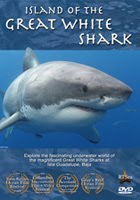
New England Aquarium hosts Island of the Great White Shark screening

On 05/07/08, RTSea wrote: Richard Theiss just returned from Boston, MA where a successful screening of "Island of the Great White Shark" was held at the New England Aquarium. Accompanying him was Mauricio Hoyos, the shark researcher featured in the film. Both Mauricio and Richard were interviewed on 5/05/08 by WGBH (Nova) for the Greater Boston series, hosted by Emily Rooney.

The New England Aquarium was a most generous host and has a wonderful staff of committed marine conservationists (my thanks to Vickie Cataldo, Dr. John Mandelman, Dr. Greg Stone, and Tony LaCasse). And the people of Boston have a great fascination and interest in sharks, in no small part due to the fact that Boston was the home of the late Peter Benchley who became quite a shark advocate in the years following the success of "Jaws." Peter's original writings reflected the attitudes of the times and as his popularity put him in the limelight and in continual contact with developing science, he came to be a very prolific writer on behalf of sharks.

This is what new research findings and media presentations like "Island of the Great White Shark" hope to accomplish - to sway public opinion in favor of realizing the important role these animals (indeed, many marine animals) play in maintaining a healthy ocean, and the need to protect them. We all grew up a little afraid of sharks, but now fear must give way to appreciation and respect.

The event was sponsored by the Aquarium's Lowell Lecture Series.

Richard Theiss responds to San Diego shark incident on CBS News

On 04/28/08, RTSea wrote: From Richard Theiss, filmmaker Island of the Great White Shark, regarding the recent San Diego shark incident:

On Friday, 4/25, the news hit of a man fatally bitten by a white shark off Solana Beach, near San Diego, CA. I was asked by CBS and KCAL news to comment (http://www.cbs2.com/video/?id=65566@kcbs.dayport.com).

It's always a tragic event when someone is attacked by an animal and my heart goes out to the victim's family and friends. Judging by the news reports that filtered in over the course of the day, it would appear that the attack was a classic case of mistaken identity with the shark mistaking the swimmer for a possible seal. Apparently, the swimmer was slightly apart from a group of other swimmers 150 yards off shore, with some of the swimmers wearing dark wetsuits or swimsuits. The shark approached in the manner typical of a seal hunting behavior.

It has been many years since there has been a shark attack in Southern California and the news organizations have made quite a fuss, as the southland was preparing for a sunny and warm weekend. Without minimizing the loss of a popular local resident, let's hope level heads prevail so as to not generate 70's-style "Jaws" hysteria