skip to main |
skip to sidebar
 Now here's an odd bit of news.
Recent research presented at the 2012 Ocean Sciences Meeting in Salt Lake City, Utah, indicated that some species of squid could be using flying as a more efficient method of traveling long distances, like in seasonal migrations.
Oh, sure, squid can "fly" underwater using their siphon like a jet engine and the two fins framing the squid's mantle acting like wings. Sure, we've all seen that.
No. I'm talking airborne.
A team of researchers from Dalhousie University, Canada, and Stanford University, studied three species of squid and tracked the small orange-black squid leaping into the air off the coast of Brazil. Going airborne has long been recognized as a method that some squid will use to evade a predator. But what the researchers saw was repeated bursts into the air at a speed of fives time what the squid can achieve underwater. The theory is that to more efficiently use available energy as the squid continues through its long migration, it will choose to go airborne from time to time.
“As soon as we thought about the possibility that these things flew, it became plausible that these animals actually use flight as a way of reducing energy cost,” said Dalhousie University marine biologist Ronald O'Dor.
Other researchers tracked species like the Humboldt squid and found them covering distances greater than what their underwater speed suggested. Could they, too, be taking the occasional aerial stroll?
No one is suggesting extended flight; the squid has no way to sustain its flight through the air. However, with its powerful siphon capable of generating a sudden underwater thrust of jet propulsion, the idea of airborne squid is not that far-fetched of an idea. And it has been hypothesized that the squid's swimming fins have enough size and shape to act as ailerons, providing some measure of stability while aloft.
Not all scientists are convinced but they do find it tantalizing and are hoping for more research in the future to make a determination one way or another. For now, it's an interesting solution to the squid's ability to cover long distances.
Next it will be pigs.
Source: NTD Television
Source: 2012 Ocean Sciences Meeting - abstract
 In California, many people involved in ocean conservation are familiar with the ground-breaking work of Dr. Barbara Block and the program she started, TOPP (Tagging of Pacific Predators). Using various types of telemetry and satellite tags, the TOPP crew has tagged a variety of ocean animals, from sharks to tuna, to turtles and more. Doing so has enabled them to determine many of the key migration routes these predators take - quite often of a seasonal nature, traveling great distances back and forth between key locations year after year.
After 10 years of tracking using over 4,000 tags and accumulating data from over 23 different species, TOPP has released a final report of its findings in conjunction with the Census for Marine Life, published online in Nature. The report shows that migration patterns play a very crucial role in the lives of many ocean predators. Writing in the Washington Post, Julie Eilperin repeated TOPP's description of the eastern Pacific Ocean as being akin to Africa’s Serengeti, teeming with wildlife and crisscrossed by migration corridors used by sharks and seabirds. Two currents play a key role in the migrations: the California Current - which stretches from western Canada all the way south to Mexico - and the North Pacific Transition Zone - which travels east and west between the sub-arctic and subtropical waters.
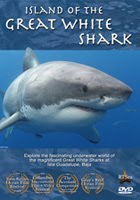
 Because of my interests with great white sharks in California and Mexico, I have watched the TOPP data over the years and was fascinated by the migration patterns taken by the sharks, seeing the same sharks return to locations like Isla Guadalupe, Baja year after year after year. You could predict with near certainty when sharks would be reported along the California coast based solely on the time of year and where that coincided with their migrations.
“Just off the West Coast may be one of the greatest hot spots for open ocean predators in the world,” said Dr. Block. “They have their favorite haunts, they clearly have the places they keep going back to. The upwelling [of nutrients] is so intense there in the springtime it really sets the table for the whales, the tuna and the sharks. They come and lunch at that table, from everywhere in the entire Pacific realm.”
The data collected in the TOPP program consisted of more than just the whereabouts of an animal. Water conditions including temperature, salinity, chlorophyll, and more enable researchers to examine the environments that might help to explain the migration patterns more thoroughly.
“It’s precedent-setting. It’s a tremendous tool for conservation and management,” said Jesse Ausubel, vice president of the Alfred P. Sloan Foundation and co-founder of the Census of Marine Life. “We were literally blind. We can now see. We know what’s underneath now.”
Read Julie Eilperins' article in the Washington Post.
Learn more at the TOPP website.
Migration Maps: TOPP.

 Now here's an odd bit of news.