Here is a long but valuable post script to my comments at the start of the month regarding the pseudo-scientific concept that without sharks the Earth would lose it's oxygen. My shark advocate colleague, David Shiffman (aka WhySharksMatter), weighed in with his detailed scientific perspective (see below). So I hope this will bring some closure on the subject.
For those shark advocates who have supported this idea, I hope that you will re-assess your position and stick to scientifically-proven facts; there are enough of those to make a strong case for shark conservation. And for those who are mildly curious about sharks, please know that there are serious implications to the extinction or near-extinction of major shark species, whether sought after as a commercial item or simply a product of unfortunate by-catch. But finding yourself trapped in a planetary vacuum is not one of them.
Great post, David. Thanks!“Sharks create oxygen”: A scientific perspective
By WhySharksMatter, on February 10th, 2012
I want to apologize to our regular readers for stating something that should be incredibly obvious. Sharks are in no way connected to the global supply of atmospheric oxygen. If every single species of shark went extinct, there would be a variety of negative ecological effects, but a reduction in the global supply of atmospheric oxygen would not be among them. There is not a shred of scientific evidence supporting the idea that the loss of sharks would affect our oxygen supply- not a single scientific paper, not a single technical report. I’ve attended a dozen scientific conferences focusing on marine ecology or shark biology (including three international conferences) and I’ve never seen or heard of anyone presenting or even discussing this. To the best of my knowledge, not a single person who has authored a scientific paper or technical report supports this idea. Despite the complete lack of any kind of credible evidence, and despite many recent blog posts thoroughly debunking it (see here here here here here here and here ), this pseudoscience just won’t die.
The premise of the sharks and oxygen claim is as follows:
A) Sharks, many of which are apex predators, are important in regulating marine food webs;
B) Phytoplankton, which create oxygen through photosynthesis, are in marine food webs;
C) Therefore, without sharks, phytoplankton populations will crash and we won’t have any more oxygen and we’ll all die.
A and B are reasonable enough- we know that under certain circumstances, apex predators can play important roles in structuring and regulating food webs, and we know that phytoplankton produce oxygen (though how much oxygen phytoplankton produces is another debate entirely). It’s part C of the sharks and oxygen claim that’s the problem.
This flawed leap in logic, like many other bits of pseudoscience, is loosely based on reality- specifically, the concept of the “trophic cascade”. To explain a trophic cascade, consider a simple hypothetical food chain where grass is the primary producer, goats consume grass, and chupacabras consume goats. Trophic refers to “trophic level”, an alternative term for a step of a food chain. Grass would be trophic level 0, goats would be trophic level 1, and chupacabras would be trophic level 2. The cascade refers to ripple-like effects that travel throughout a food chain despite initially affecting only one level- for example, a change in chupacabra populations could eventually affect goat populations, which would eventually affect the grass.
One classic example of a marine trophic cascade comes from Estes et al. 1998. In the original kelp forest system, kelp provided habitat for countless species of fish. Sea urchins ate kelp, but their numbers were kept in check by sea otters. Once orca whales began preying upon sea otters, sea otter populations decreased. With fewer sea otters eating them, sea urchin populations increased- and ate all of the kelp.
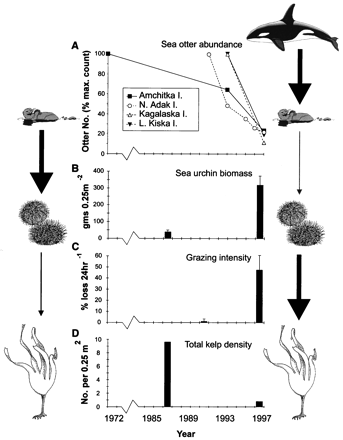
Figure 1 from Estes et al. 1998. " (A) Changes in sea otter abundance over time at several islands in the Aleutian archipelago and concurrent changes in (B) sea urchin biomass, (C) grazing intensity, and (D) kelp density measured from kelp forests at Adak Island. Error bars in (B) and (C) indicate 1 SE. The proposed mechanisms of change are portrayed in the marginal cartoons—the one on the left shows how the kelp forest ecosystem was organized before the sea otter's decline and the one on the right shows how this ecosystem changed with the addition of killer whales as an apex predator. Heavy arrows represent strong trophic interactions; light arrows represent weak interactions."
A similar trophic cascade involving sharks was reported in Myers et al. 2007, though these conclusions are still considered controversial among the scientific community. According to this paper, in the Outer Banks, a decrease in shark populations led to an increase in the populations of these sharks’ prey (including cownose rays), and increased cownose ray populations led to a decrease in their prey (including scallops, which used to be the basis for an important coastal fishery).
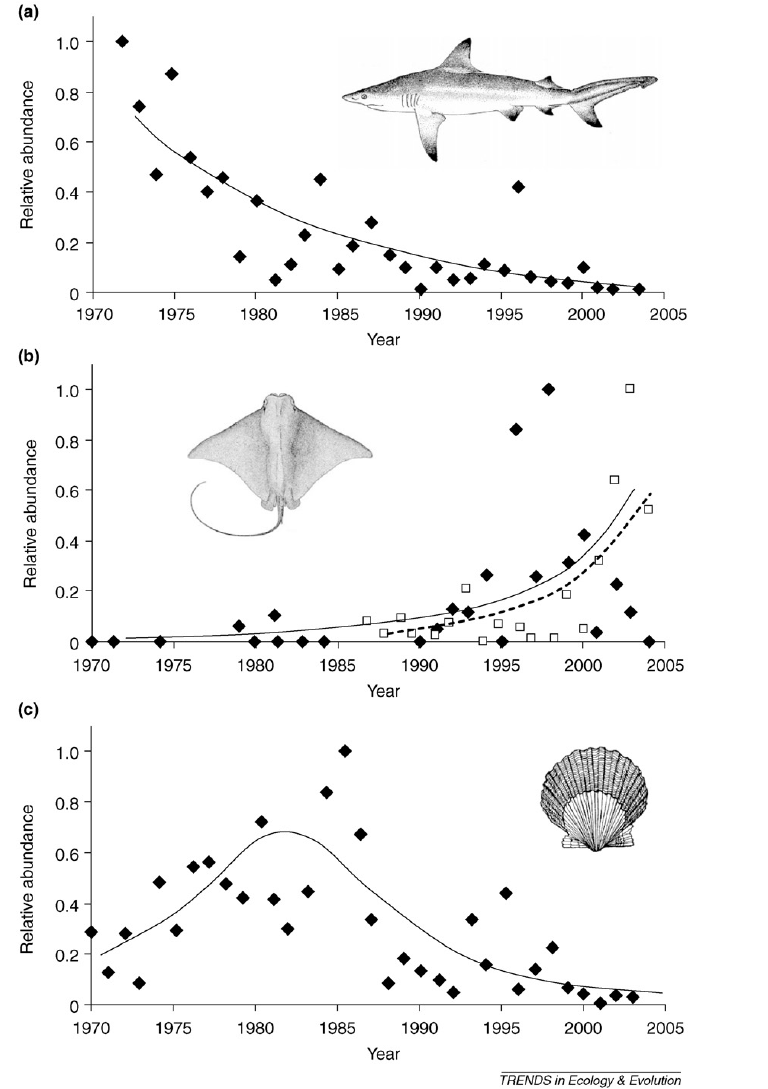
Figure 1 from Heithaus et al. 2008, a review of shark ecosystem effects, referencing the Myers et al. 2007 conclusions. "The removal of marine predators can result in cascading effects through communities. As (a) catch rates of large sharks, such as blacktip sharks (Carcharhinus limbatus), declined during research surveys along the east coast of the United States, (b) cownose rays began to increase, leading to eventual declines in (c) catches of North Carolina bay scallops (Agropecten irradians). Population densities are expressed as proportions of the observed time series maximum. Trend lines are best fits from generalized linear (a,b) or additive models (c). In (b), filled symbols and line denote Delaware Bay surveys, and open symbols and dashed line are Pamlico Sound, NC, surveys. Field experiments confirmed that scallop declines resulted from increased ray predation [5
Technically speaking, just because no one has ever written about this phenomenon applying to sharks doesn’t, in of itself, mean that it doesn’t apply to sharks. However, there’s a very good reason why the loss of sharks won’t affect phytoplankton. Trophic cascades tend to occur in simple ecosystems. In the kelp forest, basically only one type of organism eats kelp from the base (sea urchins) and basically only one type of organism eats sea urchins (otters). Sharks fit into different ecosystems differently, and many of those ecosystem are quite complex, so the claim that the loss of sharks will have a uniform global effect is inaccurate at best.
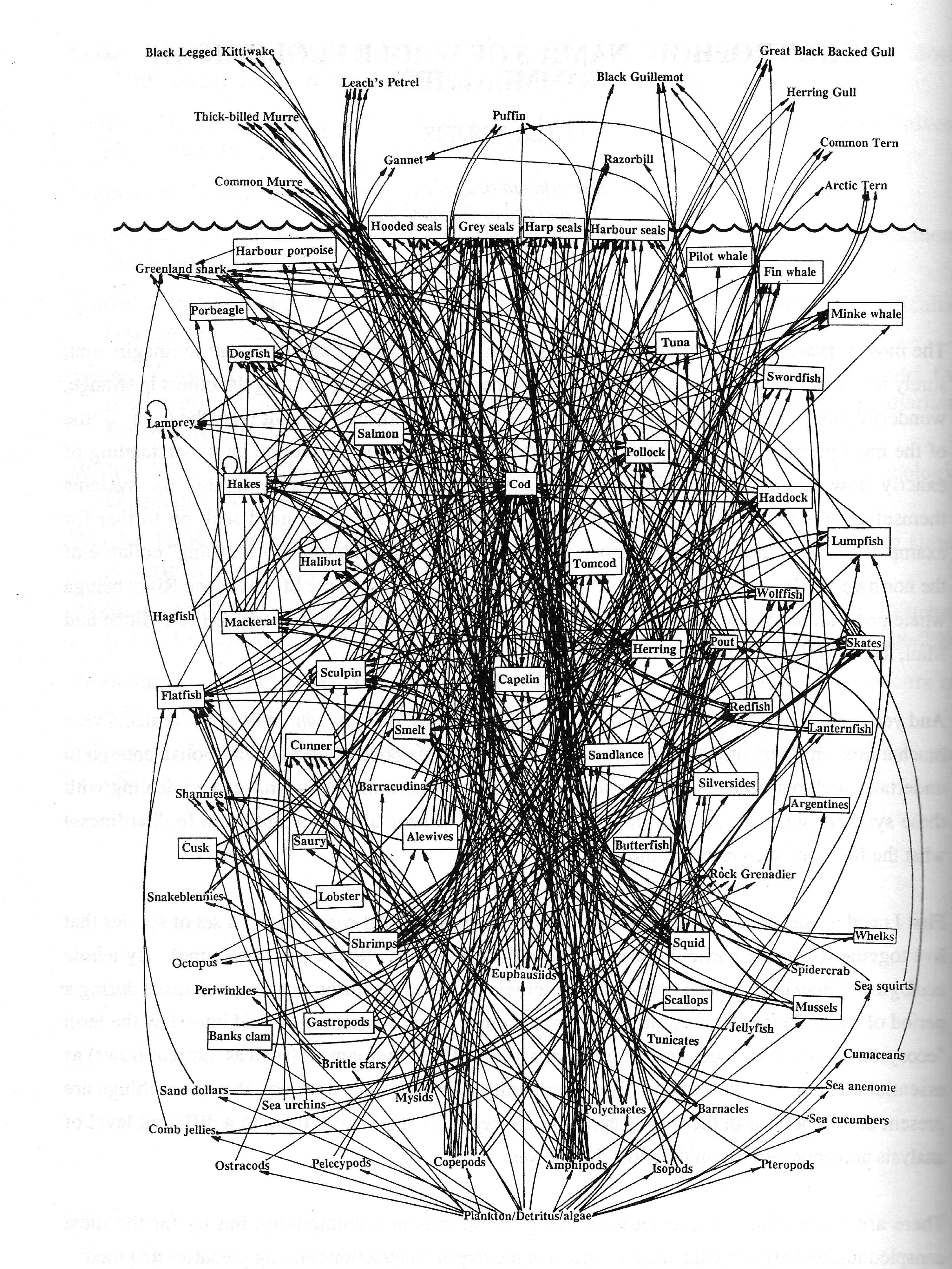
Research from coral reef ecosystems shows than when predator/prey interactions are more diffuse (for example, a system might have many herbivores, many secondary consumers, etc.) , trophic cascades don’t occur. Sharks may eat some herbivores, but they also eat animals that eat those herbivores, so the ecological effects would be less direct. Additionally, even if one prey species experiences “predation release”, other species with similar ecological niches are not affected in the same way. In a complex ecosystem, sharks can be considered to be “trophically decoupled” from phytoplankton- their populations will not affect those of phytoplankton because the trophic relationships are diffuse and complex. Most marine ecosystems are quite complex, as seen below:
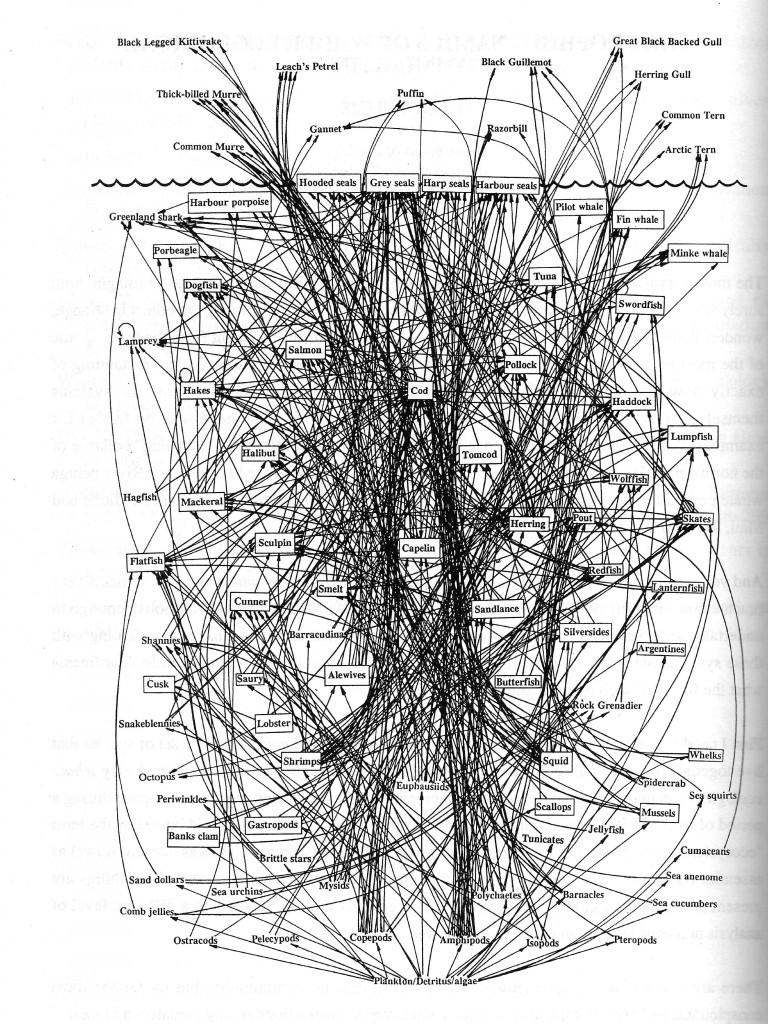
A cod-based food web in the North Atlantic, a region of the ocean with relatively FEW species. Image from David Lavigne, National Science and Engineering Research Council
In fact, emerging research in the field of fear ecology has shown that the most important effects resulting from the loss of sharks in an ecosystem may actually be indirect and related to behavior rather than population structure. In other words, sharks may exert more of an influence on an ecosystem by causing organisms in that system to alter their behavior to avoid being eaten. A great example of this comes from Dr. Mike Heithaus’ work in Australia. He found that animals like dolphins, sea turtles, and dugongs (relatives of manatees) will alter their preferred foraging ground during times of the year when large tiger sharks are present. They will forage in areas with less food but less chance of encountering a tiger shark.
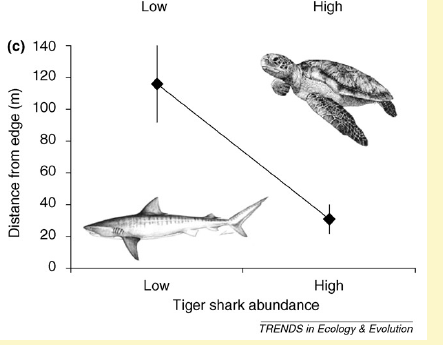
Figure 2 from Heithaus et al. 2008. "Risk effects of tiger sharks on megagrazers in Shark Bay, Australia....Green turtles in good body condition (assumed to indicate a good energy state) shift to safe microhabitats with nutrient-poor seagrass when sharks are common"
Many species of sharks have been dangerously overharvested, resulting in alarmingly rapid and severe population declines. The loss of sharks can result in disruptions to the food web, resulting in ecological (and in many cases economic) problems. Conservationists are correct to be concerned about the loss of sharks and the effects this will have on our oceans, and we can and should work to protect these animals. However, sharks have absolutely nothing whatsoever to do with the global oxygen supply. There is absolutely no evidence in favor of this claim, and lots of evidence against it.
Spreading inaccurate claims in support of a worthy cause can only harm that cause by reducing credibility with the public and with policymakers. There are enough real reasons to protect sharks that we shouldn’t need to make up nonsense with no factual basis. I call on all responsible conservationists and advocates to stop perpetuating this pseudoscience.
Source: Southern Fried Science