Saturday, October 31, 2009

Mother Nature Network: a change of pace in conservation news

Do you find yourself getting a little overwhelmed with the weighty subjects and seriousness on many of the conservation sites (this one too sometimes, although I try to keep it in check)? Well, here's an interesting change of pace. . .

My friend Charlotte Vick, communications director for Dr. Sylvia Earle's Deep Search Foundation, brought a web site to my attention: the Mother Nature Network. This site is a patchwork ranging from current conservation news issues to environmental, organic, and green fluff. Want an organic pumpkin pie recipe mixed in with your latest briefing on Washington DC energy policy? Then this just might be the place for you.

Of note is Mother Nature network's Earth Matters department which not only contains the primary big issues but also includes a section titled "Translating Uncle Sam." Here you will find many hot button issues and topics spelled out in layman language, devoid of the heavy jargon you sometimes find in detailed press releases; a good way to get a quick grasp on an issue or provide you with some simpler talking points when discussing the issue with others less well-versed as yourself.

Content contributors run the gamut from The Nature Conservancy to professional bloggers to student contributors; so there's something for everyone here. I am new to the site so I will be checking it out carefully; I noticed some of its sponsors are major energy, technology, and pharmaceutical corporations, so I will be watching for potential bias - let's hope not. Check it out.

Thursday, October 29, 2009

Oceana.org: new web site keeps score of accomplishments

There are many conservation organizations vying for our attention and support. I subscribe to several to get the latest updates on what is happening in the world of conservation. Typically each organization has a particular strategy that best maximizes their available resources: some focus on legal action, others go after illegal trade in threatened species, while others focus on general public awareness.

Oceana is one of the larger and more prominent organizations involved in ocean conservation. They approach a wide range of issues and have international reach. They recently revised their web site and I think it's worth a look. While sprucing up a web site with the latest technology in look and feel is common today, what I found noteworthy with Oceana's new web site was some of the information it provides.

In particular, the web site explores various issues and lists what Oceana's involvement is, what they are doing regarding, say, overfishing, ocean acidification, or shark conservation. And then, most importantly, they list their victories. This is critical when you are considering whether an organization is worthy of your support, particularly your financial support: what are they doing and what have they DONE.

Unfortunately, there are a lot of well-intentioned groups out there with worthwhile agendas but, in the end, its what they accomplish that really matters. So it's good to see Oceana providing that kind of information.

The web site also contains information on a long list of various species that are endangered or threatened with extinction. And there is information on many of their ongoing scientific research projects and expeditions, which are of considerable interest to me (I'm always interested in what is going on out in the field and how these results are being communicated to the decision-makers and general public).

Oceana is among my top A-list of committed ocean conservation organizations. Check out their new web site at www.oceana.org.

Wednesday, October 28, 2009

Orcas: new studies show changes in killer whales

When discussions of Arctic or Antarctic species come up, they often focus on polar bears, penguins, and walruses - all animals worthy of our concern and whose populations are at risk from changes in their environment due to climate change, pollution, or oil drilling development.

Orcas - or, if you like, Killer Whales - are also being impacted by environmental changes, some good and some not so good.

In a report from Canadian scientists, there is evidence that orcas are able to manage changes in their ocean environment by moving more northward, extending their uppermost boundaries in the Arctic Circle. This is made possible by the reduction of sea ice, particularly in the summer months.

Orcas typically cruise the thinner edges of the Arctic ice but avoid the thicker ice where access to the surface for breathing would be more limited. The scientists reviewed data of orca sightings dating back centuries and saw a definite increase since 1900 in the Arctic region, including into the Hudson Bay, that coincides with the recorded reduction of the Arctic sea ice. It remains to be seen whether this will disrupt the marine ecosystem as the orcas possibly begin to prey more and more on northern Arctic species like bowhead whales, belugas, and narwhals.

In another study, orcas were cited as a probable cause for the decline of sea otters, seals, and sea lions along southwest Alaska over a period of several decades. Not to completely blame the orcas, the study points to a cause for this change in the orcas' diet as the result of industrialized whaling. Whaling decimated whale populations and deprived orcas of an important food source. Hence the shift to other marine mammals as prey.

Orcas are extremely social animals, living in family units or pods, that can exist for many years, complete with elaborate and close social hierarchies. External stressors (ie: changes in their environment and/or food source) that produced changes in populations have been cited in a recent report as a possible cause for changes in the social structure of orcas in Canadian/U.S. waters. It opens the door for more study as to the impact of habitat change on the social order and survivability of this highly social marine mammal.

And lastly, according to a scientific report, the population of orcas that inhabit the Antarctic's Ross Sea, has apparently been decreasing both in terms of frequency (when observed) and in numbers and the primary culprit is, once again, commercial overfishing. In this case, the overfishing of the Antarctic Toothfish, a primary food source for this particular orca population. Whether the orcas have declined or are moving on to better hunting grounds has yet to be determined. But it is another example of the struggle between man and nature over available marine resources. And if the ocean's animals keep losing - from the smallest feeder fish to large predators like orcas - then ultimately we lose.

Tuesday, October 27, 2009

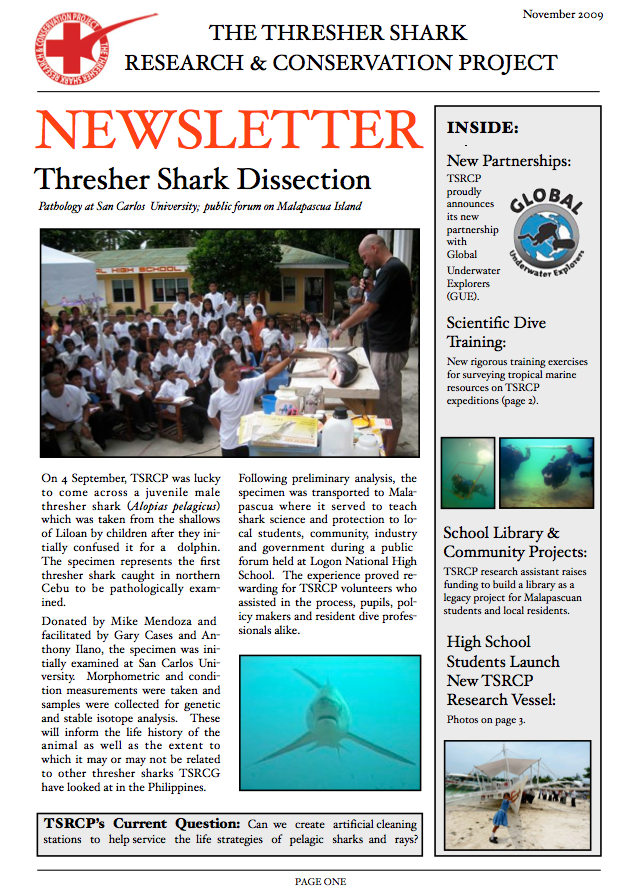
Thresher Shark: non-profit dedicated to shark's preservation

Speaking of sharks, here's a species you don't hear too much about and yet faces imminent danger: the thresher shark.

One of the more unusual and distinctive sharks due to its namesake elongated upper caudal fin or tail, it is believed that the shark might use its tail as a hunting device to stun schooling fish. The thresher shark is a popular seafood item in many forms - fresh, dried, salted - and so it's numbers have suffered (all three thresher shark species are listed as "vulnerable" by the IUCN).

Here's a post from the Shark Divers blog, discussing one of the few shark organizations devoted to the thresher shark. Based in the Philippines where considerable local fishing, commercial and, sometimes, illegal fishing takes place, this group has their work cut out for them.

Of the myriad of shark conservation sites worth visiting, none come better then the Thresher shark research & conservation project.

We have been following this site for the past year and are always happy with the vibrant field updates, images, video and news.

Consider taking the time to get to know the team behind the Thresher shark research & conservation project.

Shark conservation efforts are hard enough to get traction with; in places like the Philippines, it's doubly so.

It's takes determination, good outreach, and a serious research program to make a difference.

Monday, October 26, 2009

Shark Trust Wines: saving sharks case by case

Here's a quick plug for a good friend and a great example of business and conservation coming together. Shark Trust Wines was the brainchild of Melanie Marks, ocean and shark conservation advocate, who established the company with the idea of providing a portion of her revenue for shark research and conservation organizations. The company's wines have been served at some of the nation's leading ocean conservation events.

Shark Trust Wines is in the process of clearing out some inventory of quality wines at rock bottom prices. This is a special offer not found on the web site but only through the company's Facebook Fan Page. Check it out and get some great wine for the holidays at one-time only prices.

Visit Shark Trust Wines' web site and Facebook page.

Sunday, October 25, 2009

Species Migration: Humboldt squid - a hungry predator moves northward

When we think of "invasive species," one might think of the example of the Lionfish that has invaded Florida waters due to being initially released from a home aquarium. Or perhaps algae, seaweeds or other parasites or bacteria that get discharged from the bilges of freighters and tankers, thousands of miles away from its point of origin.

But there is also species migration, wherein a species enters into a new region sometimes because of a change in its typical prey diet or because of a change in its environment - such as temperature change.

Both factors enter into the migration that has occurred over the past several years by the Humboldt Squid - a large and particularly voracious predator.

I have had the pleasure of working on several potential projects with Scott Cassell, CEO of the Undersea Voyager Project and one of the leading experts on Humboldt Squid, a distinction borne out of his having spent more time face-to-face with these creatures than anyone else. Scott has made the rounds of many news programs to express his concern with the recent regional habitat changes of the Humboldt Squid and what it represents to the balance of the marine and terrestrial ecosystems and even the safety of humans.

The Humboldt Squid is a large deep water predator, typically found along the west coast of Mexico and South America. But over the past several years, there have been two major changes that have impacted this animal. One factor: the overfishing of shallower-water predators that either feed on the squid or on the squid's food supply - thereby establishing territorial boundaries based on depth. Without these shallower predators, the squid can and has begun to roam in search of food. The second factor: increasing water temperatures which have allowed the squid to migrate up the coast and as far north as Washington and Alaska. Another possible variable is that changing temperature and acidification upwardly expands the low-oxygen water column that the squid seems to favor.

Moving into shallower water is of concern to Scott as that can increase the likelihood of a Humboldt Squid encountering curious divers or even swimmers. This past summer, divers were regularly seeing Humboldt Squid during night dives at La Jolla, CA, near San Diego. Whether on the hunt or simply being curious, these animals are not to be taken lightly - they have powerful suckers, a beak that can break bones, and the speed and strength to drag a diver around in the depths.


The squid's migration northward is also of concern because of its ability to disrupt the food supply for other animals. They have been cited by some as being responsible, along with commercial fishing, for a reduction in the northwest population of salmon. And this can impact other animals that depend on this particular food source. As an example, Grizzly Bears count on the fat-rich salmon for building up their stores to survive the winter.

There have been other invasive species migrations due to changing ocean temperatures; in particular, several jellyfish species that have moved into both Northern Atlantic and Pacific waters and doing considerable damage to commercial fishing or aquaculture operations - their stinging tentacles spoil the catch.

But the Humboldt Squid is just not someone you want to bump into in the middle of the night. He's just doing what evolution has taught him to do, but this is one critter than can really give you the willies!

350 Reasons: new web site promotes species protection from climate change

In anticipation of the Intergovernmental Panel on Climate Change meetings to be held in December at Copenhagen, the Center for Biological Diversity has launched a new web site: 350 Reasons.

The site provides information on 350 species of flora and fauna subject to decline or extinction due to climate change. The significance of the number "350" is that it ties in with the level of atmospheric CO2 emissions (350 parts per million) that has been proposed by many leading scientists as the goal we all should be striving for. Currently, we are averaging 387ppm and it's increasing.

The web site allows you to look up specific species or families - or you can select your home state or region on a map and see what species are at risk.

The web site is all part of an effort to bring more awareness to the importance of the December meetings. You can review the site and sign a petition to President Obama, urging him to follow the proposed 350 ppm guideline as an international objective and mandate in climate change policy.

Check it out here.

Thursday, October 22, 2009

Filmmaker's Journal: Eastern Sierras in the Fall

California has many magnificent natural resources, from its shoreline to snow-capped mountains - and all need to be conserved and protected.

Joining my good friend, photographer Budd Riker, I recently spent a few days at the base of the eastern Sierra Nevada mountains, moving from the Alabama Hills, near Lone Pine, up north to the Tioga Pass with stops at Bishop Creek Canyon and Mono Lake. This is a beautiful time of year for this region: the weather is beginning to cool, the Aspens are still ablaze in flaming yellow, and the mountains were dusted with snow from a recent storm.


This trip was more pleasure than professional, getting a feel for a new video camera and forgoing building blinds to capture patience-inspired closeups of various wildlife. (The squirrels and kangaroo rats seemed to know that and would tauntingly appear in the open when they heard the click of the last closing latch on my camera case!) No, this was not business; this was more one of those moments when you just suck it all in: the gorgeous vistas, the wind-rustled leaves, and the chance to clear the cobwebs from your mind.

But finding the occasional Starbucks cup or someones initials carved in the side of an Aspen, there were also those reminders that this is an area that must be protected if it is to be appreciated for generations to come. While we all know what needs to be done regarding local issues like trash and vandalism, we must also consider the larger ecological issues of how climate change, CO2 emissions, and the health of other ecosystems - whether aquatic or terrestrial - are impacting this region.

The Sierra Nevada's may seem light years removed from a South Pacific coral reef, but neither exist in a vacuum - all are connected, all are part of this planet's (and our) life support system.

View more video clips at RTSeaTV.

Tuesday, October 20, 2009

Commercial Fisheries: new economic objectives for a public resource

I was reviewing several articles regarding fish stocks and fisheries. Many of these articles were based on recent scientific studies covering a range of issues that reflect the current declining state of fish populations and the precarious position that industrialized fishing finds itself.

To be expected, over-fishing is one glaring issue, from declining cod fisheries in the North Atlantic to dwindling anchovy and other "feeder fish" populations in the waters off of developing nations in Africa and Southeast Asia. In some cases it is a matter of specific species depletion and in other cases, it's an overall decline brought about by a disrupted ecosystem.

Bycatch also plays a key role, particularly in areas where industrial fishing is present. This includes longline and driftnet fishing either for pelagic species or bottom-dwellers like rockfish or shrimp.

Then there is climate change, which is disrupting populations by compressing northern habitats for species like cod through overall increases in water temperature. Or the opposite expansion of habitats for warmer-water species has been effecting ecosystems and predator-prey relationships as new species migrate into different regions, also exposing themselves as potential commercial target species.

In Scientia Marina (Vol. 73[2]), Daniel Pauly postulates that the key issues that have sent commercial fishing to the brink of collapse has been a decades-long, post-World War II tri-mix of underreporting, ignoring scientific advise, and blaming the environment whenever a fishery collapsed. And as fisheries weakened, economic decisions were made to expand fishing territories, making agreements with other countries as if the fish in other territorial waters were natural resources that were fixed in place (a kind of "what happens in Vegas, stays in Vegas" view of fish populations). Additionally, the shift was made to different species to catch, sometimes selecting a "lesser grade" species and often mislabeling these catches (in Southern California markets, for many years local Rockfish was listed as Pacific Snapper, which is a separate species unto itself).

Pauly concludes that, "Notably, fisheries biology, now predominantly concerned with the welfare of the fishing industry, will have to be converted into fisheries conservation science, whose goal will be to resolve the toxic triad alluded to above, and thus maintain the marine biodiversity and ecosystems that provide existential services to fisheries. Similarly, fisheries economists will have to get past their obsession with privatising fisheries resources, as their stated goal of providing the proper incentives to fishers can be achieved without giving away what are, after all, public resources."

The ocean is one vast public resource. Despite the territorial lines drawn on a map, it belongs to everyone and its future is every one's responsibility. Or else we all pay the price.

Support individuals and organizations, whether political or scientific, who are working towards better fishery management and make sound personal choices regarding seafood, whether you choose to consume "sustainable" species or decide to pass on eating seafood altogether.

Read entire article.

Monday, October 19, 2009

Blue Ocean Institute: Founder nominated for award; sustainable seafood guide

Hello, readers. Took a few days off to film along the eastern Sierra Nevada mountains in California. Beautiful time of year and I will have a few clips available shortly.

In the meantime, I received word that Carl Safina, note scientist, ocean conservationist, and author has been nominated for the prestigious Indianapolis Prize, a well-regarded reward for animal conservation. I met Carl in June at the BLUE Ocean Film Festival and found him to be both very dedicated and accessible. Carl, along with Mercedes Lee, founded the Blue Ocean Institute, a non-profit organization dedicated to ocean awareness through not only the dissemination of science, but through art and literature - mediums that can connect with the imagination and creative energies of the general populace, from children to adults.

The Blue Ocean Institute has a very readable "sustainable seafood" chart that you can download and carry with you when you travel to the market or restaurant. What makes it noteworthy is that it provides information as to why a particular seafood item is a good or bad choice - not just a simply color threat-level indicator. You can download it at the web site or click here.